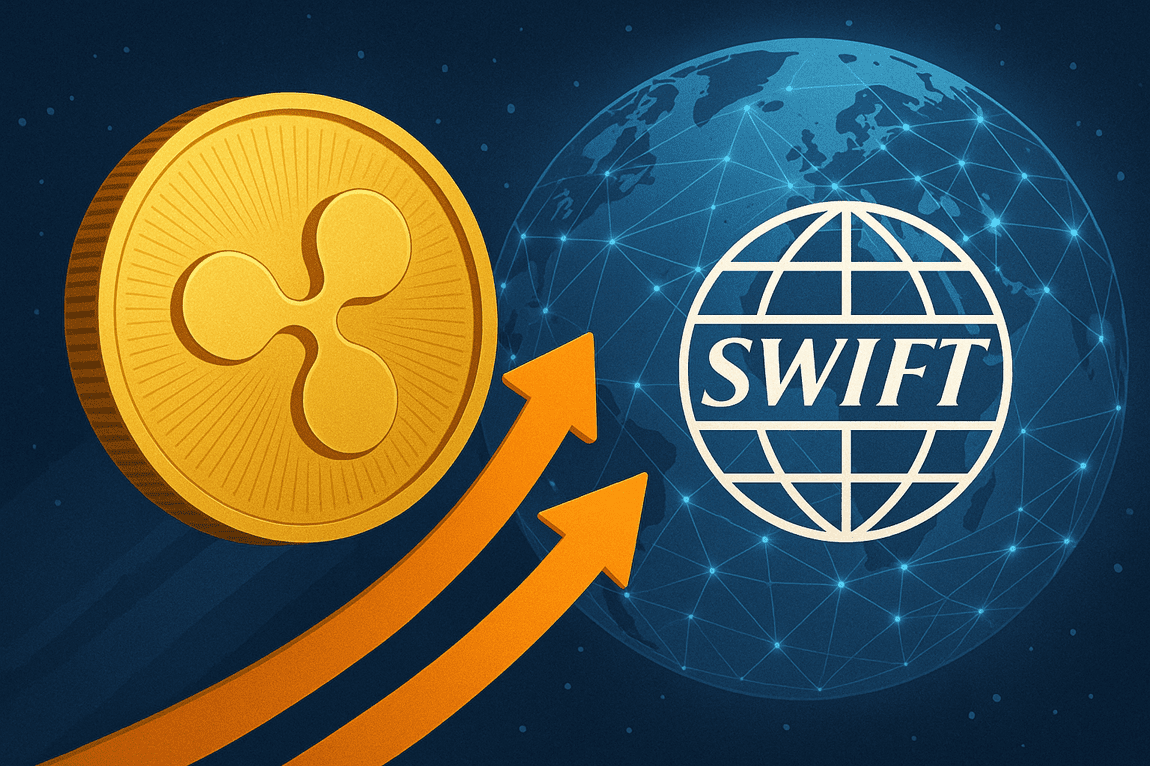
The world of cryptocurrency continues to witness bold predictions, particularly with the rise of payment solutions like Ripple’s XRP. At the recent XRPL Apex 2025 conference, Ripple’s CEO, Brad Garlinghouse, made an ambitious forecast for XRP’s future in the financial ecosystem. He emphasized, “Driving liquidity is pivotal for XRP… in five years, we aim for a 14% share,” making a clear distinction between the messaging services offered by SWIFT and the actual liquidity that facilitates transactions.
Garlinghouse elaborated on the dual aspects of SWIFT—its messaging network and the liquidity managed primarily by banks. He suggested that the real focus should be on liquidity, indicating a strategic vision for Ripple’s enhancement. This perspective aligns with the view that future growth in finance will heavily rely on the efficient movement of capital rather than just communication pathways.
In an engaging discussion with Ripple’s chief technologist, David Schwartz, the broader market implications were highlighted. Schwartz pointed out the significant potential for tokenized assets, estimating that we might see hundreds of billions of dollars shift towards this innovative financial technology. He noted the inherent issue in corporate auditing—how to ensure financial accuracy when external debts may not be recorded—and how blockchain technology provides a solution through enhanced transparency, which will drive faster adoption.
Implications of XRP’s Potential 14% SWIFT Market Presence
Understanding Garlinghouse’s target necessitates an examination of SWIFT’s operational scale. Industry reports indicate that SWIFT processes nearly $5 trillion in transactions daily. If Ripple were to capture 14% of this activity, it would equate to an astounding $700 billion per day, significantly boosting XRP’s utility and market presence.
When looking at annual figures, the cross-border transactions managed by SWIFT are estimated to reach around $150 trillion. Capturing 14% of this would mean XRP facilitating $21 trillion each year, a stunning number that would surpass the combined GDP of some of the world’s largest economies, such as Germany and Japan.
These figures underscore the ambitious nature of Ripple’s goals. If XRP could indeed manage a portion of even the lower $21 trillion figure, it would boast a transaction capacity that would outperform most national payment infrastructures globally.
Garlinghouse’s emphasis on liquidity supports Ripple’s long-term strategy, which has been unfolding since 2018, advocating for XRP as an effective bridge asset for banks aiming to optimize their balances. SWIFT, with its service to over 11,500 financial institutions, recognizes its crucial role in global finance, sending trillions of dollars daily—a reality Ripple is keenly aware of.
This focus on liquidity is further demonstrated by Ripple’s recent advancements showcased in Singapore. The introduction of institutional-grade tokenization modules aims to tap into the potential for hundreds of billions in assets. Additionally, a revamped liquidity hub is designed to automatically route transactions between fiat and digital assets, minimizing slippage for large institutional trades throughout the day.
As the fourth-largest cryptocurrency by market cap, XRP’s valuation hovers around $132 billion, showcasing a remarkable increase over the past election cycle. Despite such growth, current trading volumes suggest that XRP still operates at a fraction necessary to support a multi-hundred-billion-dollar daily processing capacity.
Ripple revealed that its liquidity corridors saw “single-digit billion” transactions in the last quarter. For Garlinghouse’s ambitious targets to materialize, a substantial increase in transaction volume—by two orders of magnitude—would be essential.
As of now, XRP continues to show promise, trading at approximately $2.25 as interest in the currency grows amid these encouraging forecasts.