In a groundbreaking development, Input Output Global (IOG), the research and engineering team behind Cardano, has introduced “Cardinal.” This innovative protocol enables native Bitcoin unspent transaction outputs (UTXOs), including popular Ordinals, to function within Cardano’s decentralized finance (DeFi) ecosystem without the need for custodians or federated networks.
The announcement, made by IOG’s Chief Technology Officer Romain Pellerin, highlighted the significance of Cardinal as a pioneering solution in the cross-chain world of cryptocurrencies. He emphasized that this new approach preserves the integrity of Bitcoin transactions while offering enhanced flexibility within the Cardano platform.
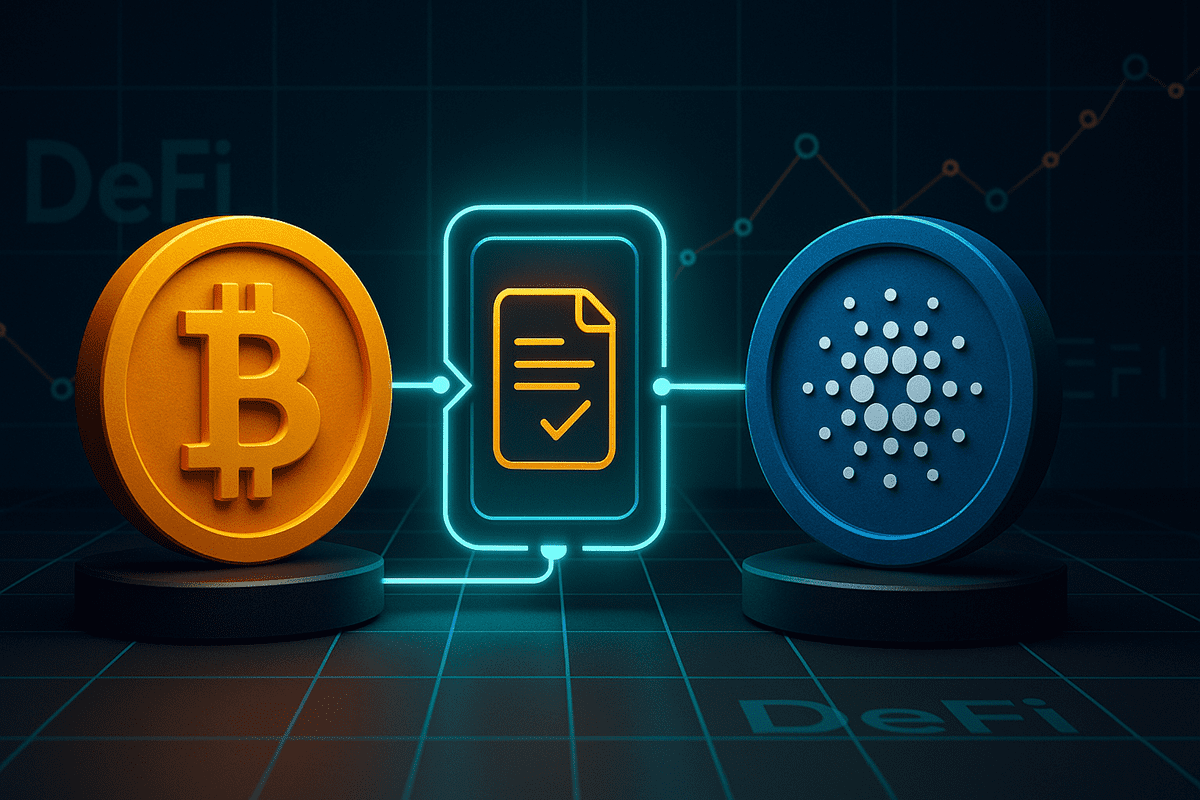
Understanding the Mechanics of the Cardinal Protocol
Cardinal operates by keeping original satoshis securely locked on the Bitcoin blockchain, utilizing a MuSig2 aggregated multi-signature framework. This setup is overseen by a rotating group of operators, ensuring security and reducing risks. A hashed-timelock contract (HTLC) outlines the conditions under which funds may be retrieved. On the Cardano side, an extended UTXO (eUTXO) smart contract mints a non-fungible token (NFT) that represents the locked UTXO, maintaining a 1:1 peg. Additionally, off-chain verification is conducted through the BitVMX framework, which provides fraud proofs to safeguard against operator misconduct.
One important aspect of Cardinal is how it treats each wrapped output as an NFT, thereby preserving the on-chain history of Ordinals during the transfer process. Once on Cardano, these wrapped assets become versatile, allowing owners to engage in actions like deposit into automated market-maker pools, earn yield through lending, or even use them as collateral—all without losing the original asset’s ownership. “Ordinals can now actively participate in DeFi, serving various purposes, including collateral and cross-chain auctions,” Pellerin stated.
The Challenges of Existing Bridge Solutions
Traditional custodial and federated bridges, such as BitGo’s wrapped-Bitcoin contracts on Ethereum, currently dominate a market valued at approximately $8.7 billion. However, these bridges pose significant risks, including centralized points of failure and rehypothecation concerns. Data shows that over $2.5 billion has been lost to exploits in the bridging landscape since 2021, prompting the need for a more secure infrastructure like Cardinal. By employing a robust one-of-n MuSig2 approach, Cardinal aims to minimize trust issues while maximizing capital efficiency, initiating a burn on Cardano that corresponds with the unlock of Bitcoin, with necessary proofs provided by BitVMX if required.
The Symbiosis of Cardano and Bitcoin
Cardano’s eUTXO accounting format closely resembles Bitcoin’s UTXO model, facilitating straightforward mathematical proofs essential for maintaining a symmetric peg. Factors like stable transaction fees, native tokenization, and predictable transaction costs played a key role in the architecture choice, reinforcing its efficacy. Interestingly, the technical specifications available on GitHub showcase a chain-agnostic design, with plans for compatibility with Ethereum, Solana, and Avalanche already outlined.
Following this landmark revelation, Cardano’s founder, Charles Hoskinson, shared his enthusiasm with his followers, declaring: “We are witnessing the dawn of Bitcoin DeFi on the Cardano platform.”
A Call for Collaboration and Further Development
While Cardinal presents an exciting opportunity, it is important to note that it is not yet fully operational for consumers. Pellerin emphasized that this release is primarily an infrastructure tool, and he encouraged external developers to contribute their expertise in areas such as SNARK-based burn-proof generation and user experience enhancements. Furthermore, independent audits will be crucial in evaluating the MuSig2 system and the operational rotation processes to identify and mitigate any potential vulnerabilities.
At the time of writing, ADA was trading at approximately $0.6984, illustrating ongoing interest in Cardano’s innovative developments.