In an important address today, Ethereum Foundation (EF) Co-Executive Director Tomasz K. Stańczak emphasized the necessity of the upcoming Fusaka upgrade for the Ethereum (ETH) ecosystem, slated for implementation in Q4 2025. His remarks serve as a rallying call for the community to prioritize the success of this crucial enhancement.
Fusaka Upgrade Poised for Q4 2025 Launch
In his recent social media update, Stańczak articulated the significance of the Fusaka upgrade, urging developers to concentrate their efforts on this initiative instead of getting sidetracked by the glamsterdam hard fork, which is projected for Q1 or Q2 of 2026.
He advised project leaders to momentarily set aside discussions about Glamsterdam and dedicate resources toward ensuring that Fusaka stays on track. Stańczak remarked:
The collaborative efforts geared towards Ethereum’s roadmap are futile if we cannot ensure that our milestones are consistently met. A talented team is working flat out to address the challenges that prompted suggestions to delay. We must collectively recognize that timelines carry significant weight.
For those new to the conversation, the Fusaka upgrade promises to deliver pivotal technical advancements to Ethereum. It serves as a subsequent step following the Pectra upgrade, implemented in May 2025, which enhanced performance for validators and improved account abstraction features.
Insight into the Fusaka Upgrade
The Fusaka upgrade comprises two significant components: Fulu, focused on the consensus layer, and Osaka, aimed at the execution layer. Together, they will introduce an array of new features, including 11 Ethereum Improvement Proposals (EIPs), Peer-to-Peer Data Availability Sampling (PeerDAS), and Verkle Trees.
A notable EIP, EIP-7825, is designed to strengthen the network’s defense against malicious activity by implementing a transaction gas limit that caps at 16,777,216 units. This enhancement aims to minimize spam and protect nodes from coordinated assaults.
PeerDAS allows network participants to verify shard data availability without the necessity of downloading extensive data collections, which greatly enhances scalability. It reinforces the security and decentralization of the network’s sharded architecture by thwarting data withholding attacks while lessening the demands placed on individual nodes.
Verkle Trees represent an advanced approach to cryptographic data structures, optimizing the process of storing and validating larger data quantities as opposed to traditional Merkle trees. They will allow eth nodes to demonstrate and verify state data with significantly smaller proofs, leading to reduced storage needs and quicker synchronization times.
Ongoing technological advancements in Ethereum have spurred interest among corporations to integrate ETH into their financial portfolios. Recently, exchange-traded funds (ETFs) tracking ETH have observed inflows that outpace those of Bitcoin (BTC) investments.
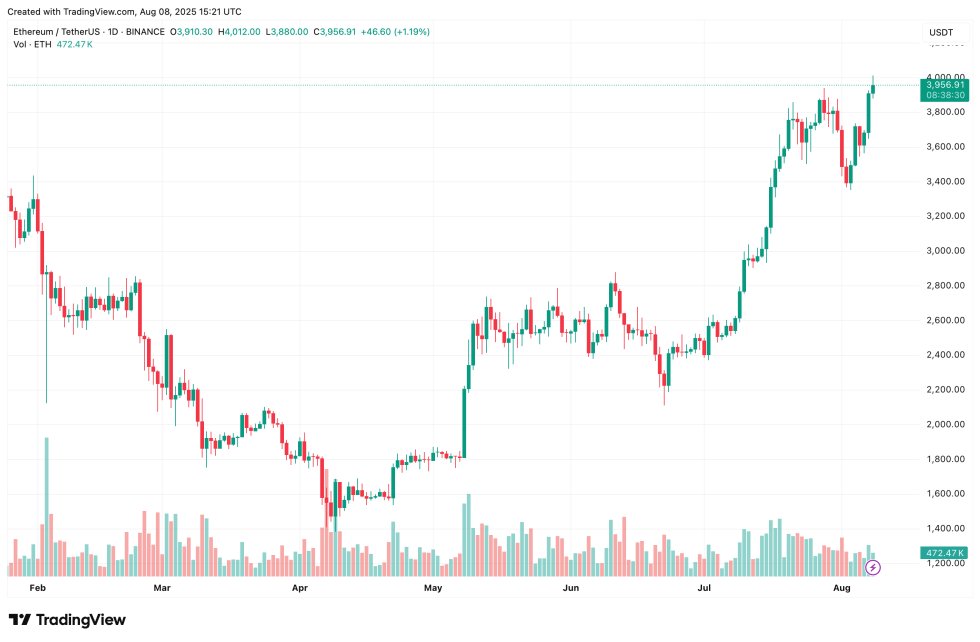
Moreover, a fresh report from VanEck indicated that Ethereum, rather than Bitcoin, could emerge as a favored store of value moving forward. As of now, ETH is trading at $3,956, reflecting a rise of 3.4% within the last 24 hours.