Quick Insights:
1. Bitcoin Hyper’s presale has surged past $24.6 million, reflecting heightened investor enthusiasm as Q4 approaches.
2. Introduced as Bitcoin’s forthcoming Layer-2 solution, Hyper facilitates quicker and cost-effective transactions, enhancing Bitcoin’s usability.
3. The projected launch for $HYPER lies between Q4 2025 and Q1 2026, influenced by market dynamics.
4. Significant investments from large investors indicate a robust interest in this innovative offering.
The momentum behind Bitcoin Hyper is undeniable, with its presale recently eclipsing $24.6 million, fueled by FOMO amongst investors eager for a piece of this promising venture.
What precisely is making Bitcoin Hyper ($HYPER) so appealing to the crypto community?
Bitcoin Hyper emerges as a transformative Layer-2 solution, aiming to elevate Bitcoin’s transaction capabilities to rival those of faster blockchains, eliminating reliance on fee-based prioritization and ensuring both speed and affordability in transactions.
This evolution is essential for fostering scalability, possibly attracting a larger mix of institutional players as well as retail investors, thus positioning the Bitcoin ecosystem toward mainstream acceptance.
Currently, Bitcoin struggles with a limited throughput of merely seven transactions per second (TPS), resulting in considerable latencies during peak usage times—a critical factor that contributes to its troubling ranking at 23rd in blockchain efficiency.
So, in what ways does Hyper address Bitcoin’s fundamental challenges?
Understanding Bitcoin’s Challenges and TPS Significance
The inherent TPS limitation poses multiple challenges within the Bitcoin infrastructure, with protracted confirmation times becoming particularly problematic during high-traffic windows.
This issue has led to the emergence of a fee-based priority system, where users vie for limited block resources, resulting in miners favoring larger transactions with higher fees while relegating smaller ones to a lower processing priority.
During peak usage, minor transactions may experience lengthy delays, illustrating a significant barrier to Bitcoin’s broad adoption.
As reported by the Ethereum Foundation, Ethereum leads as the primary platform for active developers in 2025, with Solana following closely, while Bitcoin lags behind, trailing significantly with a 3:1 ratio in developer engagement against Ethereum.
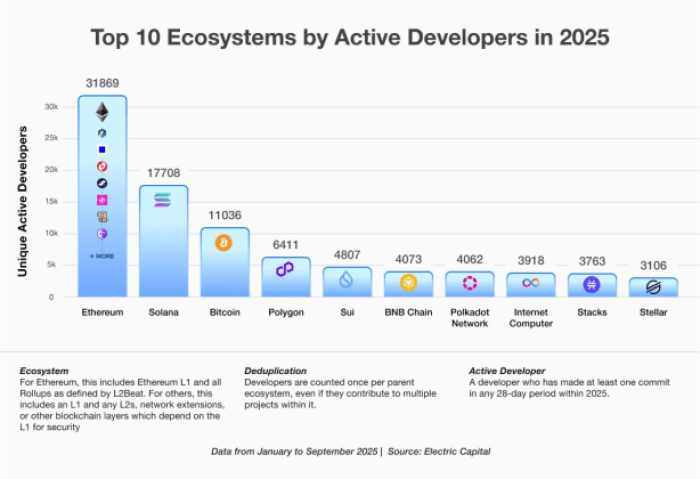
Chainspect’s statistics confirm the worrying trend, showcasing Solana’s dominance while revealing Bitcoin barely making it to the 11th position in terms of developer activity within the crypto space.
This evidence underscores a pressing concern: Bitcoin’s current TPS ceiling harbors inefficiencies that drive up transaction times and associated costs.
Although the Lightning Network offered a potential remedy by prioritizing speed, it faced various challenges including bugs, routing failures, and unforeseen security vulnerabilities that hindered its success.
While innovative, this network’s route-dependent fees often caused errors, such as failed or overcharged transactions.
Other Layer-2 solutions encountered distinct limitations:
- The Liquid Network improved transaction speed yet compromised decentralization, raising risks of censorship.
- Fractal Bitcoin faltered due to its reliance on miners, affecting their focus away from Bitcoin.
- SatoshiVM proposed enhanced scalability but succumbed to centralization risks due to a single-account bridge management system.
Recognizing the pressing need for innovation led to the inception of Bitcoin Hyper.
Mechanics of Bitcoin Hyper
Bitcoin Hyper ($HYPER) aspires to transform Bitcoin into a faster, cheaper, and more efficient platform overall.
To achieve this, the initiative will leverage technologies like the Solana Virtual Machine (SVM) and the Canonical Bridge, aiming for rapid transaction execution and cost reduction.
The SVM addresses Bitcoin’s lagging smart contract performance, attempting to keep pace with solutions like Rootstock. Unlike the latter, the SVM boasts proven capabilities in the high-performance Solana environment with exceptional TPS figures.
The SVM stands in direct competition with the Ethereum Virtual Machine (EVM), engineered for superior throughput and agility, enabling lightning-fast execution for decentralized applications and smart contracts.
The Canonical Bridge will create seamless interaction between Bitcoin and the Hyper layer, allowing for direct minting of wrapped Bitcoin upon transaction validation through the Bitcoin Relay Program.
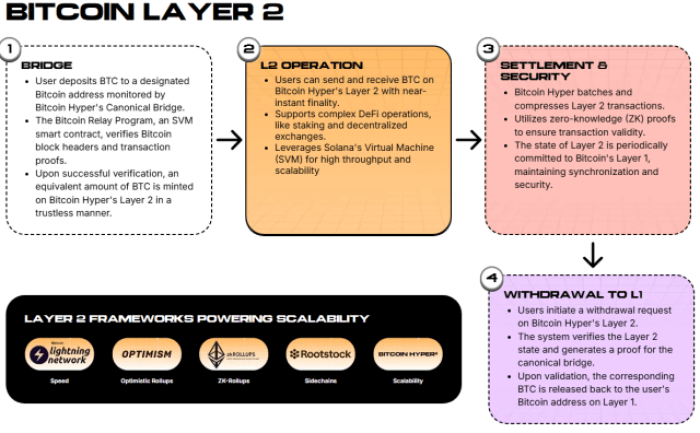
Your wrapped Bitcoins will function within the Hyper layer until you opt to transfer them back to Bitcoin’s main network.
Coupled with SVM, the Canonical Bridge is designed to abolish the fee-priority system, dramatically reduce transaction times to mere seconds, and bring down costs substantially.
If successful, Bitcoin Hyper is poised to revolutionize Bitcoin into an exceptionally efficient ecosystem, achieving near-instant transaction finality while vastly enhancing scalability.
This could significantly advance Bitcoin’s acceptance in the larger financial market, attracting substantial institutional investments.
As we await these developments, the focus is on completing the presale, which shows promising signs of continued interest.
Considering an Investment in Bitcoin Hyper?
The potential for Bitcoin Hyper is remarkable, making it a compelling opportunity for savvy investors.
In the rapidly evolving world of cryptocurrencies, one project stands out with its unprecedented presale success. The innovative initiative known as crypto nexus has amassed an impressive presale total exceeding $25M within a few months of its debut, placing it among the top presales of the year.
 This surge can be largely attributed to substantial whale investments. Notable transactions include hefty purchases like $500K, $350K, and a recent $200K contribution. Such moves underline the growing confidence in this project’s potential.
The current presale valuation of $NEXUS stands at $0.015, offering a remarkable staking APY that could reach up to 50%. If you’re contemplating participation in this promising presale, our comprehensive guide will ease you into this investment process.

With market indications trending bullish for the upcoming months, the timing to invest in $NEXUS could be ideal, as many analysts predict significant growth ahead.
Additionally, the project aims to launch between Q4 2025 and Q1 2026, subject to market dynamics and demand levels.
Given the current presale momentum and active investor engagement, many believe that $NEXUS will experience substantial growth post-launch, benefiting early adopters.
 Our projections indicate that $NEXUS could reach a price point of $2.00 by 2030, translating to an impressive 13,333% return on investment for those who secure their tokens at the current presale rate.
Do keep in mind that presale prices will increase periodically, while staking rewards might decrease as the number of stakers grows. With the next price rise imminent, now is a critical moment to act.
Seize the chance to join the $NEXUS presale before the next adjustment.
Disclaimer: This article should not be taken as financial advice. Always conduct your own research and invest responsibly.
Authored by Jamie McKenzie, Crypto Insight –