Waiting a decade can feel like an eternity. For countless individuals who lost their investments when the Mt. Gox exchange folded in 2014, this lengthy period has turned into a test of patience and resilience.
Recently, the former leader of this exchange is advocating for a remarkable change — one that would fundamentally alter how Bitcoin operates.

A Revolutionary Suggestion for Bitcoin’s Protocol
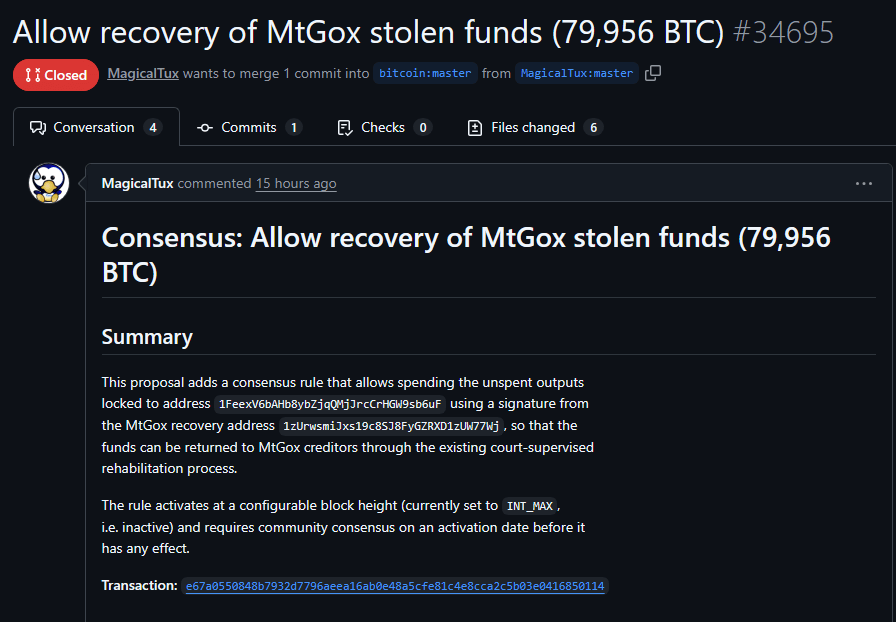
Mark Karpelès, the ex-CEO of Mt. Gox, proposed a structural adjustment on GitHub last week, advocating for a hard fork of Bitcoin’s software. This modification would enable the transfer of approximately 80,000 Bitcoin — valued at over $5 billion — to a designated recovery wallet without requiring the original private keys.
Former Mt. Gox CEO Advocates Hard Fork to Recover $5.2B in $BTC
The ex-CEO of Mt. Gox is calling for the #Bitcoin community to contemplate a #network hard fork to reclaim nearly 80,000 Bitcoin. #crypto pic.twitter.com/xKUG2B0pAR
— CryptOpus (@ImCryptOpus) February 28, 2026
Reports indicate that these Bitcoin funds have remained stagnant in a single wallet for over 15 years, making them one of the most scrutinized addresses in the cryptocurrency landscape.
This is a protocol level change and therefore must be established as a BIP prior to becoming a pull request aimed at modifying code in implementation.
— Jameson Lopp (@lopp) February 27, 2026

Karpelès was straightforward about his demands. He emphasized, “This is a hard fork,” in his proposal. “It transforms a previously non-viable transaction into a viable one.”

His arguments rest on a stalemate that has arisen between significant stakeholders. The trustee managing the repayments to creditors has resisted pursuing any on-chain solutions without assurances that such a rule alteration would be accepted by the Bitcoin network.
Not that way. The court should compel the thief to relinquish the private key.
— Luke Dashjr (@LukeDashjr) February 28, 2026
However, the community is unable to properly assess that option without a solid proposal laid out before them. Karpelès believes his submission on GitHub breaks this impasse.
Opposition Fears Potential Consequences
Responses poured in quickly. On the Bitcoin forum Bitcointalk, users expressed concerns that the proposal could jeopardize Bitcoin’s quintessential trait — the permanence of confirmed transactions that cannot be undone.
One participant cautioned that agreeing to such a rule modification would create a precedent that future hacking victims could exploit. Others voiced worries about external governmental influence over Bitcoin’s operational framework.
These apprehensions are understandable. A significant part of Bitcoin’s value hinges on the conviction that no individual, judicial entity, or government can manipulate or transfer assets without the necessary keys. Compromising this rule, even for a seemingly justified cause, could undermine its very foundation.
Creditors Remain in Limbo After Many Years
Mt. Gox was once a titan in the cryptocurrency world. At its peak, it facilitated approximately 70% of global Bitcoin transactions.
Security vulnerabilities had been exposed as early as 2011, leading to gradual thefts that went unnoticed for an extended period.
By early 2014, the exchange sought bankruptcy protection in Tokyo, revealing losses of 750,000 Bitcoin belonging to customers and an additional 100,000 of its own, amounting to about $500 million at that time.
Image sourced from Unsplash, data from tradingview