Charles Hoskinson, the co-founder of Cardano, has recently emphasized the critical need for DReps (Delegated Representatives) to support a funding proposal aimed at the platform’s research initiatives. He cautioned that neglecting this area could undermine Cardano’s core identity as a research-driven blockchain.
During a livestream broadcast from England on May 21, Hoskinson stated that the Cardano ecosystem is currently in what he termed “treasury season,” which presents a more challenging funding landscape than in previous years. The ecosystem is seeking approximately $52 million for this year, a notable reduction from the $98 million requested in the previous year, resulting in workforce reductions affecting engineers and community teams.
“Many individuals have made significant sacrifices,” Hoskinson remarked, noting that the cuts have led to the departure of valuable personnel, including engineers and familiar community members.
The Importance of Research in Cardano
Hoskinson framed the discussion surrounding the funding proposal as being about more than just budgetary concerns. He reiterated that Cardano’s extensive research program has been essential to its identity and a primary reason for its distinction within the blockchain space.
“The cornerstone of what makes Cardano unique has always been its commitment to being the research-centric platform,” he stated. “Over the last decade, substantial investments have been made, engaging numerous researchers, making it one of the largest research groups focused on cryptocurrencies.”
Examples of Cardano’s research contributions include:
- Proof-of-stake research
- Extended UTXO (Unspent Transaction Output) model
- Development of Plutus (the smart contract platform)
- Sidechain technology
- Research related to DeFi on Bitcoin
Additionally, Hoskinson highlighted Cardano’s partnerships with notable academic institutions, such as Stanford and the University of Edinburgh, emphasizing their irreplaceable value.
Critics of the funding proposal have suggested that research funding should be selectively allocated. Hoskinson countered this notion by emphasizing that such an approach would not allow for informed decision-making, potentially harming the entirety of the research operation.
The Risk of Talent Loss
A key argument made by Hoskinson is that if Cardano’s investment in research diminishes, the talented researchers could be enticed away by better-funded competitors. He pointed out that other blockchain projects with larger treasuries would likely seek to recruit these specialists, comprising cryptographers, programming language experts, and distributed systems researchers.
“If these researchers are treated as expendable, they will undoubtedly pursue opportunities elsewhere,” he warned. “They will move to ecosystems that can offer more substantial financial support and long-term job security.”
He stressed that losing this talent is often irreversible. The foundation for academic and technical capabilities relies on stability, and once these skilled individuals leave, it becomes challenging to bring them back. “Once they’re gone, it’s usually permanent. We can’t just express regret and expect them to return,” he said.
Additionally, Hoskinson linked this matter to investor sentiment. He posed critical questions about how cardano’s appeal to investors would evolve if research support were deemed non-essential. Without a solid research backbone, Cardano might have to rely heavily on conventional metrics, such as monthly active users or total value locked (TVL).
The livestream concluded with Hoskinson making a direct appeal to those DReps who had yet to vote, as well as those who had expressed opposition to the funding proposal. He urged them to reconsider, insisting that investing in research is integral to Cardano’s long-term competitive advantage.
“You cannot maintain stability without a strong foundation,” he asserted. “I urge you to support the research funding proposal. It is foundational to our mission, and we cannot afford to lose it.”
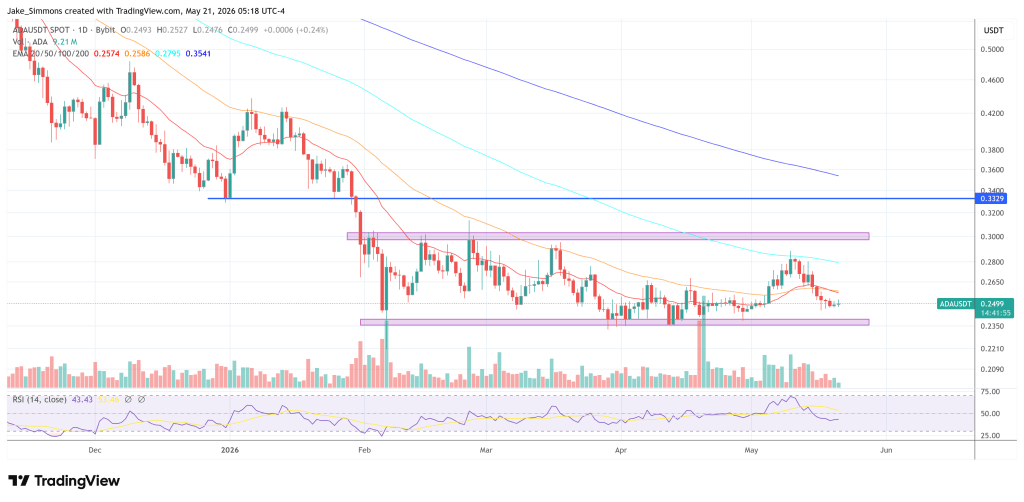
As of the latest update, ADA was trading at $0.2499.