A federal judge has cleared two brothers, Anton and James Peraire-Bueno, of charges related to a $25 million scheme involving Ethereum trading bots, marking a significant conclusion to the government’s first criminal case centered around a major maximal extractable value (MEV) exploit.
On November 16, US District Judge Jessica Clarke ruled that prosecutors did not present sufficient evidence to demonstrate that the brothers committed wire fraud. This ruling also absolved them of conspiracy charges tied to wire fraud and money laundering.
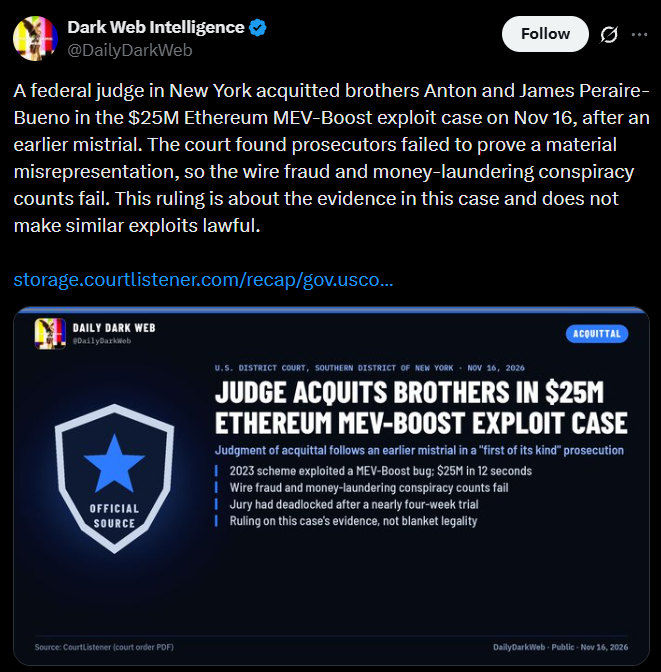
The case drew attention following allegations in April 2023 that the Peraire-Bueno brothers operated a sophisticated trading scheme, which led to a mistrial in November 2025 when jurors were unable to reach a unanimous decision.
In her ruling, Judge Clarke referred to the Ethereum environment as “trustless” and “highly adversarial,” noting the complexities of interpreting whether exploiting vulnerabilities in blockchain systems constitutes criminal activity.
Mechanics Behind the $25 Million Extraction
According to court documents, the brothers exploited automated trading bots that analyze Ethereum’s mempool, where pending transactions are held. These bots aim to capitalize on maximal extractable value (MEV) by manipulating the order of transaction processing.
A typical method used in such schemes is called a sandwich attack. This involves a bot recognizing an imminent large purchase, making the same asset purchase beforehand, and then selling it once the price inflates due to the original transaction. Prosecutors alleged that the brothers executed eight bait transactions in April 2023 to lure these bots.
Once their validator was chosen to process a block, the brothers took advantage of a flaw associated with the Ultrasound relay. This allowed them to create a fake block header with two fields incorrectly set to zero, which the relay failed to verify, thus exposing the transactions.
They were then able to construct an alternative block, retaining the bot transactions but substituting the bait transactions with sales that decreased asset prices. As a result, the bots faced $25 million in losses within a matter of seconds, while the brothers’ validator incurred a penalty of around 1 ETH.
Reasons for the Judge’s Ruling Against Fraud Claims
The core issue revolved around whether the brothers had made any material misrepresentations that other parties depended upon. Judge Clarke determined that the prosecution failed to prove this critical aspect of wire fraud, dismissing claims that posting transactions in Ethereum’s public mempool signaled a binding agreement for processing in a specified order.
Additionally, the court found that the fabricated block-header fields did not amount to fraud because the relay never checked them, thus they did not affect its operation.
While acknowledging that the brothers may have concealed their intentions and acted contrary to the intended use of the relay software, Judge Clarke emphasized that improper conduct does not inherently amount to criminality as per the specific charges brought against them.
Closure of a Major Ethereum Case Following Mistrial
This acquittal concludes a lengthy legal battle that began with significant allegations of financial wrongdoing. The case was notably marked by the 2025 trial, which ended in a mistrial after jurors could not agree on the charges against the brothers. Judge Clarke’s ruling now instructs the closure of the case without future proceedings.
Interestingly, the financial aftermath revealed that only one of the wallets, holding approximately $3 million of the $25 million, was frozen, while the brothers managed to transfer the remaining funds by October 2023.
The implications of this ruling could serve as a reference for future legal disputes involving MEV and similar automated trading strategies, posing critical questions about the boundaries of criminal liability within decentralized networks. However, it does not offer a definitive resolution regarding the ethical concerns surrounding sandwich attacks or the obligations of blockchain participants.
What do you think about this ruling’s impact on legal interpretations of MEV trading on Ethereum? Will future prosecutions encounter similar hurdles in cases involving complex blockchain exploits?