The cryptocurrency landscape is facing challenges as major players like Bitcoin and altcoins struggle to maintain critical support levels. This ongoing downturn has created a cautious atmosphere within the digital asset space. Recent corrections have left the market reeling, particularly since the downturn initiated earlier in 2025. Even though some minor recoveries have occurred, they have not been sufficient to instill confidence, resulting in a market that is fraught with uncertainty and high volatility. Investors are now adopting a more measured approach, prioritizing careful allocation of resources over aggressive investment in higher-risk assets.
A new report highlights an essential factor contributing to this market slump: the stagnation in liquidity. The analysis indicates that without consistent capital inflows, the market cannot effectively shift into a recovery phase. Additionally, macroeconomic conditions are less than favorable for risk assets at this time. Recent discourse from Federal Reserve leadership suggests that strong data from the labor market could lead to a sustained interest rate policy, which typically acts as a deterrent to riskier investments.

As liquidity continues to tighten, there is a notable shift in capital among investment sectors. Funds are increasingly moving toward traditional equities and commodities, spurred by developments in the artificial intelligence sector and the ongoing strength of gold and silver. This allocation signifies that the cryptocurrency market might remain in a defensive stance until liquidity conditions begin to recover.
Examining Stablecoin Flows: A Reflection of Market Liquidity
The trends in stablecoin movement offer vital insights into liquidity within the crypto markets. For instance, an increase in stablecoin assets on exchanges often suggests a readiness among investors to enter riskier positions. In contrast, consistent outflows typically represent a decrease in trading interest or a withdrawal of capital.
Data from Binance indicates that there has been a marked decline in stablecoin reserves since mid-November, with nearly $10 billion withdrawn as investors appear to be reducing their market exposures. The reserves have decreased from approximately $50 billion to just over $41 billion, representing a contraction of around 18%. This pattern signifies a significant pullback in liquidity available on one of the largest exchanges in the market.
Furthermore, the current reserve levels at Binance are similar to those from October 2024, pointing toward a persistent trend that could influence overall market liquidity. While Binance maintains about 64% of the stablecoin reserves across centralized exchanges, such significant changes can have ripple effects throughout the cryptocurrency market.
If the outflow trend remains steady, the prospects for price stability could become increasingly grim. Historically, robust inflows of stablecoins have coincided with a renewed appetite for risk and upward price trends. Therefore, a meaningful reversal in stablecoin flow patterns will likely be essential for a stronger recovery to take hold.
Analyzing Total Market Cap: Approaching Key Support Levels
The total market capitalization of cryptocurrencies illustrates a marked shift from growth to consolidation following the peak witnessed during the 2025 market surge. After peaking close to $4 trillion, the market has entered a corrective phase, compressing down to the $2.1–$2.2 trillion range. This downward trend reflects a broader risk-aversion attitude affecting not just Bitcoin but altcoins as well.
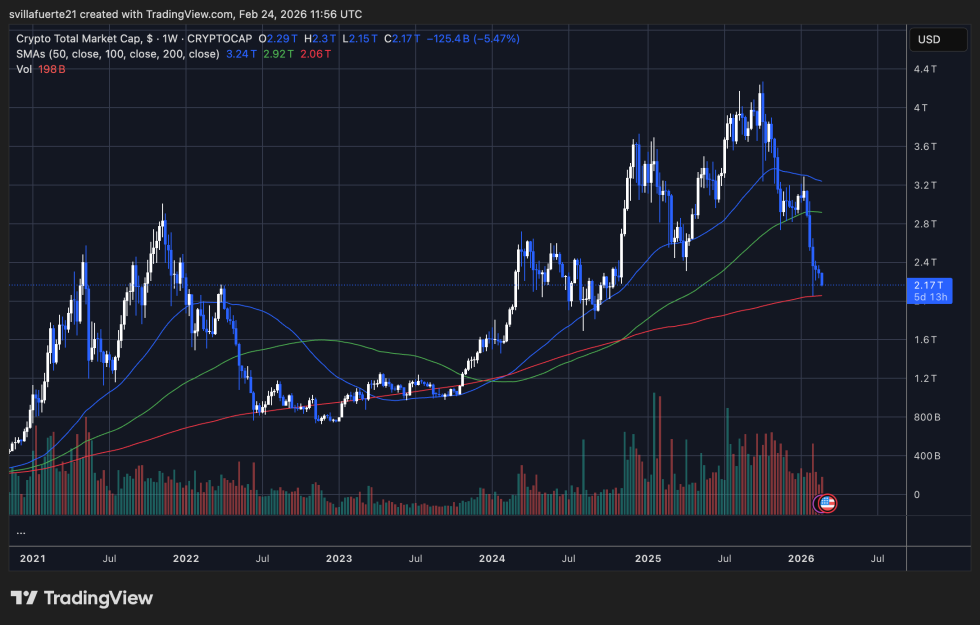
From a structural standpoint, the market is currently trading below the 50-week moving average and is nearing the 100-week average, with the 200-week average trending upwards beneath current price levels. Typically, such scenarios may signify mid-cycle corrections rather than complete structural reversals, although confirmation will depend on stabilization above critical support levels.
Volume analysis further hints at distribution patterns rather than aggressive accumulation by investors. Notable increases in selling during downturns are more apparent than buying activity, signifying ongoing caution in the marketplace. The lack of powerful follow-up rallies reinforces the notion that liquidity remains constrained.
If the $2 trillion support level cannot hold, we may witness increased volatility due to decreased liquidity. In contrast, if the market manages to stabilize above current thresholds while simultaneously seeing renewed inflows—especially through stablecoins—this could signify a gradual return of broader market confidence.
Source image courtesy of ChatGPT, with charts sourced from TradingView.com