Fidelity’s Jurrien Timmer, Director of Global Macro, shared insights on the debate between Bitcoin and gold as reliable stores of value. He discussed scenarios where each asset class could hedge against inflation based on the economic landscape.
The Relationship Between Money Supply, Asset Valuation, and Inflation
Timmer’s analysis revolves around the concept of “fiscal dominance,” where government actions to expand the money supply can impact the currency’s purchasing power. He highlighted the historical M2 money supply/CPI relationship as a confirmation of impending inflation.

While Bitcoin and gold are considered inflation-resistant assets in theory, Timmer believes the full realization of such an environment is yet to materialize, despite recent Federal Reserve policy shifts.
Bitcoin is often referred to as “digital gold,” combining traditional monetary attributes with innovative internet technology, according to Timmer. However, Bitcoin’s path to rivaling gold hinges on sustained abnormal growth in fiat monetary aggregates.
While the pandemic initially led to a spike in the M2 money supply, Federal Reserve tightening policies curbed this growth, indicating that both gold and Bitcoin may be premature in their roles as ultimate value stores.
Bitcoin’s price surge to $69,523 follows the latest CPI report, suggesting a potential strengthening of its position as a store of value.
Gold prices also saw a 0.91% increase post-CPI report, reaching $2,336 per ounce, reflecting positive market sentiment.
Impacts of Treasury Yield Associations on Bitcoin
Recent data from Barchart indicates a declining correlation between Bitcoin price and the 10-year U.S. Treasury bond yield, reaching its lowest in 14 years at -53.
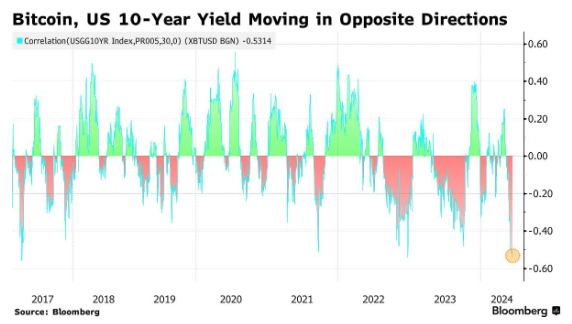
This decoupling suggests that Bitcoin is increasingly moving independent of traditional financial instruments like Treasury bond yields, possibly signaling its evolution into a distinct asset class.
If this trend continues, Bitcoin could strengthen its position as a non-traditional hedge against fiscal uncertainties, further distinguishing itself from conventional assets like gold.
Timmer acknowledges that Bitcoin and gold have limitations as value stores, with their true potential dependent on future economic developments related to money supply and inflation.
Image credits: DALL-E, Chart source: TradingView