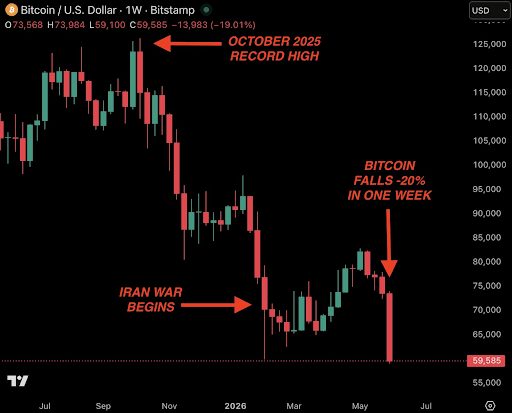
Bitcoin’s recent decline below $60,000 raises significant questions about the overall market landscape, particularly in light of changes reflected in the May 2026 jobs report. This unexpected report has implications for risk assets, suggesting a cautious sentiment within the cryptocurrency space.
According to the US Department of Labor, the labor market remains unexpectedly strong. However, this strength complicates liquidity for risk assets like Bitcoin, making it more vulnerable at a time when investor confidence is already dwindling.
Strong Performance in the May Jobs Report
The Bureau of Labor Statistics announced that in May, 172,000 jobs were added in the US, vastly exceeding economists’ projections of 85,000 according to LSEG. This substantial increase signals robust economic activity, contradicting some forecasts of a slowing labor market.
The unemployment rate held firm at 4.3%, which could unsettle expectations surrounding interest rate cuts. Revisions for previous months also offered promising updates, with job counts for March and April collectively raised by 93,000 jobs, adjusting March to 214,000 and April to 179,000.
This report is the second strongest in over a year, prompting immediate reactions in investment markets. Following the release, Polymarket increased probabilities for a Federal Reserve rate hike before year-end to 53%. The CME FedWatch tool indicates a 42.7% chance of higher rates by December. Current predictions estimate around 68.8% probability of no cuts in 2026.
Lindsay Rosner of Goldman Sachs Asset Management termed the report a “Payroll Blowout” and suggested it has bolstered the Federal Reserve’s confidence regarding the labor market.
Bitcoin’s Liquidity Challenges
The Kobeissi Letter illustrated the scale of market reaction, noting that the S&P 500 lost almost $2 trillion in market capitalization shortly after this influential jobs report. Bitcoin, consequently, has seen a decline of more than 50% from its peak in October 2025, with this bear market intensifying and negatively impacting risk appetite.
The drop beneath $60,000 highlights traders’ concerns over diminishing liquidity. Recent weeks have seen significant outflows from spot Bitcoin ETFs, which were crucial to supporting demand during earlier price surges.
Despite these challenges, there are potential signs of hope for Bitcoin investors. The cryptocurrency dipped below its 200-week moving average of $61,000, marking its first significant interaction with this metric since 2022. Historically, Bitcoin has often reached bear-market bottoms around this moving average during major cycles from 2015 to 2020, making this moment noteworthy.
Geoff Kendrick, Standard Chartered’s global head of digital assets research, recently indicated that the current bear market might be nearing its conclusion. He noted that the recent declines could represent a buying opportunity for investors optimistic about Bitcoin reaching $100,000 and Ethereum hitting $4,000 again.