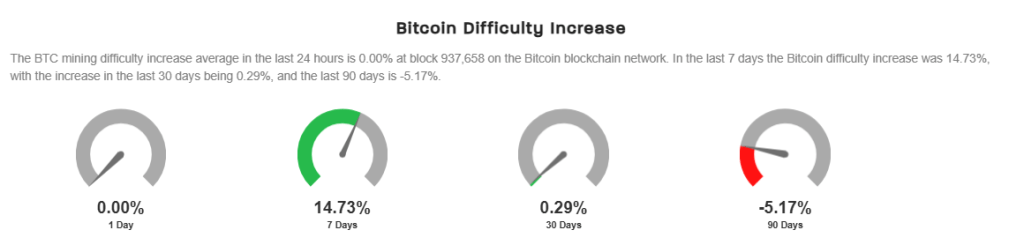
The recent rise in Bitcoin hashing power has led to a significant spike in mining difficulty, surpassing a staggering 144 trillion. This remarkable shift, observed through CoinWarz, indicates a rebound following a 10% decline driven by significant outages across various regions in the United States.
These fluctuations highlight the resilience of the network, where downtime during extreme weather events was followed by a swift recovery as machines powered back up and the system recalibrated.

Impact of Weather Events on Mining
The recent winter storms had a noticeable effect on mining operations, particularly at Foundry USA’s pool, which saw its hash rate plummet to nearly 198 EH/s before soaring back to around 400 EH/s. Many miners temporarily halted their operations to safeguard equipment and assist struggling power grids.
This proactive approach saw collaborative efforts with energy providers to conserve power and redirect resources during critical periods.
Innovative Energy Solutions Boost Mining Flexibility
In addition to merely pausing operations, various miners engaged in strategic partnerships. For example, LM Funding America reported that they effectively curtailed their mining activities while returning excess contracted power to the grid. This strategy allowed them to earn curtailment payments, offsetting some of the lost revenue from downtime.
Moreover, companies like Canaan Inc. have actively participated in demand response measures alongside local energy partners, demonstrating an ability to adapt to changing conditions while maintaining financial stability.
The Significance of Increased Difficulty
The fundamental structure of Bitcoin dictates that mining difficulty undergoes a reset every 2,016 blocks, ensuring that the average block generation time remains stable around the targeted 10-minute mark. A rise in hash power results in heightened difficulty, which contributes to enhanced security against potential network attacks while increasing the computational effort required to earn block rewards.
However, this increase poses challenges for miners, particularly those utilizing older technology or facing elevated energy costs, as it reduces the Bitcoin yields associated with their computational efforts.
Market Reactions to External Stimuli
Currently, Bitcoin hovers around $68,000, influenced by escalating geopolitical tensions, notably between the US and Iran. The market’s response has been cautious, with trading volumes diminishing and price movements often tethered to headline-driven narratives. Investor sentiment continues to vacillate with ongoing global developments.
Even as market dynamics evolve, it is crucial to recognize the underlying technical metrics that may diverge from macroeconomic influences, creating a complex landscape for traders and miners alike.
The United States plays a pivotal role in global hash power, as indicated by the Cambridge Centre for Alternative Finance. Consequently, local incidents, weather patterns, and energy policies markedly impact worldwide miner economics and security.
Many organizations are now viewing mining as a flexible load, enhancing grid stability during peak demand periods and developing new revenue streams beyond traditional block rewards.
Political Climate and Market Sentiment
Political statements and global events can significantly influence market psychology. Recent comments from key figures have been broadly linked to rising market volatility, highlighting how geopolitical factors can dampen investor enthusiasm and confine crypto prices within specific ranges.
Although the recent difficulty rise did not trigger a sharp price increase, it serves as a reminder of the network’s adaptability and its capacity to handle disruptions. Nonetheless, miners continue to navigate a tightening financial environment.
Featured image from Pexels, chart from TradingView