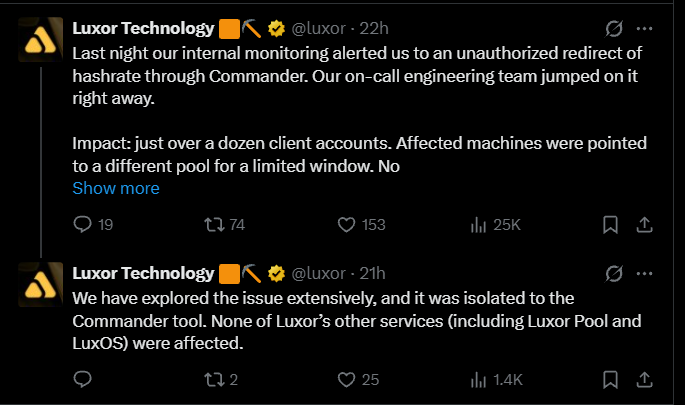
A significant security breach affecting Bitcoin miners has come to light, as Luxor Technologies announced that its mining management software, Commander, was exploited by attackers. This breach allowed unauthorized users to redirect computing power from multiple customer accounts to a different mining pool while also altering the addresses set to receive payout rewards.
The incident was first detected on November 14, prompting Luxor to quickly patch the vulnerability within two hours and begin restoring the affected mining configurations. The company has assured its customers that they will be fully reimbursed for their losses incurred during the attack.
Details of the Breach
The attack targeted Luxor’s Commander platform, which enables operators to oversee and adjust their mining equipment remotely. By gaining unauthorized access, the attackers altered the mining pool settings and redirected payouts to a pool named OCEAN. This pool allows miners to aggregate their computing power and share rewards based on their contributions.
This type of attack does not necessitate physical access to mining machines or direct theft of Bitcoin from users’ wallets. Instead, it allows attackers to siphon off revenue from mining activities while legitimate owners continue to bear operational costs such as electricity.
Luxor clarified that the breach was contained to the Commander software, stating that its Luxor Pool and LuxOS services were unaffected. The company found no evidence that customer data had been extracted or compromised.
Financial Impact of the Attack
Blockchain activities indicate that the attackers successfully received mining rewards totaling approximately $15,700 from three separate Bitcoin block rewards. These payments went to an address linked to the mining host CoreX Hosting.
The OCEAN payout system allows for previous mining work to remain eligible for rewards, meaning that payments can continue to flow even after control over the affected machines has been regained by their legitimate owners.
While this monetary loss has been identified, the complete financial implications of the breach remain uncertain, as it’s unclear how much revenue was redirected in total during the incident.
Extent of the Impact
Reports suggest that up to 64,000 mining machines may have been compromised, far exceeding the number of customer accounts Luxor initially confirmed as affected. Mining operators began noticing unauthorized adjustments to their equipment’s pool settings, leading CoreX Hosting to alert other operators of the suspicious activity. Following the discovery, there was a noticeable drop in the redirected hash rate, indicating that most compromised machines had either been restored to their previous configurations or were no longer contributing to the OCEAN pool.
CEO’s Warning on Cybersecurity Threats
In discussing the incident, Luxor’s CEO Nick Hansen characterized the breach as a sophisticated attack, allegedly assisted by artificial intelligence. He expressed concerns regarding the increasing sophistication of cybersecurity threats targeting cryptocurrency businesses.
However, further details about how AI was employed in the attack were not provided, nor did the company disclose the method through which the attackers gained their initial access to Commander. Luxor has since halted new feature development to focus its resources on enhancing security measures.
Broader Security Implications
The Luxor breach has raised alarms over security vulnerabilities not just in cryptocurrency exchanges, but also in mining management platforms. These platforms control critical aspects of mining operations and dictate where the rewards from mining activities are allocated.
By gaining unauthorized access to mining configurations, attackers can pose a significant threat to the profitability of mining operations without needing to directly steal equipment or Bitcoin. While Luxor’s promise to reimburse affected customers addresses immediate financial concerns, the incident prompts deeper questions regarding access controls, monitoring processes, and the overall security of remotely managed mining solutions.
As the cryptocurrency space evolves, will Luxor’s commitment to full compensation restore confidence in its mining management software?