In recent trading, Bitcoin’s value has shown signs of fluctuation, hovering around $67,000. Attempts to push past the $71,000 barrier have yet to yield definitive results. However, the trends among cryptocurrency miners indicate a shift that may hold significant relevance for the future.
Recent insights from a mining behavior analysis conducted by XWIN Research Japan reveal a noteworthy decrease in miners’ selling activities. This trend signals a crucial on-chain supply dynamic. With miners being a primary source of new Bitcoin supply, a reduction in their selling signals a potential shift in market conditions.

Such changes in selling patterns don’t occur without reason. They typically suggest that forced liquidations have settled down. This implies that the more vulnerable market participants have exited, leaving behind miners who are more resilient and strategically positioned.
This phenomenon is often referred to as “late-stage capitulation.” Historical trends suggest that this phase commonly precedes a bottoming out in prices.
While the current selling pressure appears to be easing, caution remains essential. The demand side of the market is still weak. Following an uptick in supply without a corresponding increase in demand could create a precarious balance. Although the groundwork may be laid for recovery, the requisite buyers have yet to engage.
Consolidation in the Mining Sector amid Challenging Conditions
The aforementioned study sheds light on developments that conventional price charts may overlook. Even as mining profitability declines, the hash rate, representing the collective computational effort on the Bitcoin network, continues to grow. Currently, hash prices are nearing unprecedented lows, with production costs soaring to around $80,000. This scenario places many operations in a challenging financial position.
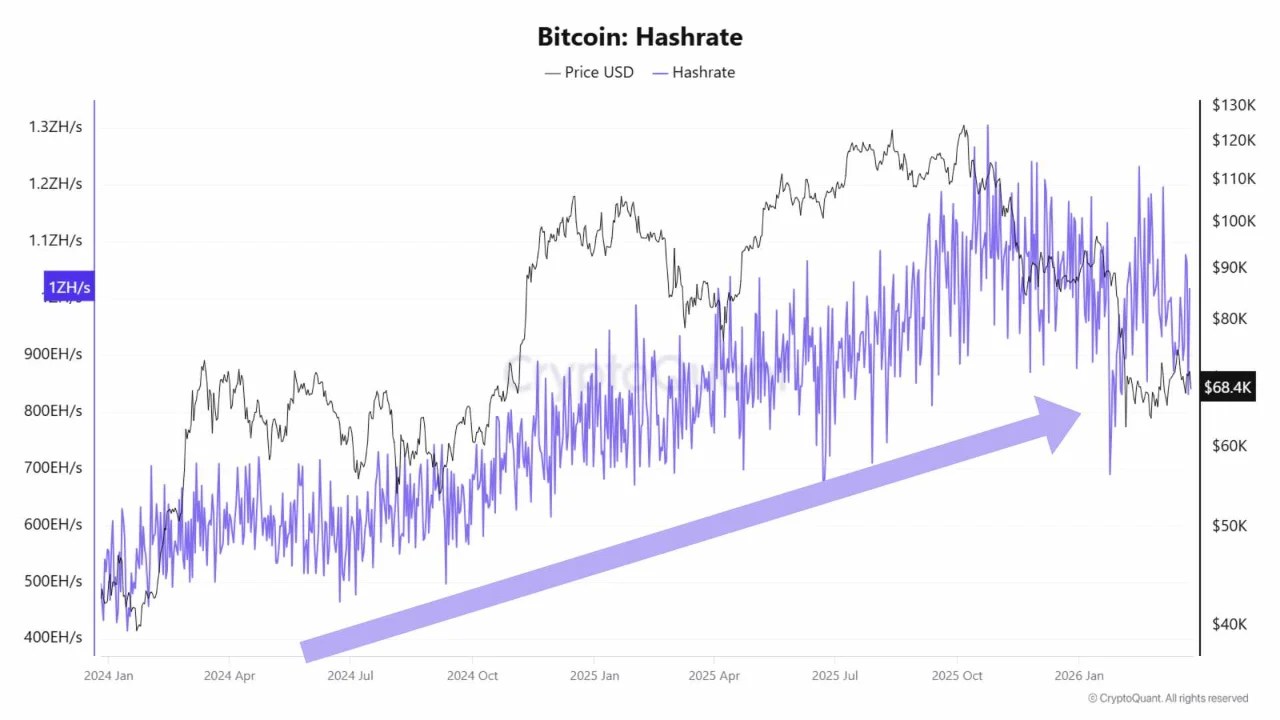
The rise in hash rate amidst diminishing profitability indicates that only the most resilient miners are sustaining operations. Companies that lack robust capital have either exited or are in the process of being forced out.
What remains is a more consolidated sector dominated by larger entities. These players have secured affordable energy sources, access to funding, or alternative revenue streams, often including cutting-edge technologies like AI and high-performance computing. Thus, many mining systems are being repurposed, and operational models are evolving.
The implications of these shifts for Bitcoin’s supply are significant and long-lasting. A more consolidated mining landscape tends to hold more Bitcoin, responds differently to price fluctuations, and may stabilize the market in the short term. In the medium term, the supply dynamics will have been fundamentally altered by the challenges currently faced by the industry.
The current situation presents undeniable challenges, but it is also paving the way for future transformations.
The Bitcoin Market Faces Resistance
Currently, Bitcoin trades at approximately $67,688, reflecting a 1.65% decline for the day. The session began at $68,820, with earlier highs reaching $69,179 before a steady decline. The frequent attempts to breach the $69,000 threshold have met resistance, leading to a lack of significant bids.
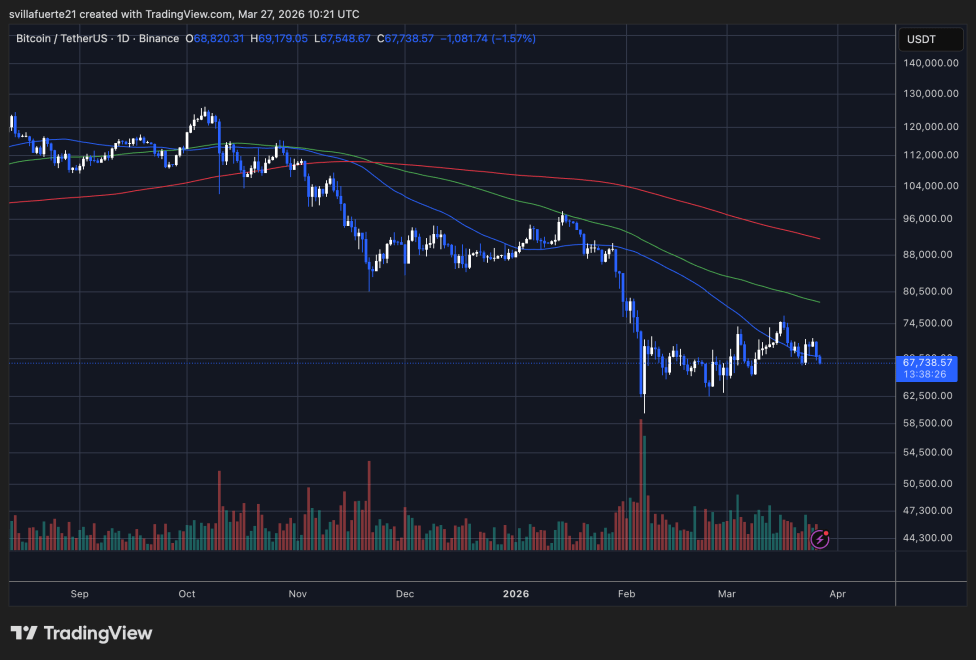
The daily moving averages suggest no immediate recovery. All three moving averages are on a downward trend, with current prices falling below them. Recent activity, including a death cross between the 50-day MA and the 100-day MA, signals challenges in overcoming the $80,000 to $88,000 range. Meanwhile, the 200-day MA looms above at $96,000 to $104,000, highlighting the prevailing structural issues.
The significant volume spike observed in February during a dip to $59,000 has established a critical support level. While Bitcoin has seen recoveries since then, they have stalled, and current momentum appears to be testing the lower boundary of this range.
Key price points to observe include $67,500 as immediate support, followed by $63,000, and finally the February low of $59,000. While on-chain signals appear promising, current price action has yet to confirm these indications.
Image credits: Featured image from ChatGPT; chart provided by TradingView.com.