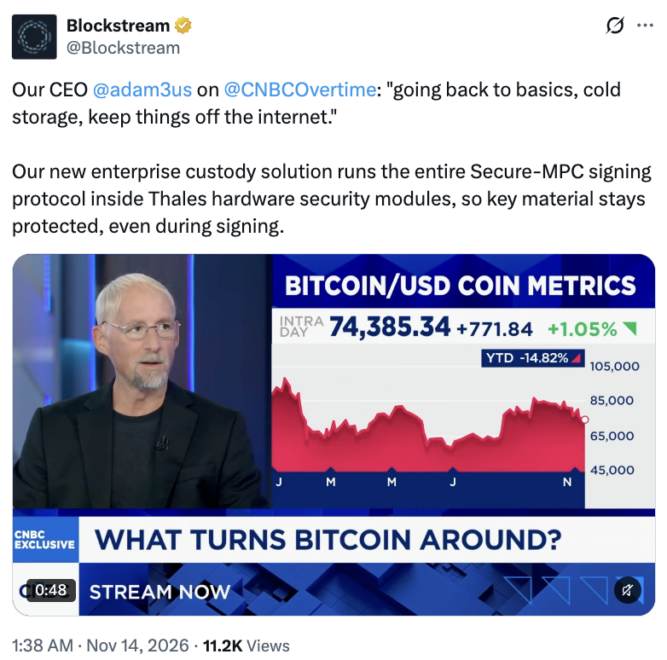
The recent surge in cyberattacks has prompted one of Bitcoin’s oldest infrastructure firms, Blockstream, to enhance its security offerings with a new enterprise custody solution. Announced on November 13, this initiative marks a collaboration with Thales, a French technology and cybersecurity company.
Blockstream is reacting to evolving threats in the cryptocurrency landscape. Their proposed solution emphasizes hardware-first security, keeping the crucial aspects of Bitcoin transactions—primarily transaction signing—secured within dedicated hardware that is insulated from external threats.
Overview of the New Custody System
The newly launched solution is integrated into Blockstream’s Enterprise platform and is the result of a two-year partnership with Thales. It combines Thales’ hardware security modules (HSMs) with Blockstream’s innovative Secure Multi-Party Computation (Secure-MPC) technology. MPC divides authority over signing transactions, so control of the private key does not rest with a single individual or machine.
Unlike traditional MPC methods that may expose parts of the transaction signing process to potentially vulnerable systems, Blockstream executes the entire signing protocol within the secure environment of the HSM. This approach significantly minimizes the risk of compromise, according to Jeff Boortz, Blockstream’s chief product officer.
The system also employs the FROST protocol, a threshold signing method that enables multiple authorized parties to create a signature collectively without ever unveiling the complete private key.
Contextual Relevance Post-Binance Hack
This announcement comes on the heels of a substantial breach where hackers stole approximately $6.3 billion from Binance, a leading cryptocurrency exchange. The FBI has linked this attack to North Korean operatives, highlighting vulnerabilities in human behavior and computer security as the primary points of failure. Attackers utilized fraudulent job interviews to deploy malware on an engineer’s work computer, leading to further compromises within the exchange’s infrastructure.
The timing of Blockstream’s launch underlines the urgent necessity for enhanced security measures. With signing keys isolated within a dedicated device, risks involving compromised computers are drastically reduced.
A Return to Robust Security in the Age of AI
Adam Back, Blockstream’s co-founder, has been an advocate for offline key storage methods for years. The company has already established a foundation in hardware wallets and HSMs for cold storage, as well as enterprise wallets tailored for custodian services.
As cybersecurity threats evolve, particularly with advancements in artificial intelligence, both Blockstream and Thales are leaning toward a strategy of minimizing access points where keys can be compromised. Recently, Blockstream faced its own security challenge when nearly 4,000 BTC were drained from its Liquid Network due to a software vulnerability, although the majority of the stolen funds were later returned.
Implications for Bitcoin Adoption
The introduction of more secure custody solutions is crucial for mainstream acceptance of Bitcoin among institutional investors. Financial institutions require robust infrastructure to safely manage Bitcoin within their operations. Michael Minkevich, Blockstream’s president, emphasized that as institutional demand grows, especially following the successful launch of spot Bitcoin ETFs in 2024, reliable custody measures will facilitate deeper integration of Bitcoin into traditional financial systems.
Despite current fluctuations in Bitcoin’s market price, trading below $70,000 amid a recent sell-off, the infrastructure designed to support the next wave of investments continues to strengthen. For ongoing news and updates, many in the crypto community remain focused on how security solutions can bolster institutional confidence in Bitcoin.
As discussions unfold, the crypto industry is left to ponder: Will the lessons learned from the binance hack drive more institutions toward adopting hardware-based custody solutions, or is self-custody with cold storage still the safest route for asset management?