In recent developments, the conversation around Bitcoin and its resilience against future quantum computing threats has gained renewed focus. Notably, the announcement from Blockstream this week regarding a new protocol mechanism has reignited discussions about the seriousness with which the crypto community is tackling post-quantum cryptography. This announcement serves as a reminder that ongoing research and debate in this field are far from dormant.
Debunking Myths about Quantum Preparedness
Matt Corallo, a prominent Bitcoin core developer, was swift to address misconceptions circulating within the community. He emphasized that claims suggesting a lack of serious work on PQC for Bitcoin are misguided. This prompted further attention on the detailed elements of Blockstream’s upcoming presentation on OP_SHRINCSVERIFY, a critical piece of technology that reflects the community’s proactive approach to quantum threats.

Blockstream has positioned this event to underscore the significance of this development. Not only is Jonas Nick’s presentation at OPNEXT 2026 expected to draw attention, but the schedule also features various sessions focusing on the intricate relationship between Bitcoin and quantum technologies. This demonstrates that the discourse surrounding quantum risks is pervasive and contributes to the overall knowledge base.
Clearly, the ongoing discussions around Bitcoin’s capability to withstand potential quantum attacks are becoming increasingly relevant, indicating that this is not an area being ignored.
Understanding the Mechanics of SHRINCS
The hybrid signature model, known as SHRINCS, was articulated by Jonas Nick in a comprehensive post that emphasized its innovative structure. It fuses a stateless method, such as SPHINCS+, with a stateful method based on unbalanced XMSS. The intended effect is twofold: optimizing efficiency while ensuring that wallet states remain safeguarded, and providing a fallback option that users can trust if the primary state is compromised.
Nick elaborated on the advantages of SHRINCS, noting that it is “highly efficient for situations requiring a limited number of signatures,” with the added feature of utilizing a static seed for backups. Furthermore, Bitcoin Optech clarified that this method balances cost-effectiveness for standard transactions with the heavier processing required during fallback scenarios.
One of the standout benefits of SHRINCS is its efficient signature size, which is much smaller compared to existing post-quantum alternatives. For example, the size formula suggests that when just a single signature is generated, the size remains competitive with other options in the market.
The preliminary work surrounding hash-based signatures indicates potential promise in post-quantum environments. The argument is that they could offer a robust and scalable solution, given their reliance on hash assumptions for security.
However, while progress is evident, it is important to recognize that Bitcoin does not currently have a definitive roadmap for dealing with post-quantum challenges. Discussions among developers and researchers continue, focusing on practical aspects such as performance benchmarks and the feasibility of integrating these methodologies into existing systems.
Corallo’s comments highlight a vital point in this ongoing discourse. We are not at a point where solutions are finalized, but it is clear that robust engineering efforts are taking place and are visible to the community. The introduction of OP_SHRINCSVERIFY signifies that conversation is evolving from mere speculation to actionable insights and real-world applications.
As developments unfold, Bitcoin’s standing within the landscape of quantum computing will hinge on ongoing research and innovation. This journey is far from over, but the foundational work being done now may shape a secure future fueled by cryptographic advancements.
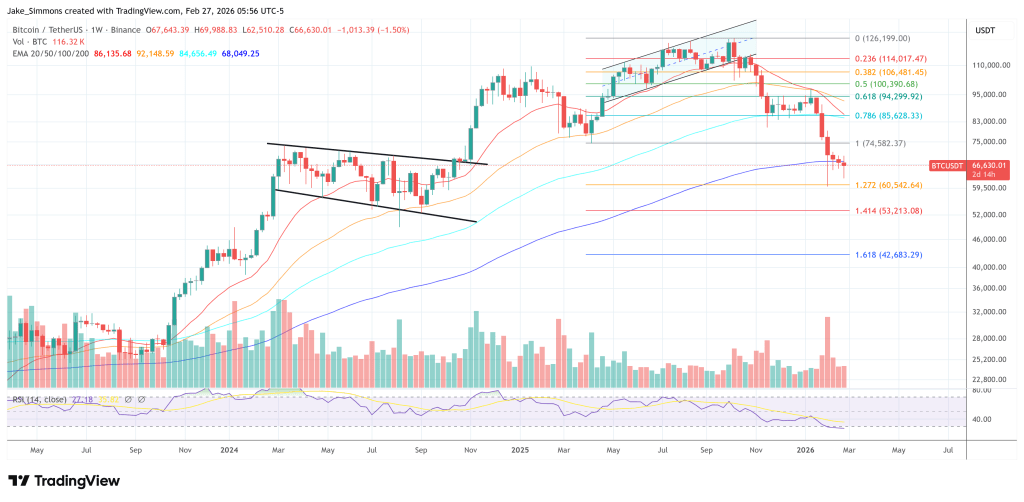
At the time of this writing, BTC is trading at $66,630, reflecting the ongoing interest and investment in the cryptocurrency.