Deutsche Bank Enters Crypto Custody Market with New Services for Institutions in Europe
A Strategic Move into Digital Assets
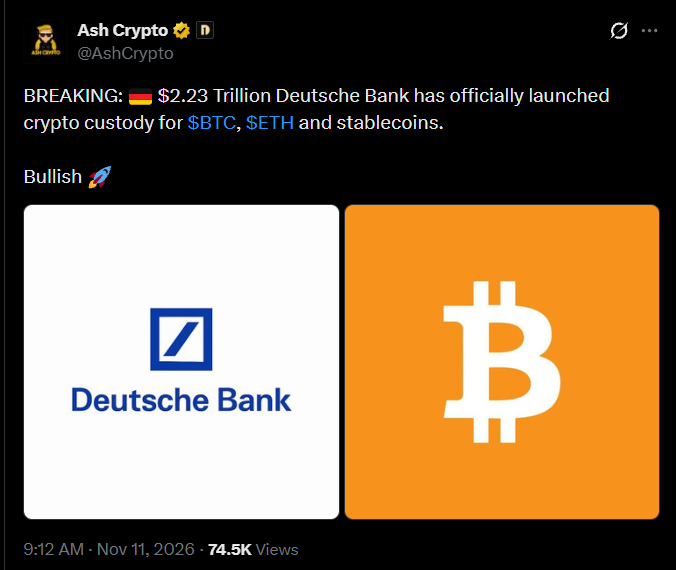
In a significant advancement into the digital finance sector, Deutsche Bank has officially launched its crypto custody service tailored for institutional and corporate clients across Europe. This newly unveiled service enables clients to securely store and transfer Bitcoin, Ether, and a selection of stablecoins, with the bank managing the wallets and private keys.
Regulatory Compliance and Service Features
The launch follows Deutsche Bank’s initial announcement from September and comes after securing regulatory approval. The bank’s registration for crypto custody and transfer services was completed under the European Union’s Markets in Crypto-Assets Regulation (MiCA) on October 12, with oversight from Germany’s BaFin.
Clients can now store Bitcoin (BTC), Ether (ETH), and a curated selection of stablecoins, including Circle’s USDC and EURC as well as AllUnity’s EURAU. This service aims to provide a regulated, bank-level custody solution tailored for institutions that prefer not to use crypto-specific platforms.
Years of Preparation Yielding Results
The launch of this service did not occur in isolation. In 2023, Deutsche Bank collaborated with swiss crypto infrastructure provider Taurus to develop the necessary custody technology, laying the groundwork for today’s offerings. The efforts included applying for a digital asset custody license in Germany.
Gerald Podobnik, co-head of Deutsche Bank’s corporate bank, has indicated plans for the service to expand to Asian markets by 2027, in line with the established timeline following this European launch.
Expanding Beyond Custody Services
In conjunction with the custody service launch, Deutsche Bank has also signed a memorandum of understanding with Deutsche Asset Management, its majority-owned asset manager. This collaboration aims to explore opportunities in tokenizing money market funds, creating crypto asset exchange-traded commodities, and developing stablecoins.
This dual initiative underscores Deutsche Bank’s strategic vision, indicating that custody services represent just the initial phase of a broader ambition within the digital asset arena. By integrating secure storage options with innovative product developments in tokenized finance, the bank aims to cater to a wide array of digital finance needs.
Implications for Institutional Investors
The introduction of regulated custody services by a major European bank addresses critical concerns for traditional financial institutions considering engagement with digital assets. Many have been wary due to uncertainties surrounding private key management and regulatory clarity. Offering these services under the MiCA framework provides a reliable pathway for organizations to hold crypto assets.
The inclusion of both USD- and euro-denominated stablecoins also signifies a rising institutional interest in on-chain cash equivalents, facilitating smoother transactions between traditional and digital financial systems.
Looking Forward: Client Adoption and Future Developments
With the European service launch now underway, the focus shifts to client adoption rates and the anticipated expansion into Asian markets by 2027. The partnership with Deutsche Asset Management may pave the way for new investment structures that blend traditional finance with emerging blockchain technology.
Deutsche Bank’s entry into the crypto custody landscape adds a prominent player to the roster of institutions offering regulated cryptocurrency services in Europe. As the MiCA regulations continue to shape the sector, more banks are likely to follow suit, though few possess the institutional strength and connections that Deutsche Bank brings.
As the bank opens its digital asset custody vault, many are left wondering how many institutions will take the step to engage with this evolving service.