The evolving landscape of institutional investment has thrown a spotlight on cryptocurrency, particularly bitcoin. As traditional investment strategies face new challenges, firms are reassessing how digital assets fit into the broader portfolio context. Recent findings from research conducted by Fidelity Digital Assets emphasize the need for institutions to rethink their asset allocation strategies.
According to the research published recently, Fidelity emphasizes that the conversation around bitcoin is no longer about whether to include it in portfolios. Instead, it raises a critical inquiry: “How much bitcoin should you hold?” This shift in focus signifies a growing recognition that a complete absence of bitcoin could no longer be justified without a detailed rationale.

Understanding the Value of Bitcoin in Modern Portfolios
Historical evidence supports the case for including bitcoin as a part of an investment portfolio. Fidelity reports that bitcoin has outperformed traditional assets in a majority of the last several years. When evaluating returns and risk-adjusted metrics, bitcoin consistently ranks high. This prompts a reconsideration of asset mixes that have previously leaned heavily on stocks and bonds.
Critics often highlight bitcoin’s volatility as a drawback; however, Fidelity contends that its risk profiles, measured via Sharpe and Sortino ratios, reveal favorable comparisons to traditional asset classes, particularly in periods of inflation where bonds have faltered.
Shifting to practical applications, Fidelity’s report delves into portfolio design. It cites bitcoin’s fixed supply and its low correlation with mainstream assets as key attributes, indicating that bitcoin can act as a hedge against traditional market dynamics.
Notably, Fidelity’s research finds a strong correlation between changes in global money supply and bitcoin’s price fluctuations, indicating a significant relationship worth analyzing. The report draws parallels between bitcoin and gold, suggesting they can coexist in a diversified portfolio strategy, each providing unique benefits.
One of the most intriguing findings is that adding bitcoin to a traditional 60/40 portfolio has historically yielded increased returns without a corresponding spike in risk, particularly for allocations between 1% to 3%. This data suggests that a modest exposure to bitcoin can enhance overall portfolio performance significantly.
Furthermore, the report elaborates on more aggressive investment scenarios. For example, in simulations assuming conservative annual returns for bitcoin, portfolios optimized for maximum Sharpe ratios indicated potential allocations of nearly 10% towards bitcoin, bringing into question the necessity of holding bonds within a diversified portfolio.
Through various analyses, Fidelity highlights a transformative challenge to the established 60/40 investment model. With interest rates fluctuating and the consistent performance of equities facing scrutiny, the report suggests that traditional portfolios may not weather upcoming economic challenges effectively.
Despite its findings, Fidelity stops short of endorsing a blanket approach to bitcoin investment, leaving the decision surrounding optimal weight open-ended. Nonetheless, the underlying message resonates clearly: even a small allocation to bitcoin may provide significant advantages in today’s economic climate.
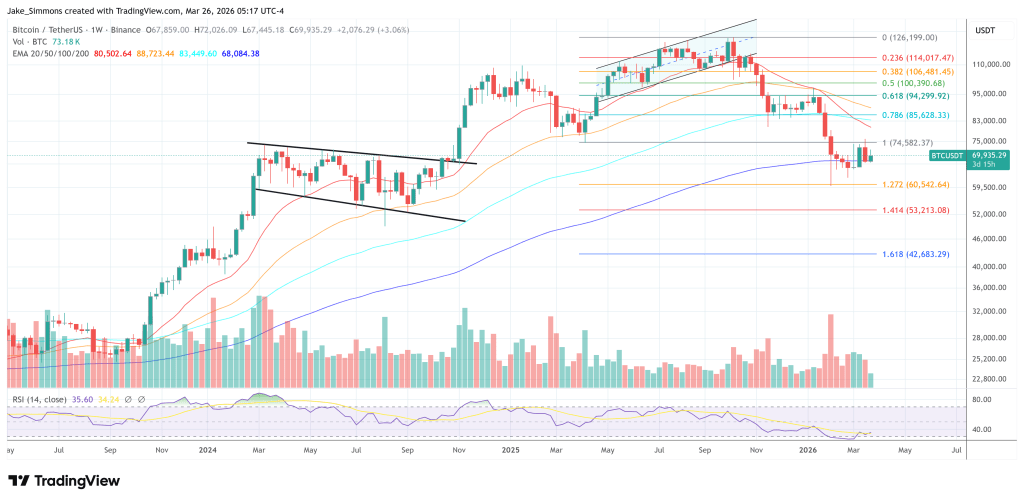
As of now, the trading price for bitcoin stands at an impressive level, reflecting its growing traction and acceptance within the financial community.