In a startling revelation, cybersecurity experts have unveiled a database comprising an alarming 16 billion login details, obtained through extensive hacks across various industries.
These compromised credentials span major platforms such as Apple, META (Facebook), Telegram, and even sensitive government databases.
The aggregated datasets varied significantly, with the smallest containing 16 million records and the largest exceeding 3.5 billion.
Notably, this data leak affects users globally, encompassing regions like Russia, Portugal, the United States, and China.
However, even more concerning than the magnitude of leaked data is its ongoing nature.
A Constant Wave of Data Breaches
According to the researchers involved in the findings, this isn’t merely a singular massive breach or a few isolated incidents.
Rather, there’s a continuous influx of breaches, aggregating into a troubling scenario:
“This isn’t just a leak – it’s a comprehensive agenda for large-scale exploitation. With over 16 billion credentials exposed, cybercriminals possess unmatched access to personal data, heightening the risks of account takeovers, identity theft, and targeted phishing attacks. This represents fresh, weaponizable intelligence at an unprecedented scale.”
—Cybersecurity Analysts, Cybernews Report
The gravity of this situation leads many to view the 16 billion credential exposure as just a fraction of the actual problem. For instance, a major data leak in China revealed 4 billion records, while the infamous Mother of All Breaches (MOAB) unveiled a staggering 26 billion credentials.
Cybernews first reported the latter in early 2024, affecting Leak-Lookup, a renowned data breach search engine.
Leak-Lookup shared on X that the incident stemmed from a configuration error in their firewall, which has since been addressed.
Adding to this unsettling narrative, a hacker group linked to pro-Israel agendas, known as Predatory Sparrow, publicly claimed responsibility for a $90 million theft from an Iranian cryptocurrency exchange.
The group’s motivation was purportedly to undermine Iran’s military capabilities in the ongoing conflict.
While no official government connection was asserted, Rafe Pilling, the director of Threat Intelligence at Sophos, remarked:
“It exhibits the characteristics of a deceptive persona employed by a state-sponsored threat organization to conduct disruptions against entities associated with Iran’s illicit revenue streams, logistical networks, and pivotal sectors. We don’t expect to discover direct technical links between Israel and Predatory Sparrow, yet their actions resonate with Israel’s regional interests.”
—Rafe Pilling, Interview with The Guardian
Yet, the majority of data breaches remain unnoticed, revealing only a fraction of the problem. The potential real-world consequences of this surging cybercrime wave are deeply troubling.
Bright Defense’s insights depict a comprehensive view of the ramifications tied to cybercrime in recent years, a list that is far too extensive to encapsulate in a single snapshot.
 This underscores the crucial importance of cybersecurity today, particularly within the cryptocurrency domain, which faces heightened data security challenges.
Non-custodial wallets, such as Best Wallet, emerge as a possible solution, placing the responsibility of data and private keys with the user rather than the exchange, which may easily fall victim to breaches.
Boosting Your Cryptocurrency Security with Best Wallet
Best Wallet enhances your cryptocurrency security as a non-custodial wallet that operates without the need for extensive user verification.
This approach fosters user anonymity, minimizes your blockchain footprint, and protects your assets against potential data breaches.
The wallet boasts a user-friendly interface that surpasses traditional hardware wallets and is entirely free to download.
 The app offers effortless features, empowering you to swap, deposit, and stake your crypto assets seamlessly.
Furthermore, it includes a Token Launchpad that provides early access to token presales, allowing you to invest in burgeoning projects before they hit the market.
Among these is Best Wallet’s native $BEST token, which has already accumulated $13.45 million with a token price of $0.025205.
Participants in the staking program benefit from a dynamic APY of 103%, featuring four distinct phases with a series of long-term objectives.
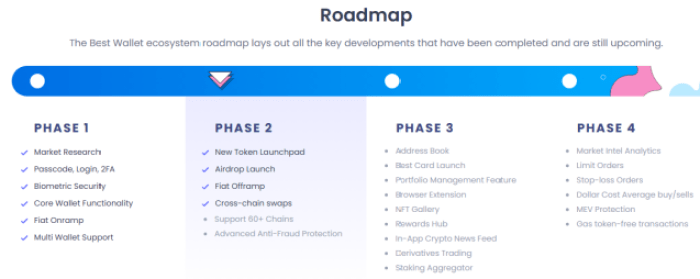 Holding $BEST entails various advantages, such as enhanced staking rewards, governance rights within the community, lower transaction fees, and early access to upcoming projects.
Based on the token’s utility and expected widespread adoption following its launch, analysts project that $BEST could reach a value of $0.072 by the close of 2025, representing a return on investment of 185%.
In a five-year outlook, we anticipate $BEST soaring to $0.82, indicating a dramatic ROI of 3,153% for those who invest at the current rate. This positions $BEST as one of the most promising altcoins to acquire this year.
To maximize your experience with Best Wallet, consider purchasing $BEST today through its Upcoming Tokens section or via the official presale website.
The Impact of Data Leaks on the Cryptocurrency Industry
It’s improbable that data leaks will hinder or adversely affect the cryptocurrency sector, given its relentless expansion and ongoing advancements in cybersecurity practices.
By utilizing solutions like Best Wallet, you can enhance your security and anonymity on the blockchain, thereby minimizing your risk exposure to data leaks.
This content should not be interpreted as financial advice. Always perform your own research (DYOR) and make informed investment decisions.