MEGA, the organization behind the Ethereum Layer 2 network MegaETH, has announced a 20% workforce reduction as it shifts focus from blockchain infrastructure to artificial intelligence (AI) products.
On November 13, co-founder Shuyao Kong revealed the restructuring move, which affected employees across the blockchain, wallet, and ecosystem teams. While the exact number of layoffs was not disclosed, the company affirmed that its founders, early contributors, and core engineering team remain committed to the MegaETH project.
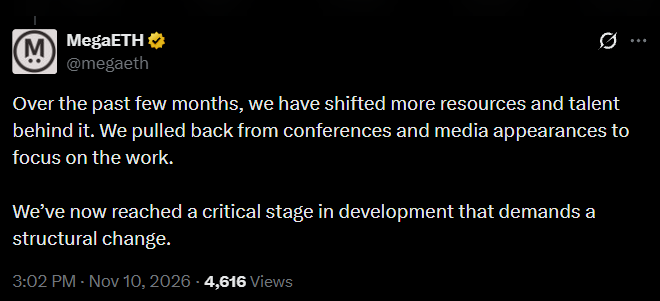
This decision follows the recent rebranding of the MegaETH Foundation to MEGA and a commitment of $30 million from its treasury to support product development on the network, with the launch of an AI marketplace scheduled for December.
MegaETH Shifts Focus to AI
Kong stated the organization had been evaluating its strategic direction for several months before opting for the workforce reduction. The restructured team includes individuals who have contributed to MegaETH since its inception. According to Kong, the decision to extend beyond blockchain infrastructure aims to capitalize on opportunities in the burgeoning AI sector.
MEGA’s plan is to develop products directly on its network instead of solely providing underlying technology for other applications. This transition reflects a broader ambition to enhance its offerings.
With a focus on AI services, the organization is channeling $30 million from its existing treasury to support this initiative, although specific funding allocations across the forthcoming products have not yet been detailed.
Upcoming AI Marketplace
The first product under MEGA’s new strategy is an AI inference marketplace, designed to provide customers access to services from various competing AI model providers.
This AI inference process enables trained models to generate predictions and responses based on user input. The proposed marketplace aims to simplify the comparison and accessibility of these AI services for users.
The project’s white paper outlines potential features such as methods for users to verify actual models utilized by providers and the ability to reserve computing power at predefined prices. These capabilities are meant to enhance transparency and reliability, issues often associated with AI services.
Challenges in the DeFi Space
MEGA’s strategic pivot comes at a time when activity within the MegaETH decentralized finance (DeFi) ecosystem has decreased significantly. Data from DeFiLlama indicates that the total value locked (TVL) in the network has plummeted to roughly $8.8 million from a high exceeding $245 million, highlighting the challenges in maintaining liquidity and attracting engagement.
After originally being developed to enhance Ethereum’s functionality for applications like trading platforms and games, MegaETH is now exploring new use cases in the AI domain. The organization’s pivot aims to rejuvenate demand for the network while extending its utility beyond just DeFi.
Evaluating MEGA’s New Direction
The reduction in workforce and focus on AI mark a significant change for MEGA as it seeks to merge decentralized technology with artificial intelligence innovation.
The success of this new approach hinges on the ability of the upcoming marketplace to attract customers, AI providers, and ample computational resources. Additionally, the verification features must prove their practicality and differentiate MEGA from existing competitors.
While MEGA intends for its new AI products to operate on the MegaETH platform, it continues to work towards decentralization changes, expected by the end of March 2027. The launch of the AI marketplace will be crucial in establishing a new source of network activity amidst the backdrop of declining DeFi participation.
As the industry evolves, questions remain: Will decentralized AI marketplaces emerge as a key application for Ethereum scaling networks, or will established AI providers retain their upper hand?