How to Earn PAPER on Papertrade: A Step-by-Step Guide
The Papertrade platform offers a unique way for users to earn PAPER tokens through trading. This guide outlines the essential steps to participate effectively.
Step 1: Access the Official Papertrade Exchange
Begin by navigating to the official Papertrade exchange website. Ensure you are using the correct URLs: papertrade.xyz, exchange.papertrade.xyz, and docs.papertrade.xyz. Double-check the address bar to avoid phishing sites.
Step 2: Connect Your Wallet
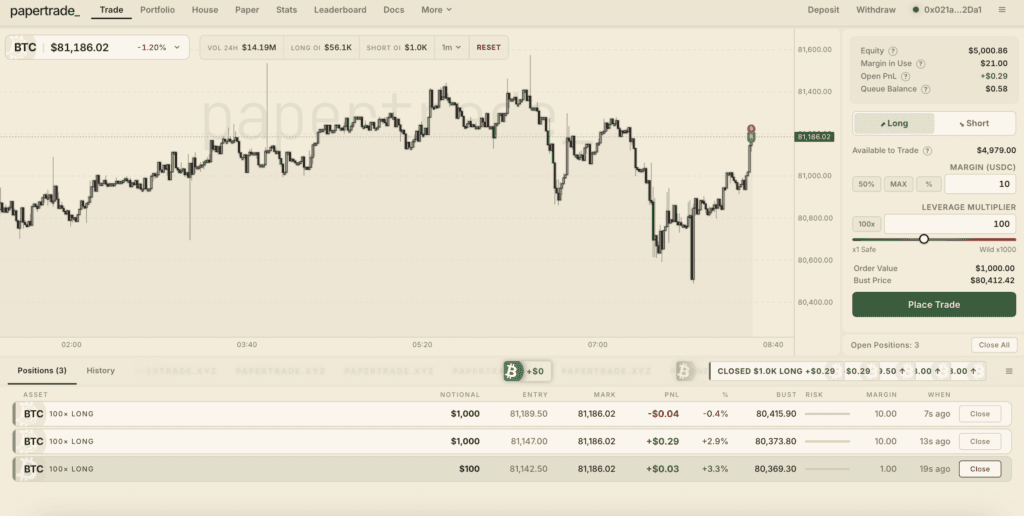
Connect an EVM-compatible wallet to the platform. You will need to sign a session key once, allowing it to execute trades on your behalf for 30 days without further confirmations or gas fees for each transaction. Note that this key will limit the ability to withdraw funds but can be used for opening and closing positions.
Step 3: Make a Minimum Deposit
To start trading, deposit at least 10 USDC. Choose the appropriate blockchain, such as Hyperliquid, HyperEVM, Ethereum, Arbitrum, or Solana. Upon your first deposit, there will also be a one-time activation fee of 1 USDC. If you lack USDC, consider purchasing it on exchanges like Bybit and withdrawing to Arbitrum or Solana.
Step 4: Open a Trading Position
Select either a long or short position on BTC or ETH, adjust your leverage (up to 1000x), and then execute your trade. Ensure you understand the mid-price at which you are entering the market and check the bust price—once a position is opened, it cannot be topped up.
Step 5: Manage Your Trades for PAPER Minting
PAPER tokens are minted based on realized losses. If you close a position at a loss, PAPER is minted from that loss, while liquidation will mint PAPERS based on the full margin. Be aware that profitable trades will not earn PAPER and will incur a fee on the remaining amount after a small price move.
Step 6: Stake Your PAPER
With your PAPER tokens earned, head to the Paper tab and stake your tokens using your wallet signature. Note that only staked PAPER will earn rewards, and staking or unstaking can be done instantly with no cooldown period.
Step 7: Claim Rewards and Withdraw
Claim your earned USDC from the Paper tab at any time. The funds will be credited to your trading balance, from which you can withdraw (with a minimum withdrawal of 10 USDC) to various platforms like Hyperliquid, HyperEVM, Ethereum, Arbitrum, or Solana.
Maximize Your PAPER Earnings: Useful Tips
Understand the mint rate: Before executing trades, familiarize yourself with the mint rate. It is important to note that this rate decreases as the trading pool’s high-water mark rises.
Understanding Papertrade: A New Player in Perpetual Futures Trading
Launched on October 10, 2026, Papertrade is a newly established perpetual futures exchange operating on HyperEVM, the smart contract layer of Hyperliquid. This innovative platform allows traders to engage in Bitcoin (BTC) and Ethereum (ETH) trades with leverage options reaching up to 1000x.
How Papertrade Works
Unlike traditional exchanges, Papertrade does not utilize an order book system. Instead, each transaction functions as a synthetic swap against a pool of USDC, leveraging the on-chain midpoint of Hyperliquid’s best bid and offer to determine pricing. Notably, the pool’s initial balance started at $0, with no deposits allowed. The pool only grows through the losses incurred by traders.
This structure means that payouts for winning trades come directly from the pool’s balance. In situations where the balance is insufficient to cover winnings, the unpaid portion is placed in a first-in, first-out (FIFO) queue, with subsequent trader losses being used to refill the pool.
PAPER Token Dynamics
Traders receive PAPER tokens, which are minted based on their trading activities. On October 17, 2026, the value of PAPER fluctuated from 1 cent at launch to approximately 8 cents. Currently, stakers have collectively earned a substantial amount of $51.2 million, showcasing the potential for passive income through staked tokens.
Risks and Considerations
While the innovative model presents exciting opportunities, it also carries specific risks. Manipulation of Hyperliquid’s mid price is cited as one of the main concerns associated with the platform. The timeframe following its launch saw reported manipulation incidents, prompting the team to impose stricter caps on open interest moving forward.
Staking and Payouts
For stakers on Papertrade, 1% of the realized profit and loss (PnL) from trades goes into a shared pool for rewards. This payout method encourages participation while also emphasizing the volatility inherent in trading. Should the pool face difficulties in covering winnings, only the unpaid profits will queue for later payment while the original capital is returned promptly to the trader.
Future Developments and Community Engagement
As of now, Papertrade does not facilitate the buying or selling of PAPER tokens outside trading, with transfers scheduled for a later phase of the platform’s rollout. The team has expressed intentions to potentially include a revenue-sharing model through builder codes for third-party interfaces, contingent on future developments.
Conclusion
With its unique approach to perpetual trading, Papertrade offers not only innovative opportunities for traders but also risks that must be navigated with caution. Given the substantial rewards for stakers and potential for high leverage, participants are encouraged to remain vigilant and informed as the platform evolves. As always, exercising due diligence and understanding the intricacies of this model is essential as one engages in trading activities on this new frontier.