In a significant overhaul of its strategy, Qubic has officially transitioned to a Dogecoin-centric mining operation, marking its advancement into what it designates as “Phase 3.” This development signifies a complete withdrawal from mining Monero (XMR) in favor of focusing entirely on Dogecoin (DOGE) and enhancing its internal AI capabilities with Aigarth.
Qubic Completes Transition to Solely Dogecoin Mining
This transition, unveiled through various channels, indicates a comprehensive shift in operational mechanics rather than simply an incremental update. The team emphasized, “Phase 3 is officially active. The transition to Dogecoin mining is complete. The architectural framework is now fully implemented, eliminating XMR from our processes.” This new setup dedicates ASIC miners specifically for DOGE, while allocating CPUs and GPUs exclusively for AI training initiatives.

Phase 3 has commenced.
Qubic has finalized the transition to DOGE mining. XMR is no longer part of our system:
ASICs → dedicated to DOGE at 100%
CPUs/GPUs → exclusively training Aigarth at full capacity.
There will be no more switching. Both operations are running concurrently… pic.twitter.com/XaRJXb3AwY
— Qubic (@_Qubic_) April 23, 2026
Previously, Qubic’s operational architecture required dividing resources between mining and AI functions. This limitation has been eliminated with the new transition. “No more switching required. Both mining and AI training are now running at full strength, marking a significant milestone in our resource utilization,” the team noted, positioning this upgrade as a major advancement.
At the core of this model lies an innovative circular economic framework. Qubic stated, “DOGE mined → sold → QU repurchased → distributed back to miners. Our economic flywheel is now in motion.” This structure effectively channels the proceeds from mining into a consistent demand for QU, which is Qubic’s native currency, while ensuring continuous DOGE production.
Alongside the launch of this upgraded architecture, Qubic shared initial performance metrics from the first day of Phase 3. The analysis utilized the DG1+ ASIC at a rate of 13 GH/s, comparing profitability with traditional mining pools.
“By mining DOGE through Qubic, users earned 10,314,425 Qu’s, equating to $7.94 daily. In comparison, traditional mining pools yielded only 62.31 DOGE, worth $6.02 daily. That’s a profit advantage of $1.92 each day, representing a 32% gain. This is achieved with identical hardware and effort, leading to vastly different financial outcomes.”
The initial performance data for Doge Mining, Phase 3, is in.
Real-world sample. The DG1+ ASIC operating at 13 GH/s.
Mining DOGE via Qubic
→ 10,314,425 Qu’s → $7.94/dayMining DOGE on traditional pools
→ 62.31 DOGE → $6.02/dayThis equals a daily profit difference of $1.92, approximately a 32% increase.
Same hardware. Same effort… pic.twitter.com/1MWOaDdi36
— Qubic (@_Qubic_) April 23, 2026
When analyzing Dogecoin’s market position, it’s evident that while Qubic has carved out a tangible, albeit modest, role in the mining sector—commanding an estimated 0.086% of the network’s hashrate (2.1 TH/s compared to the total of 2.44 PH/s)—it remains insufficient to influence overall network security or block production. However, this positions Qubic as a serious player, having established live Scrypt hash ability on the network and a model ready for scalability.
The upcoming phase is crucial, shifting focus from mere launch announcements to the path ahead. If Qubic’s DOGE hashrate continues to grow, the narrative will transition from initial entry into Dogecoin mining to how effectively it can establish a robust presence within the mining ecosystem.
Before its pivot to Dogecoin, Qubic leveraged Monero mining to validate its Useful Proof of Work model, demonstrating how computational resources could be redirected into mining and subsequently reinvested in the Qubic economy. During this period, it reportedly achieved upward of 45% of Monero’s global hashrate in a single epoch, mined 3,496 Monero blocks, and even executed a public demonstration of a 51% attack.
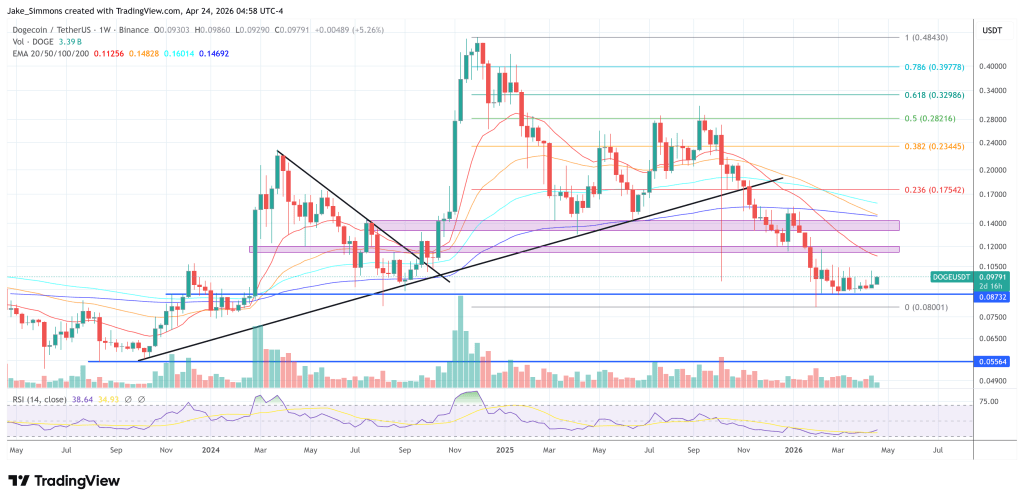
As of now, DOGE is valued at $0.09791.