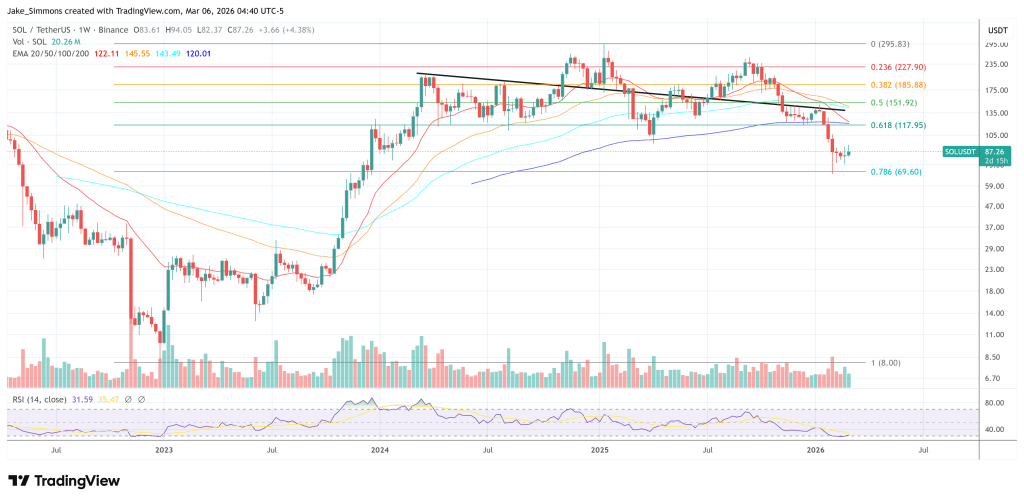
Since the introduction of Spot Solana ETFs in July, they have remarkably raised approximately $1.45 billion, even while Solana (SOL) experienced a significant 57% decline during the same period. According to Bloomberg ETF analyst Eric Balchunas, this reflects some of the most unfortunate timing observed in the ETF market. The critical aspect to consider here is not merely the flow total but also what these figures imply regarding institutional demand.
Spot Solana ETFs Surpass Bitcoin ETFs
Balchunas emphasized the importance of these inflows, arguing that their stability is as significant as their magnitude. He noted, “Solana is down 57% since the launch of spot ETFs… and yet they accumulated $1.5 billion without significant withdrawals.” He further highlighted that a substantial portion—50% of the investments—comes from 13F filers, indicating a strong institutional backing, which he views as a positive indicator for future growth.

A recent chart shared by Balchunas illustrates the trajectory of Solana ETF flows, escalating from around $410 million in late October to $1.45 billion by early March. The most substantial growth occurred between October and November, with inflows approaching $1 billion, before continuing to rise steadily into March. Despite a slight slowdown towards the end, the overall trend indicates consistent net accumulation rather than the rapid turnover characteristic of speculative investments.
An especially thought-provoking comparison made by Balchunas relates to Bitcoin. He points out that if we calibrate for market capitalization, Solana’s ETF flow is comparable to a staggering $54 billion in net new contributions—nearly double Bitcoin’s performance at that corresponding time. “Bitcoin was experiencing a rise while Solana was declining, which highlights the solid demand and interest in Solana ETFs,” he mentioned.
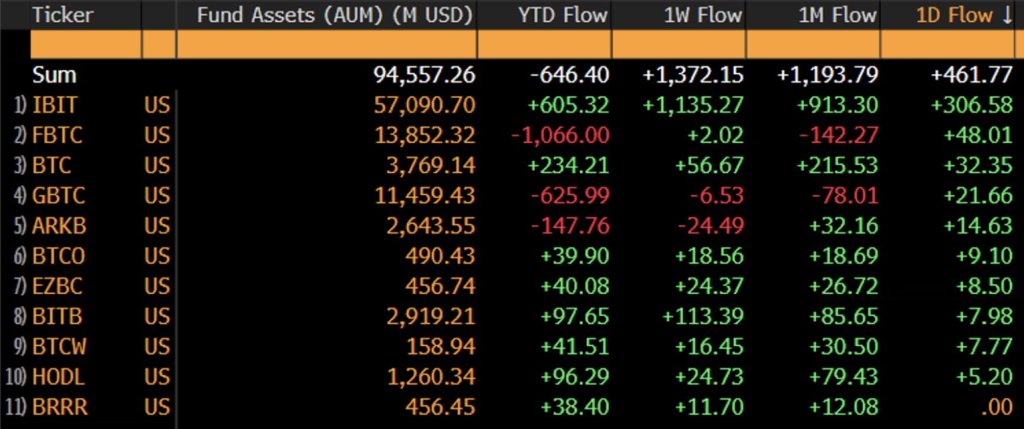
On the surface, absolute figures show Bitcoin clearly leading, with its ETF complex nearing an impressive $94.6 billion. This figure includes a dominant $57.1 billion attributed to BlackRock’s IBIT, alongside substantial allocations in Fidelity’s FBTC and Grayscale’s GBTC. Just this past Wednesday, they accumulated another $461.77 million, impacted significantly by IBIT, which alone brought in $306.58 million.
However, Balchunas cautioned against deriving decisive conclusions from short-term trends in the market. He referenced Bitcoin’s 12% increase following recent geopolitical events while gold saw a decline, provoking a rhetorical question: “Does this imply gold has failed as a safe haven?” He quickly dispelled this notion, demonstrating the complexity of market movements and pointing out that reactions may not always correlate with definitive valuations of assets.
“I do not genuinely believe this, but it illustrates the pitfalls of hasty judgments about an asset’s viability based solely on brief market shifts,” Balchunas asserted. He recognized both gold and Bitcoin as valuable assets; this framing underscores that external factors significantly influence capital flows. Investors might be reallocating funds for various reasons, as they strategize about future market directions.
This rationale could easily extend to Solana. Typically, a 57% decline might deter interest in ETFs. However, the recent data suggests that Solana products have drawn substantial, stable interest, and appear to have withstood market fluctuations remarkably well when the data is examined in relation to Bitcoin’s market capitalization.
As of today, Solana’s price stands at $87.26, showcasing the ongoing evolution of this digital asset.