The latest initiative in the evolving landscape of Solana has been introduced, known as SIMD-0326 or “Alpenglow.” This ambitious proposal aims to rewrite the fundamental consensus mechanics of Solana and has advanced into the community voting phase, comprising a three-epoch period that commenced with Epoch 840 and will wrap up at Epoch 842.
At the heart of Alpenglow is a transformative shift from the existing Proof-of-History coupled with TowerBFT to a more streamlined architecture featuring a direct-vote finality mechanism dubbed “Votor.” This proposed change promises to dramatically decrease latency, with improvements scaling from a current 12.8 seconds to a range of just 100 to 150 milliseconds. Moreover, the upgrade is designed to optimize network traffic by mitigating heavy vote-gossip through advanced off-chain messaging techniques and signature consolidation.

Validators Weigh In on the Future of Solana with Alpenglow
The governance framework for SIMD-0326 is distinctly structured. Validators can claim vote tokens proportional to their stake weights via a Merkle distributor tool. These tokens can be directed to “Yes,” “No,” or “Abstain” accounts, requiring a supermajority for approval. Specifically, the total “Yes” votes must constitute at least two-thirds of the combined “Yes” and “No” votes, with a quorum of 33%, where abstentions count towards quorum but not in the Yes/No calculation.
Initial participation metrics from the first day of the voting window (Epoch 840) indicate a cautiously optimistic response. Reports indicate a turnout rate of approximately 11.5%, with about 11.3% of the total stake expressing support for the proposal, and a negligible percentage opposed. Given that a significant portion of the stake remains unaccounted for at this early stage, this reading should be viewed as an early indication rather than a comprehensive trend. A public tally is maintained by Staking Facilities to track ongoing developments.
Beyond boosting speed, Alpenglow presents a suite of enhancements including certificate-based notarization and finalization processes, along with the aggregation of validator voting off-chain to minimize resource requirements. Noteworthy is the substitution of the traditional per-slot vote fees with a fixed “Validator Admission Ticket” (VAT), priced at 1.6 SOL per epoch, which is set to be burned. This economic measure aims to maintain cost efficiency while allowing votes to shift off-chain.
“Prior to each epoch, every validator is required to pay a set fee—initially 1.6 SOL per epoch,” the designers explain. This figure closely aligns with approximately 80% of the current on-chain voting expenses. Discussions in community forums have commenced regarding whether the steady VAT could present hurdles for smaller operators, sparking a broader conversation about the intersection of governance and economic viability.
The timing of this vote holds significant implications for both operators and tokenholders. With Solana epochs spanning roughly two days, the three-epoch voting framework translates to about six days from initiation to conclusion. Starting with Epoch 840 on August 27, 2025, the voting window is anticipated to cease around September 2, 2025, coinciding with the conclusion of Epoch 842.
Should the proposal meet the critical supermajority criteria, Alpenglow would achieve governance clearance, with activation timelines contingent upon client preparedness and adherence to Solana’s customary release protocols. For now, the spotlight remains on increasing voter turnout. Approximately 90% of the stake is yet to be captured in the preliminary snapshot, making each validator’s vote critically influential in determining if Solana will embrace a new era of sub-150 millisecond finality as its forthcoming consensus target.
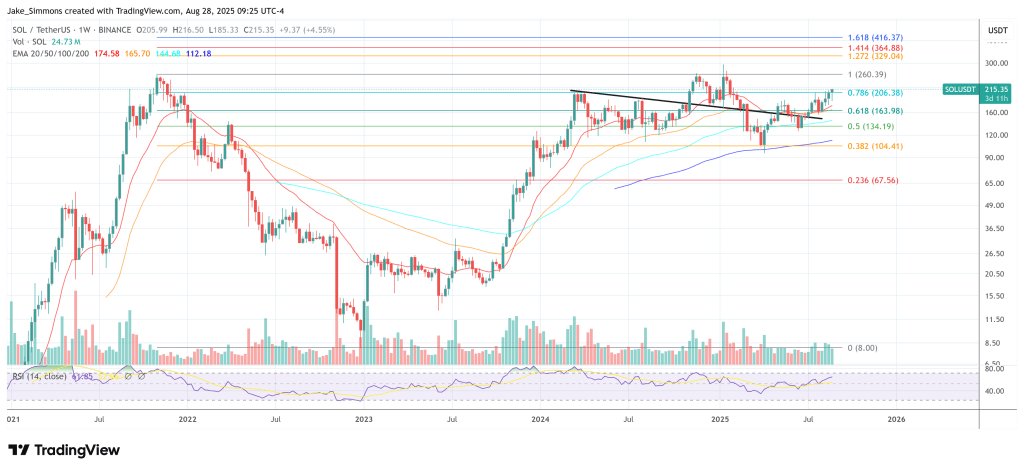
As of the latest updates, the SOL token is trading at $215.