In a thought-provoking commentary, the founder and CIO of a prominent crypto investment firm has sparked a new discussion surrounding blockchain decentralization. His thesis posits that Solana, with its innovative economic model and strategic roadmap, could ultimately surpass Ethereum in terms of decentralization metrics. This debate was ignited in an August thread where he starkly claimed, “Solana is poised to emerge as the leading decentralized blockchain,” asserting that true decentralization is economically driven, relying on fee generation rather than merely minimizing hardware requirements. “The essence of decentralization lies in transaction fees,” he emphasized, predicting that Ethereum’s inability to scale effectively may compromise its competitive edge.
The Future of Decentralization: Is Solana Leading the Charge?
The crux of the argument is built on a solid economic foundation concerning security and governance. A significant portion of the conversation revolves around how income from blockspace contributes to validator operations, ultimately allowing for a wider and more resilient network of operators. The stance is that Solana is already making significant strides down this path, while Ethereum’s focus on rollups diverts essential activity and associated fees from its primary layer. “Transaction fees will be the backbone supporting security and decentralization,” he argues, suggesting Solana’s aggressive scaling efforts ensure these funds remain within the ecosystem, rather than being exported.
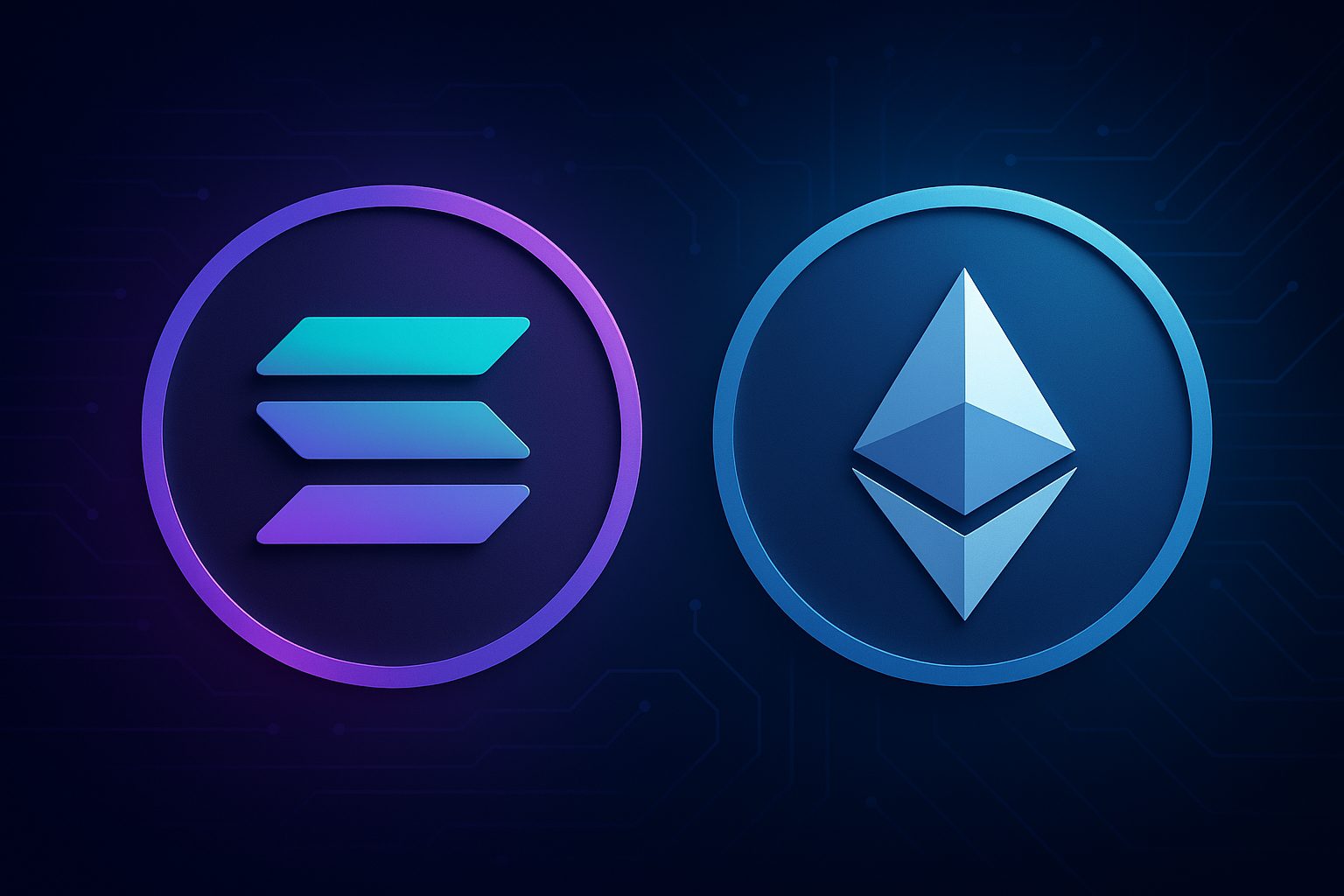
Next, the discussion turns to a comparative analysis between the two blockchain networks. A striking statistic presented was the Nakamoto Coefficient—a measure of decentralization. “Ethereum’s value stands at 2, while Solana boasts a coefficient of 19,” he noted, pointing to the implications of Ethereum’s current staking framework. He critiques Ethereum for not adopting native delegation, which, according to him, has led to centralization within its staking environment.
Governance dynamics also take center stage, with the assertion that “Ethereum exhibits centralized governance, while Solana enjoys decentralized governance!” This provocative claim is underpinned by the belief that decentralization exceeds mere hardware capabilities; it is fundamentally tied to the network’s fee-structure, stake distribution, and stakeholder influence.
A key component of his argument is what he labels the “security budget.” This budget is characterized as a function of market cap, fee income, and inflation rates, weighed against staking involvement and vulnerability to attacks. By his calculations, Ethereum’s security budget hovers around $50.5 billion, while Solana’s is approximately $25.3 billion. His essential claim is that Solana could outstrip Ethereum’s security budget with just a doubling of its price, implying more efficiency in its security mechanisms per dollar of market capitalization, making Solana a stronger contender.
This economic power, he insists, is intrinsically linked to Solana’s scaling approach. He advocates that an ideal blockchain architecture must harmonize node requirements with practical utility, arguing that achieving substantial scale generates the fee revenues needed to encourage greater participation among validators and enhance resistance to censorship. He critiques designs that overly prioritize low node requirements, suggesting such perspectives misrepresent true decentralization. In contrast, he describes Solana’s plan as a balanced approach—embracing higher node specifications to enhance utility-driven fee generation that supports decentralization and security.
Comparative Analysis: Solana vs. Ethereum
Bouncing back to his core tenet, he emphasizes, “A blockchain that cannot scale is fundamentally flawed.” This statement encapsulates both his investment viewpoint and the core cyclical reasoning underpinning his argument: increased throughput → greater usage → elevated fees → improved validator profitability → expanded stake distribution → enhanced censorship resistance. This cycle, he continues, positions Solana to eventually eclipse Ethereum in decentralization metrics if it continues to expand effectively at the layer-1 level.
His numerical comparisons extend beyond theoretical discussions, cautioning against misconceptions regarding Ethereum’s validator statistics. Some advocates conflate the 32-ETH validator keys with the number of actual machines executing block production. He suggests focusing on operator-level analytics, revealing that “Ethereum has about 8,800 validators compared to Solana’s 1,100.” This raises questions about the real levels of decentralization when these figures coexist within a broader market cap context. His conclusion is clear: relying solely on validator counts without considering operator distribution does not accurately reflect the true state of decentralization.
Concluding his discussion, he confidently states that as Solana’s fee-based governance and security frameworks mature, “it will ultimately surpass Ethereum in all facets of decentralization.” He presents this assertion as a natural outcome of distinct developmental trajectories rather than as part of a cultural conflict. By focusing on layer-1 scaling and fee retention, Solana stands poised to redefine security budgets through revenue rather than inflation—posing a challenge to non-scalable blockchains. As he put it, “Once the security budget shifts, all chains that fail to scale will falter.”
Currently, SOL is trading at $199.