Key Points:
-
The Nigerian Naira faces significant challenges, including inflation and lack of confidence.
-
Bitcoin's decentralized nature and limited supply make it a more attractive store of value.
-
Technological advancements in blockchain support Bitcoin's growth and adoption.
-
Nigeria's regulatory environment is restrictive, hindering cryptocurrency adoption.
-
Global trends indicate a growing acceptance of cryptocurrencies, contrasting with Nigeria's stance.
The rise of cryptocurrencies has transformed the financial landscape, offering alternatives to traditional fiat currencies. Among these, Bitcoin stands out as the most recognized and widely adopted cryptocurrency. In contrast, the Nigerian Naira, while a vital currency in its own right, faces numerous challenges that hinder its ability to compete with Bitcoin. This article delves into the reasons behind this disparity, examining the economic, technological, and regulatory factors at play.
The Current State of the Nigerian Naira
The Nigerian Naira (NGN) has been the official currency of Nigeria since 1973. It is issued and regulated by the Central Bank of Nigeria (CBN). Over the years, the Naira has faced significant challenges, including inflation, currency devaluation, and a lack of confidence among its users.
Inflation and Currency Devaluation
Inflation has been a persistent issue in Nigeria, with rates often exceeding 10% annually. This has led to a gradual devaluation of the Naira, making it less attractive as a store of value. For instance, in 2021, the Naira was officially pegged at around 410 NGN to 1 USD, but on the parallel market, it traded at over 500 NGN to 1 USD. Now, as of May 2025, the rate is 1,602 NGN to 1 USD (floated). Such discrepancies create uncertainty and diminish trust in the currency.
Lack of Confidence
Many Nigerians have lost faith in the Naira due to its volatility and the government’s handling of the economy. This lack of confidence has driven individuals and businesses to seek alternative forms of currency, including cryptocurrencies like Bitcoin. The perception of Bitcoin as a more stable and secure asset has contributed to its growing popularity in Nigeria.
Bitcoin: A Global Perspective
Bitcoin, created in 2009 by an anonymous entity known as Satoshi Nakamoto, has emerged as a decentralized digital currency that operates on a peer-to-peer network. Its unique features, such as limited supply, transparency, and security, have made it an attractive alternative to traditional currencies.
Decentralization and Security
One of Bitcoin’s most significant advantages is its decentralized nature. Unlike the Naira, which is controlled by a central authority, Bitcoin operates on a blockchain, a distributed ledger technology that ensures transparency and security. This decentralization reduces the risk of government interference and manipulation, making Bitcoin a more reliable store of value.
Limited Supply
Bitcoin’s supply is capped at 21 million coins, creating scarcity that can drive value appreciation over time. In contrast, the Naira can be printed at will by the CBN, leading to inflation and devaluation. This fundamental difference in supply dynamics makes Bitcoin a more appealing option for those looking to preserve wealth.
Technological Advancements and Adoption
The technological infrastructure supporting Bitcoin is far more advanced than that of the Naira. The rise of blockchain technology has enabled faster, cheaper, and more secure transactions, which are crucial in today’s digital economy.
Blockchain Technology
Blockchain technology underpins Bitcoin and allows for secure, transparent transactions without the need for intermediaries. This technology has the potential to revolutionize various sectors, including finance, supply chain, and healthcare. In Nigeria, while there are efforts to adopt blockchain for various applications, the infrastructure is still in its infancy compared to the global landscape.
Adoption Rates
Bitcoin adoption has surged globally, with millions of users and thousands of businesses accepting it as a form of payment. In Nigeria, the adoption rate is also increasing, with reports indicating that Nigeria ranks among the top countries in Bitcoin trading volume. However, the overall adoption of Bitcoin still pales in comparison to the Naira’s use in everyday transactions.
Regulatory Environment
The regulatory landscape for cryptocurrencies varies significantly between Nigeria and other countries. In many developed nations, cryptocurrencies are recognized and regulated, providing a framework for their use. In contrast, Nigeria’s regulatory stance on cryptocurrencies has been somewhat ambiguous.
Nigerian Government’s Stance on Cryptocurrencies
In February 2021, the Central Bank of Nigeria issued a directive prohibiting banks from facilitating cryptocurrency transactions. This move created uncertainty and fear among investors and users, leading to a decline in cryptocurrency trading activities. The lack of clear regulations has hindered the growth of the cryptocurrency market in Nigeria, making it difficult for Bitcoin to compete with the Naira.
Global Regulatory Trends
Globally, many countries are moving towards creating regulatory frameworks for cryptocurrencies. For instance, countries like El Salvador have adopted Bitcoin as legal tender, while others are exploring Central Bank Digital Currencies (CBDCs). These developments highlight the growing acceptance of cryptocurrencies, contrasting sharply with Nigeria’s restrictive approach.

Why the Nigerian Naira Can’t Compete with Bitcoin
In 2025, the comparison between traditional fiat currencies and decentralized digital assets is no longer a fringe conversation—it’s mainstream. In Nigeria, where inflation, capital controls, and currency devaluation have consistently plagued the Naira (₦), the rise of Bitcoin (₿) has posed an existential question: Can a centralized currency like the Naira ever rival the capabilities, utility, and resilience of Bitcoin?
The Fragility of the Nigerian Naira
The Nigerian Naira has suffered from persistent devaluation over the last decade. The Central Bank of Nigeria (CBN) has frequently resorted to foreign exchange restrictions and artificial price controls to stabilize the currency. However, these interventions have largely backfired, leading to:
-
Multiple exchange rates for the same currency
-
Loss of investor confidence
-
High inflation—over 30% as of Q1 2025
-
Increased reliance on the U.S. Dollar and alternative assets
According to a 2024 report by Chainalysis, Nigeria remains one of the highest-ranking countries for peer-to-peer crypto trading, largely due to public distrust in the Naira and the banking system.
Bitcoin: Scarcity, Transparency, and Global Utility
Bitcoin is fundamentally different. It is not backed by a central government but operates on a decentralized, borderless blockchain. With a maximum supply of 21 million coins and a mathematically enforced issuance schedule, Bitcoin presents attributes the Naira cannot replicate:
-
Scarcity: Unlike the Naira, Bitcoin cannot be arbitrarily printed.
-
Global Acceptance: BTC is accepted across the globe and has legal tender status in countries like El Salvador and the Central African Republic.
-
Transparency: Transactions are publicly auditable on the blockchain.
-
Non-Custodial Options: Users can store BTC without a bank, reducing counterparty risk.
Why the Naira Struggles to Compete
To understand why Bitcoin continues to outperform the Naira in user preference, we must examine key differentiators that go beyond just price volatility.
1. Inflation Control
The Naira has experienced severe inflation due to excessive money printing and poor fiscal policies. In contrast, Bitcoin’s issuance is algorithmically capped, making it a hedge against inflation—especially in economies like Nigeria where inflation erodes purchasing power daily.
2. Capital Controls and Transfer Limitations
The CBN enforces strict capital controls that make international remittances and foreign transactions cumbersome. Bitcoin bypasses these constraints, enabling frictionless, censorship-resistant global transfers.
3. Trust in Institutions
Public trust in the Nigerian financial system has dwindled. Frequent bank restrictions, FX shortages, and failed government projects have led to a credibility crisis. Bitcoin, while not without risks, operates transparently and independently of any central authority.
The Role of Bitcoin in Nigeria’s Economy
Bitcoin usage in Nigeria has gone beyond speculation. Entrepreneurs, freelancers, and remittance receivers increasingly rely on BTC for real-world transactions:
-
Freelancers on platforms like Upwork and Fiverr receive BTC to avoid bank delays and high fees.
-
Retailers accept Bitcoin through apps like Bitnob and Breet.
-
Youth-led startups and DeFi communities are building Bitcoin-based savings and payment tools.
In 2023, Nigerian peer-to-peer BTC trading volume surpassed $400 million, as reported by CoinDesk. This growth continues despite increasing regulatory scrutiny.
Government Pushback and Policy Inconsistencies
Despite overwhelming public interest, the Nigerian government has maintained an uneasy stance toward Bitcoin. From banning crypto transactions through banks in 2021 to launching the underperforming eNaira, the policies have often been reactionary and contradictory.
Yet these restrictions have not deterred the populace. If anything, they have driven adoption further underground and into decentralized exchanges (DEXs), self-custody wallets, and private OTC markets.
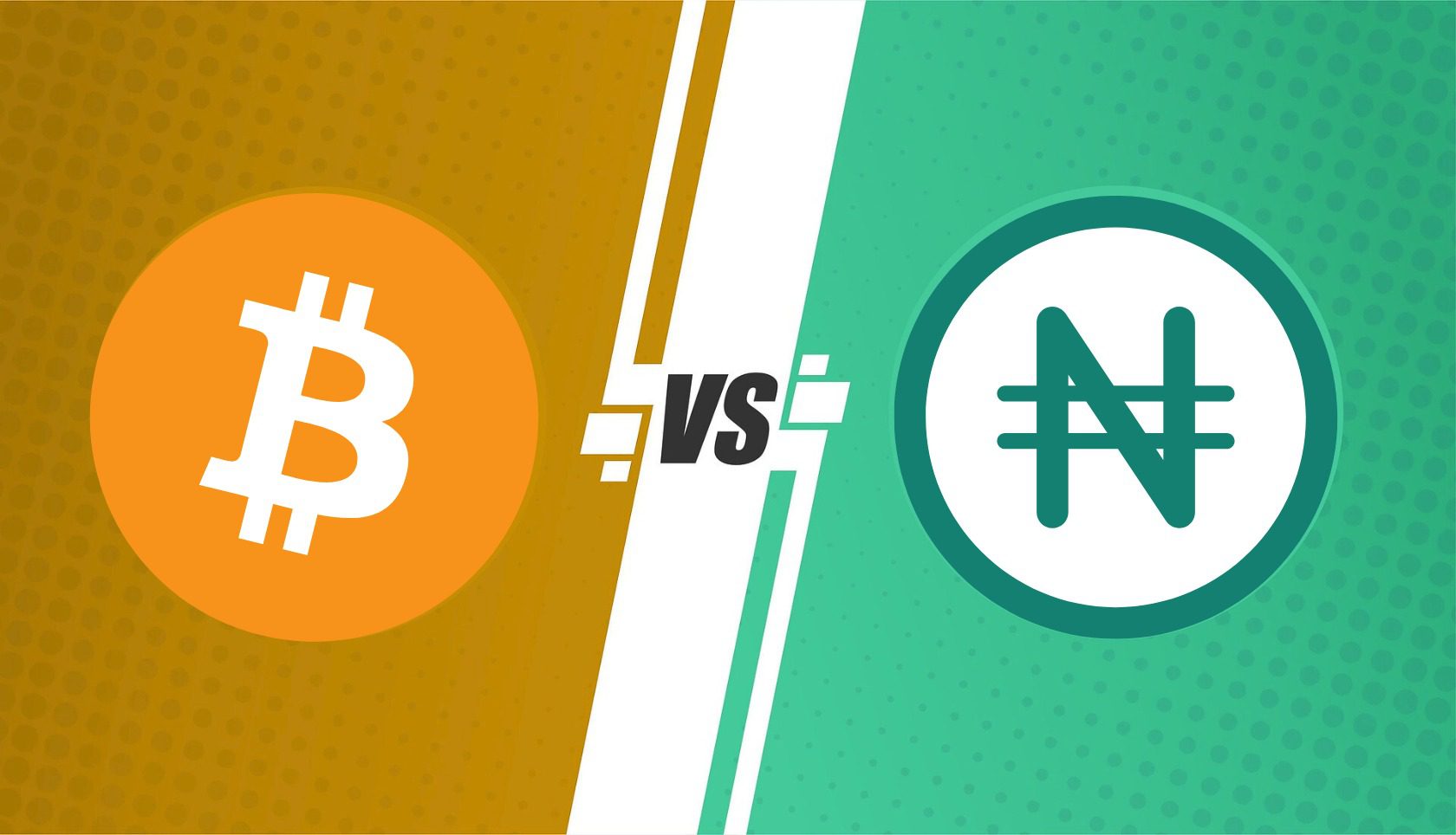
Bitcoin vs eNaira: A Losing Battle
The eNaira, Nigeria’s central bank digital currency (CBDC), has failed to gain traction. Less than 1% of Nigerians actively use it, citing lack of incentives and trust issues. Meanwhile, Bitcoin continues to thrive as a parallel financial system.
Case Study: Nigerian Freelancers and Cross-Border Payments
Nigerian freelancers often face delayed or blocked payments through traditional channels like PayPal or wire transfers. Platforms like Bitwage and direct BTC payments offer a compelling alternative.
By receiving Bitcoin, freelancers bypass banking limitations and convert funds on their terms using P2P marketplaces like Paxful or LocalBitcoins.
FAQs
What is Bitcoin?
Bitcoin is a decentralized digital currency that operates on a peer-to-peer network, allowing users to send and receive payments without the need for intermediaries.
Why is the Naira struggling against Bitcoin?
The Naira is struggling due to high inflation, currency devaluation, and a lack of confidence among users, while Bitcoin offers a decentralised and secure alternative.
How does blockchain technology benefit Bitcoin?
Blockchain technology provides a secure and transparent way to record transactions, reducing the risk of fraud and manipulation.
What are the risks associated with investing in Bitcoin?
Investing in Bitcoin carries risks such as price volatility, regulatory uncertainty, and the complexity of understanding cryptocurrency for beginners.
Can the Nigerian government regulate Bitcoin?
While the Nigerian government has issued restrictions on cryptocurrency transactions, there is potential for future regulations that could provide a clearer framework for Bitcoin use.
Conclusion
The Nigerian Naira and Bitcoin represent two distinct approaches to currency in the modern world. While the Naira serves as the official currency of Nigeria, its challenges in terms of inflation, devaluation, and lack of confidence make it less appealing compared to Bitcoin. The decentralized nature, limited supply, and technological advancements associated with Bitcoin position it as a formidable alternative to traditional fiat currencies.
As the global landscape continues to evolve, it is crucial for Nigeria to reconsider its stance on cryptocurrencies. Embracing digital currencies could provide significant economic benefits and enhance financial inclusion for millions of Nigerians. Ultimately, the competition between the Naira and Bitcoin highlights the need for innovation and adaptation in the face of changing economic realities.

Editor-in-Chief
While the Nigerian Naira remains the official legal tender, Bitcoin has proven itself as a more resilient store of value and medium of exchange in today’s digital economy. The Naira’s chronic inflation, susceptibility to government manipulation, and inefficient cross-border functionality make it increasingly inadequate for Nigerians seeking financial stability.
Bitcoin solves these core issues through its decentralized design, predictable monetary policy, and borderless transaction capabilities. However, it’s not without drawbacks – volatility remains a concern for daily spending, and regulatory uncertainty persists.
For long-term savings protection and international transactions, Bitcoin is clearly superior to the Naira. But for now, both will likely coexist, with Bitcoin serving as digital gold while the Naira handles day-to-day transactions. As infrastructure improves and adoption grows, Bitcoin’s role in Nigeria’s financial system will only expand, potentially forcing the Naira to evolve or risk becoming obsolete for digital-native Nigerians.
The choice ultimately depends on use case: those prioritizing wealth preservation and financial freedom will prefer Bitcoin, while those needing stability for daily expenses may still rely on the Naira. One thing is certain – Bitcoin has permanently changed what Nigerians expect from their money.
4.6 / 5
Pros
- Inflation-resistant: Fixed supply prevents devaluation.
- Decentralized: No single entity controls Bitcoin.
- Borderless: Enables global transactions without intermediaries.
- Transparent: All transactions are recorded on a public ledger.
Cons
- Volatility: Bitcoin prices can fluctuate rapidly.
- Regulatory uncertainty: Governments may impose restrictions.
- Adoption barriers: Not all merchants accept Bitcoin.
- Complexity in understanding and using cryptocurrency for beginners.