In a groundbreaking development within the cryptocurrency space, a unique initiative has emerged that seeks to merge two contrasting blockchain ecosystems. Recently, Input Output (IO), the organization responsible for the Cardano blockchain, announced a remarkable pipeline that allows for the execution of Cardano smart contracts directly on the Bitcoin network, without altering its fundamental consensus mechanism.
This new approach, as detailed in a series of technical posts by IO, enables smart contracts written in contemporary programming languages such as Python, TypeScript, and Scala to operate on Bitcoin. The company shared its insights on a popular social media platform, outlining the advanced compilation process required to achieve this integration.
Integrating Cardano Contracts with Bitcoin
The methodology begins with high-level programming code and progresses through a series of transformations to arrive at a format compatible with Bitcoin’s Script. Initially, the smart contract undergoes conversion into Untyped Plutus Core (UPLC), a simplified functional bytecode. This bytecode is then processed by a compact interpreter known as the Control–Environment–Continuation (CEK) machine, which plays a pivotal role in ensuring compatibility.
Rather than embedding UPLC directly into Bitcoin, IO takes a different route by compiling the CEK machine into RISC-V. This open-source instruction set architecture allows for enhanced program execution, ultimately resulting in a payload that Bitcoin can verify while maintaining the original integrity of its blockchain.
As highlighted by software engineer Riley Kilgore, the merging of UPLC, CEK architecture, and RISC-V is set to transform how smart contracts can be executed on the Bitcoin blockchain. The execution trace of the RISC-V code is deterministic, meaning it can be reliably verified without necessitating any changes to the Bitcoin codebase, thereby preserving its foundational principles.
The key innovation behind this project is BitVMX, an evolution of Robin Linus’s 2023 proposal to enable “disputable computation” on Bitcoin. BitVMX promotes a trust-minimized approach, allowing developers to pay transaction fees directly from their Bitcoin wallets and maintaining a clear, reliable framework for off-chain computation and on-chain verification.
This integration aims to leverage Bitcoin’s extensive liquidity pool while bringing Cardano’s smart contract capabilities—such as the Marlowe and Aiken frameworks—into play. The potential applications are vast, envisioning smart contract functionalities like lending and swaps, as well as NFT-backed loans secured by Bitcoin collateral, without requiring users to hand over custodial control to a sidechain.
For hardliners in the Bitcoin community, this move evokes mixed feelings. While the Taproot upgrade in 2021 introduced enhanced smart contract logic, and BitVM demonstrated advanced computational verification capabilities, IO’s latest pipeline boldly advances these concepts while keeping Bitcoin’s core unchanged—a principle that is fundamentally important to many within the community.
Though the development of this compilation pipeline is ongoing, and no official launch date has been set, IO has effectively illustrated a theoretical bridge between two prominent blockchains with differing philosophies. If the current challenges—such as transaction size and latency—can be adequately addressed, Cardano’s innovative technological stack may soon be an integral part of the Bitcoin ecosystem.
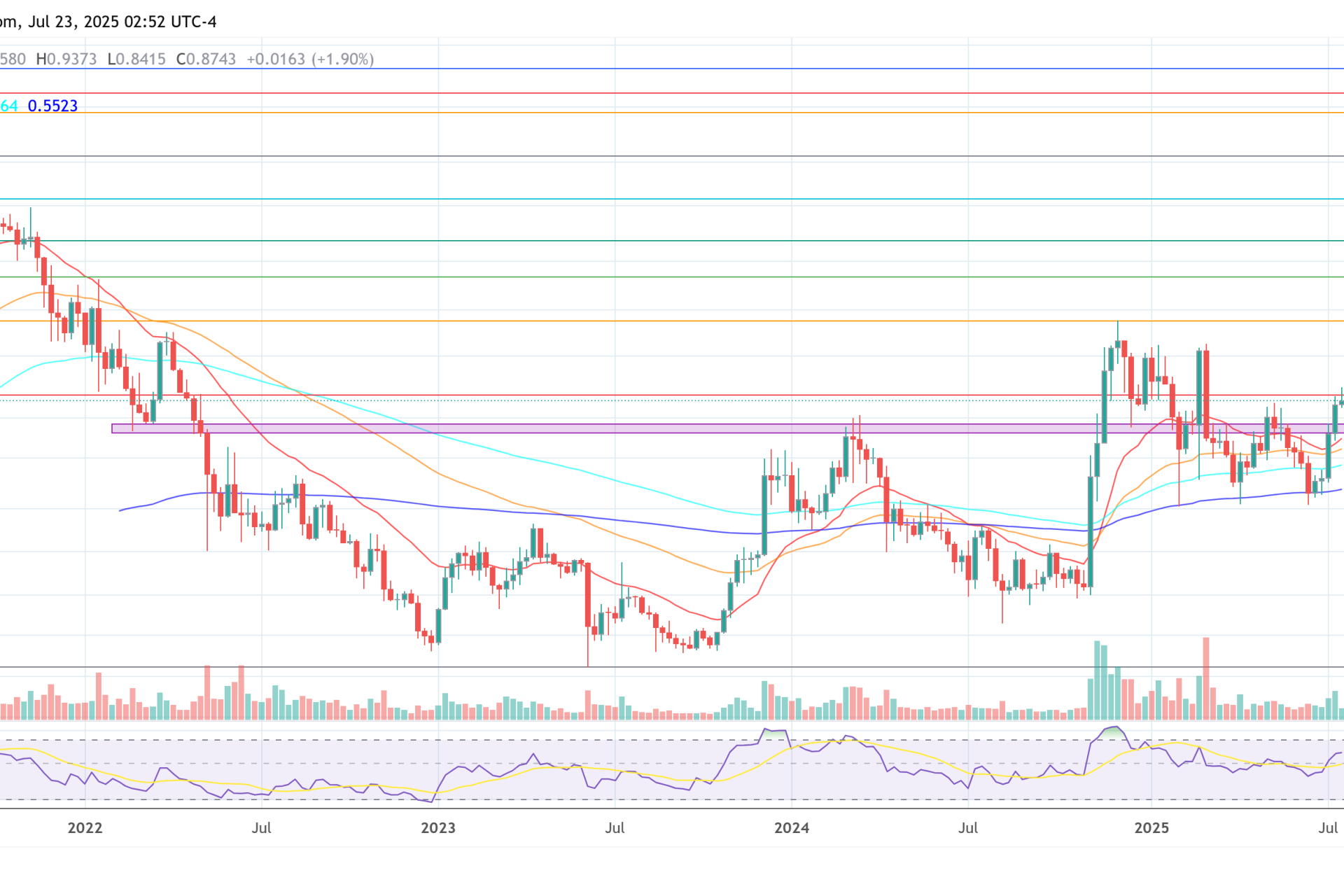
As of the latest updates, ADA is trading at $0.87.