The latest findings indicate that numerous Ethereum treasury companies are trading below their mNAV, reflecting the challenges faced in the current market downturn.
The State of Ethereum Treasury Firms
A recent discussion by crypto expert Charles Edwards on X has shed light on critical metrics related to companies holding Ethereum as part of their treasury strategy. These treasury firms are basically public entities that hold digital assets like Ethereum or Bitcoin in their reserves, impacting their financial strategies.

The concept gained traction with Michael Saylor’s pivot to Bitcoin, transitioning MicroStrategy into a BTC treasury company in 2020. Since then, the company has established itself as the leading corporate holder of digital assets, with investments totalling over $47 billion.
Initially, companies primarily focused on Bitcoin as a reserve asset, but 2023 has marked a significant uptick in the number of firms incorporating ETH into their portfolios, becoming the second most sought-after cryptocurrency.
The surge in Ethereum treasury firms reached its zenith in August; however, recent data indicates that their growth rate has slowed. Edwards presents a visual representation of this shift below.
While the chart denotes a slowing pace, the underlying trend remains positive for Ethereum treasuries, suggesting that companies continue to accumulate, albeit cautiously. This trend reflects that, despite challenges like outflows from spot exchange-traded funds (ETFs), institutional demand for Ethereum remains robust, surpassing the coin’s supply expansion, albeit marginally.
However, the effectiveness of the ETH treasury business model is coming under scrutiny for many firms, as the analysis shows a significant number are operating below their mNAV.
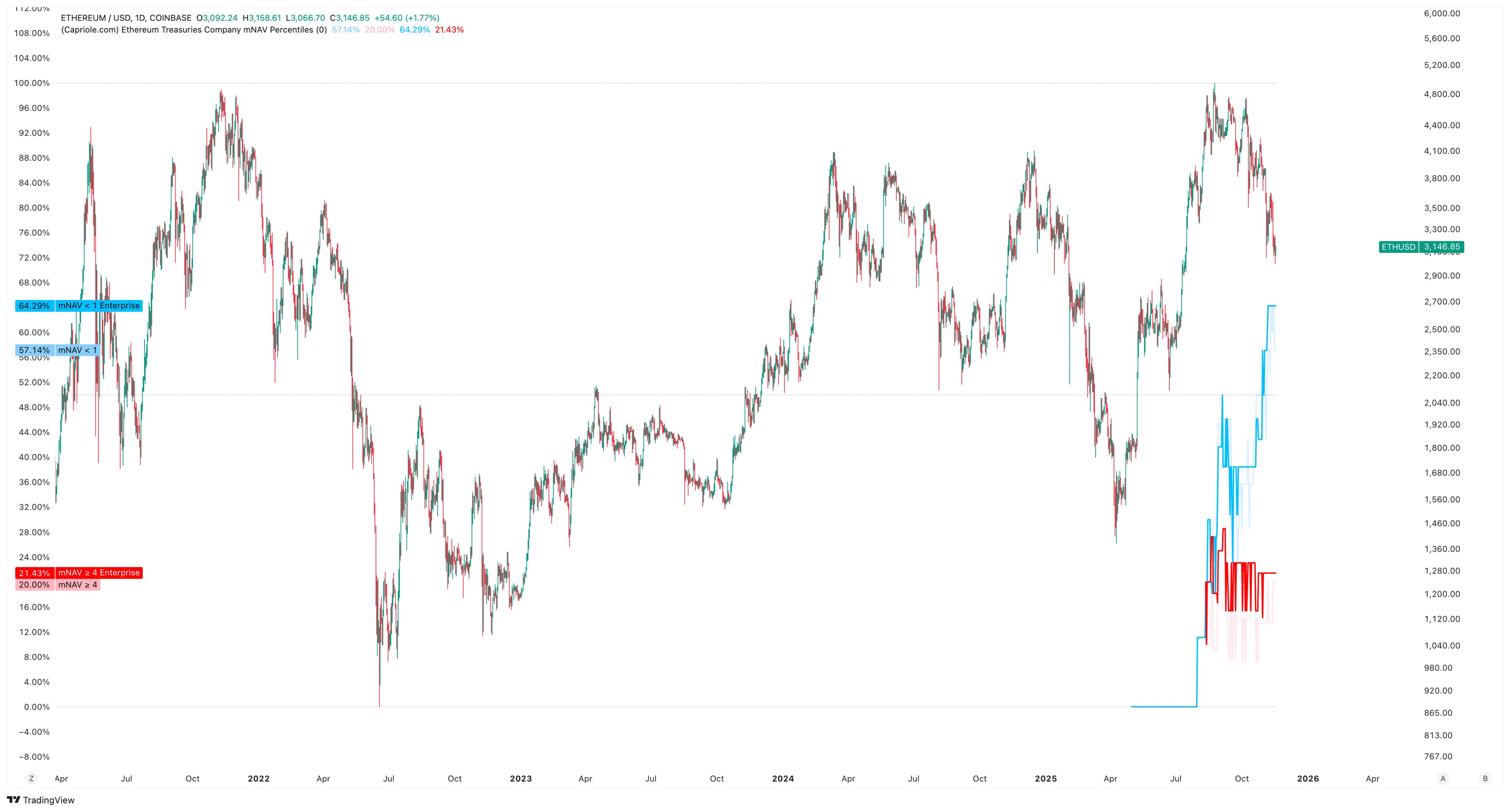
The mNAV, or Multiple of Net Asset Value, is an essential metric that analyzes a firm’s market capitalization against the total worth of its reserve assets. A reading below 1 signifies that a firm’s market value is lower than the value of its reserves.
Currently, around 64.3% of Ethereum treasury firms fall below this line, indicating a less favorable financial environment compared to Bitcoin, as noted by Edwards.
Given the increasing pressure on ETH treasuries, one might wonder if these firms are shifting their strategies by liquidating assets. The data suggests that very few are choosing to sell, with a consistent net buy/sell ratio indicating ongoing accumulation.
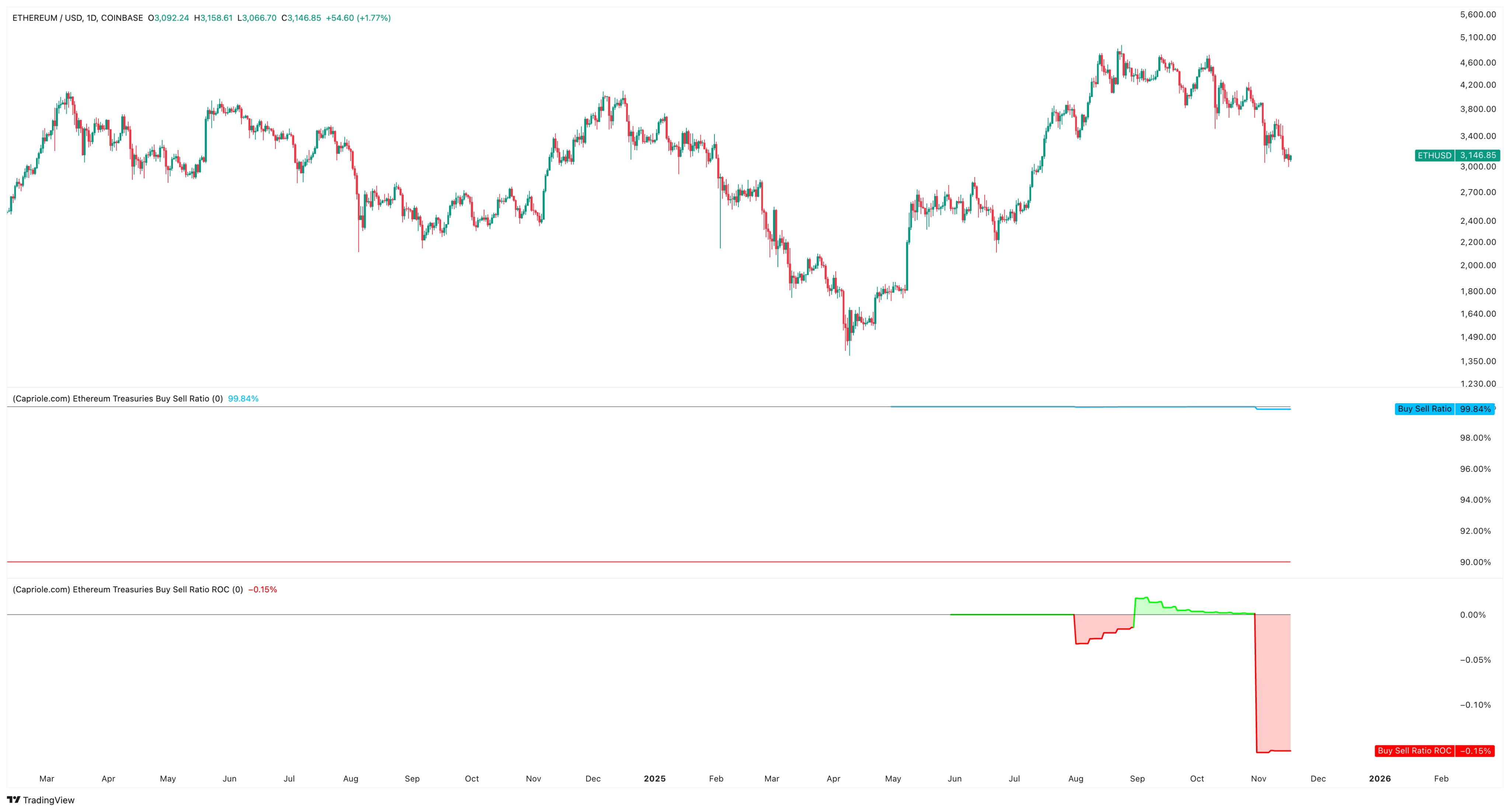
However, while nearly all Ethereum corporate holders are net buyers, there’s a notable decline in the buy/sell ratio as the price of ETH has experienced recent downturns.
Ethereum Price Trends
The price of Ethereum dipped dramatically towards $3,000 last Sunday, though it has since rebounded slightly, currently hovering around $3,200.