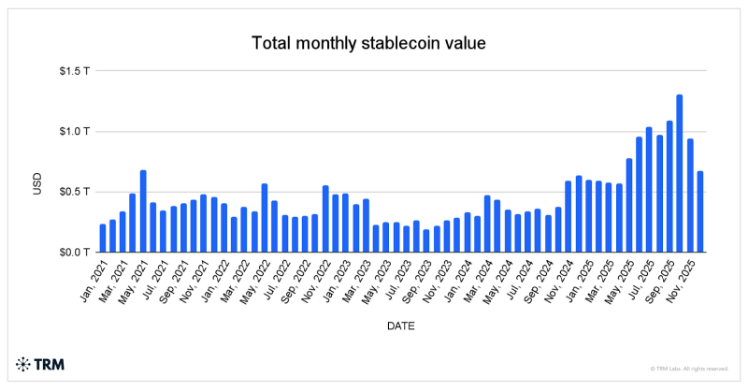
In 2026, it is projected that over $150 billion in stablecoins may be involved in questionable financial activities. This surge highlights the reliance on stablecoins for their stability and efficiency in transferring value swiftly.
The underlying reason for this increase stems from specific blockchains that utilize stablecoins, favoring their ability to provide stable value amid market volatility. While not every stablecoin is tied to illegal activity, it is evident that certain networks cater to this type of demand, enabling seamless transactions without typical banking limitations.

Key Players and Their Reach in Illicit Transfers
According to TRM Labs, illicit crypto movements associated with sanctions constituted approximately 85% of observed transactions last year. Reports indicate that around $75 billion of stablecoin transactions have been traced back to networks linked with Russian entities.
These networks are interconnected with those tied to regions like China, Iran, North Korea, and Venezuela, showcasing how stablecoins can facilitate interactions between otherwise isolated financial systems.
The crux of the issue lies in the predictable pricing of stablecoins, which ensures low volatility for users engaged in sensitive or urgent transactions.
Marketplace Operations and Human Smuggling
Some illicit online marketplaces have reported a significant rise in transactions, with stablecoins dominating the volume. Escrow services, acting as intermediaries for substantial transactions, have recorded trillions of dollars moving through their platforms.
Importantly, data suggests that these platforms predominantly operate with stablecoins, which raises concerns regarding their facilitative role in illegal trades. Analysis from Chainalysis indicates a worrying increase in transactions related to human trafficking and escort services, heavily relying on stablecoins for their operations.
In this context, liquidity and secure payments take precedence over potential profits, indicating a shift in the financial priorities of unlawful trades.
Diverse Criminal Activities Utilize Varied Routes
Fraud schemes, ransomware attacks, and various forms of theft frequently commence in cryptocurrencies like Bitcoin or Ether before they transition to stablecoins later in the laundering process. This method is preferred as criminals seek assets that retain their value while moving through fewer intermediary steps.
The Expanding Landscape of Stablecoins
Currently, the global stablecoin ecosystem has evolved into a several hundred billion dollar industry, with its market cap surpassing approximately $280 billion in early 2027.
Resources like Stablecoin.com provide metrics showing that the overall valuation of leading stablecoins consistently remains in the high hundreds of billions, predominantly propelled by fiat-backed cryptocurrencies.
In this highly competitive market, Tether’s USDT maintains a commanding lead, frequently reported with a market cap around $190 billion, accommodating over two-thirds of stablecoin activity.
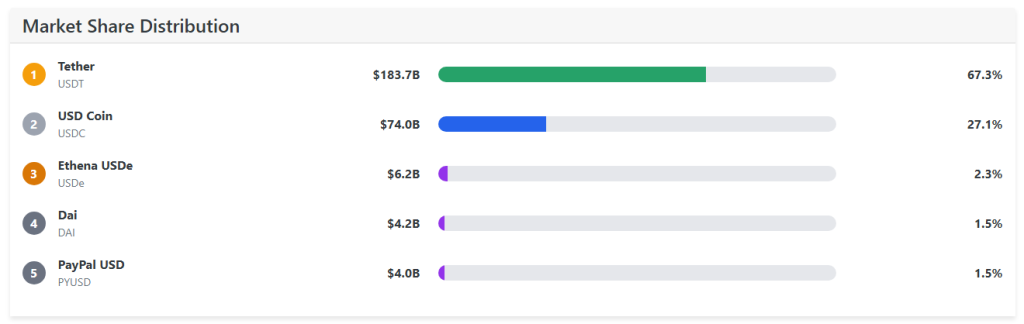
Circle’s USD Coin (USDC) follows closely, often exceeding $75 billion in market cap, collectively accounting for over 90% of the stablecoin market when combined with USDT.
While smaller stablecoins like Ethena USDe, DAI, and PayPal USD exist, their market presence is currently limited, illustrating the ongoing evolution and diversification within the stablecoin sphere, according to market analyses.
Featured image from Unsplash, chart from TradingView