Currently, the landscape for Ethereum remains challenging as market forces exert significant pressure, keeping prices below the pivotal $2,000 mark. Ongoing selling activities combined with a climate of uncertainty dampen overall sentiment in the cryptocurrency sphere. Each rebound attempt is met with skepticism, reflecting the delicate nature of price movements over recent months. These sustained stressors have heightened market volatility, complicating trading strategies, and impacting liquidity as broader economic factors influence cryptocurrency investments.
New insights from financial analyst JoeCrypto emphasize the extent of the market’s current predicament. He highlights that the downward trend isn’t just limited to casual investors but deeply affects Ethereum’s more substantial stakeholders as well. Alarmingly, a considerable percentage of large holder wallets, or “whales,” are now reporting unrealized losses. For instance, wallets holding between 1,000 and 5,000 ETH are facing a negative profit ratio estimated at around -0.15. Meanwhile, addresses with more than 100,000 ETH are seeing losses deepen, with ratios hovering near -0.10. This exodus from profit should not be overlooked as it signals a critical shift in market dynamics.

This trend is particularly concerning as Ethereum has yet to revisit its April lows, indicating that unrealized losses might be building more aggressively this time around. Such market conditions often lead to heightened sensitivity, triggering reassessments from even the most steadfast investors who may be pressured to reconsider their positions in light of continuous market fluctuations.
Capitulation Risks as Whale Activity Signals Market Shifts
JoeCrypto indicates that if the current downward trend continues, large investors might soon encounter even more profound financial stress. Prolonged declines could compound unrealized losses among whale groups, pushing some to either liquidate their holdings or reduce their market exposure dramatically. Historically, capitulation among significant players tends to create spikes in short-term market volatility, especially during times when overall liquidity is compromised.
That said, Ethereum has shown some resilience, maintaining stability above certain critical support zones. This relative strength implies that while market sentiment may be bearish, significant distribution from whale groups has not yet materialized. Understanding this distinction is crucial, as unrealized losses do not automatically lead to mass sell-offs without external pressures like poor liquidity or escalating market shocks.
Historically, periods where major holders experience distress have often marked the early stages of medium-term recovery phases. As weaker hands exit the market and leverage reduces, there is a potential transition into accumulation periods characterized by steadier prices and less volatility.
However, it’s important to remain cautious with this interpretation. Whale activities represent just one piece of the larger market puzzle, and signs of improvement depend primarily on enhanced liquidity, more robust buying demand, and favorable macroeconomic conditions before a genuine recovery is possible.
Technical Indicators Show Fragility in Ethereum’s Price Structure
Ethereum’s price continues to navigate through a challenging environment, downplaying any potential momentum as it struggles to reclaim the critical $2,000 level definitively. Following a steep rejection from all-time highs near $4,800, the price movement has entered a phase marked by lower highs and increased selling pressure—typical of corrective market behavior rather than indicative of positive accumulation.
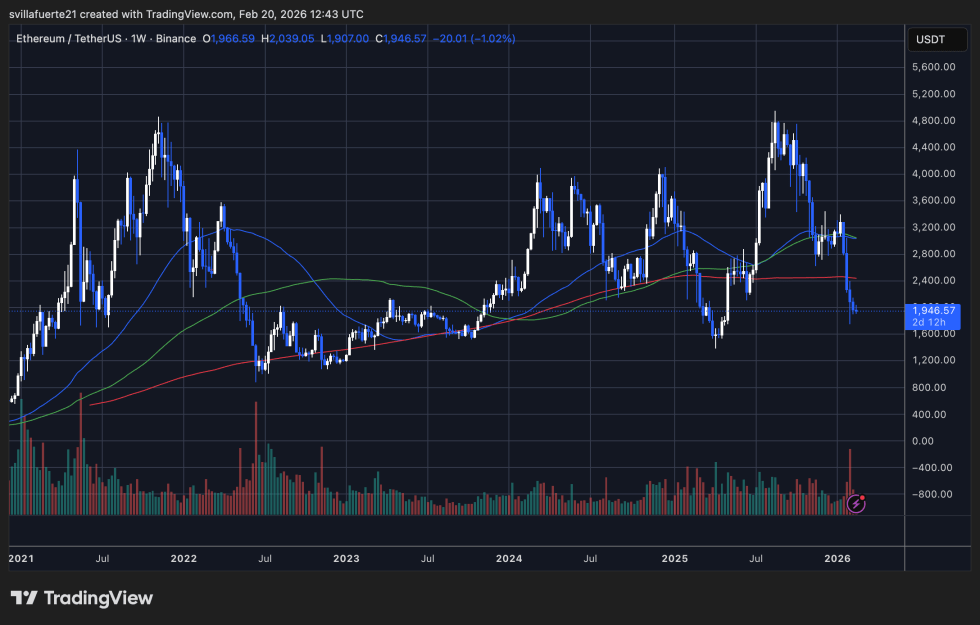
At present, Ethereum is trading below several crucial moving averages that previously served as dynamic support levels; these now act as formidable resistance points. Weak performance in the $1,900 area reflects enduring selling pressures, while consistent failures to maintain traction in the mid-$2,000 region amplify the prevailing cautious market mood.
volume trends have also waned compared to earlier energetic rally phases, suggesting decreased speculative trading activity. While a decrease in volume during downturns can frequently signify potential seller exhaustion, real stabilization needs sustained buyer interest rather than fleeting price recoveries.
From a market structure perspective, immediate support is located around the recent local lows near $1,800, whereas resistance can be found roughly between $2,200 and $2,600. Until Ethereum successfully reclaims these thresholds with significant trading volume, the technical outlook remains precarious, leaving room for further consolidation or downward movement.
Featured analysis and accompanying charts reflect the ongoing market dynamics and investor sentiment during these turbulent times.