Charles Hoskinson, the founder of Cardano, has indicated a new phase of development for the Leios upgrade, a significant enhancement to the network’s consensus mechanism. Input Output has submitted a funding proposal totaling ₳27.7 million aimed at advancing Leios from its prototype stage to a release candidate suitable for integration into the mainnet. This upgrade is positioned as a pivotal element in Cardano’s strategy for scaling by 2030.
“Leios is on its way,” Hoskinson declared on X, quoting a statement by Sebastian Nagel regarding Cardano’s capability to deliver Leios based on governance approval. This highlights that the forthcoming phase of the scaling roadmap involves both technical execution and governance decisions.
The Importance of the Leios Upgrade
The recent proposal, penned by Carlos Lopez de Lara and Nagel, seeks DReps’ approval to withdraw ₳27,714,342 from treasury funds. This will cover approximately six to nine months of development work required to transition Leios towards a release candidate that is ready for mainnet deployment. The proposal stipulates that each development milestone will be independently verified, and any unspent ADA will revert to the treasury.
Leios aims to enhance Cardano’s current consensus protocol, Ouroboros Praos, rather than replace it. The stated objective is to introduce endorser blocks and committee-based validation, designed to increase transaction capacity while maintaining the security features of Praos. Input Output describes this upgrade as a means to scale the network without jeopardizing decentralization or the economic viability of stake pool operations.
“A significant increase in throughput is essential for Cardano to realize its ambitions for 2030, and Leios is the pathway to achieving this,” the proposal explains. It mentions a potential 10–65x enhancement in transaction capacity as a critical outcome. “This increase is significant: Cardano aims to grow from approximately 800,000 monthly transactions to more than 27 million by 2030,” it details.
This ambitious 2030 goal serves as a fundamental rationale behind the funding request. The proposal contends that sustaining utilization at such levels necessitates a minimum of 6x current capacity, and Leios is expected to deliver 10x or more under validated parameters. Additionally, Input Output notes that Leios has the potential to facilitate a phased throughput increase from 2x to 30x on the mainnet, with the full capacity demonstrated during the testnet phase prior to a wider rollout.
Strategic Objectives of the Upgrade
The development plan for Leios is structured around three main objectives:
- Release Candidate Development: This includes a comprehensive rewrite of consensus components, implementing the Leios block structure for the Dijkstra era, compliance testing against the Agda formal specification, and integration into the primary node by the end of the fourth quarter of 2026.
- Building High Confidence: To achieve this, the team will undertake parameter exploration, continuous load testing, adversarial testing, red-team exercises, and an updated threat model.
- Hard-Fork Preparation: This encompasses the development of client interfaces, modernizing technical documentation, workshops for Stake Pool Operators (SPOs) and developers, as well as support for related infrastructure such as DB-Sync, Mithril, Blockfrost, testnet hard forks, governance artifacts, and contingency measures.
The proposal meticulously distinguishes tasks controlled by Input Output from those reliant on external factors. A successful mainnet hard fork will depend on ecosystem readiness, governance actions, and community votes, which are explicitly defined as risks rather than guaranteed outcomes.
Funding will be managed through the treasury reserve smart contract framework established by Intersect, utilizing milestone-based disbursements and third-party validation. The budget allocates ₳23.83 million, or 86%, for development, with the remaining funds earmarked for infrastructure, security audits, legal compliance, ecosystem support, and operational costs.
Risks associated with the project are clearly articulated, identifying factors such as community readiness, hard-fork timing, final integration of the cardano-node, and governance constraints that could impede progress. The proposal also addresses potential technical constraints, including higher operational costs for SPOs and assumptions linked to adversarial stake conditions.
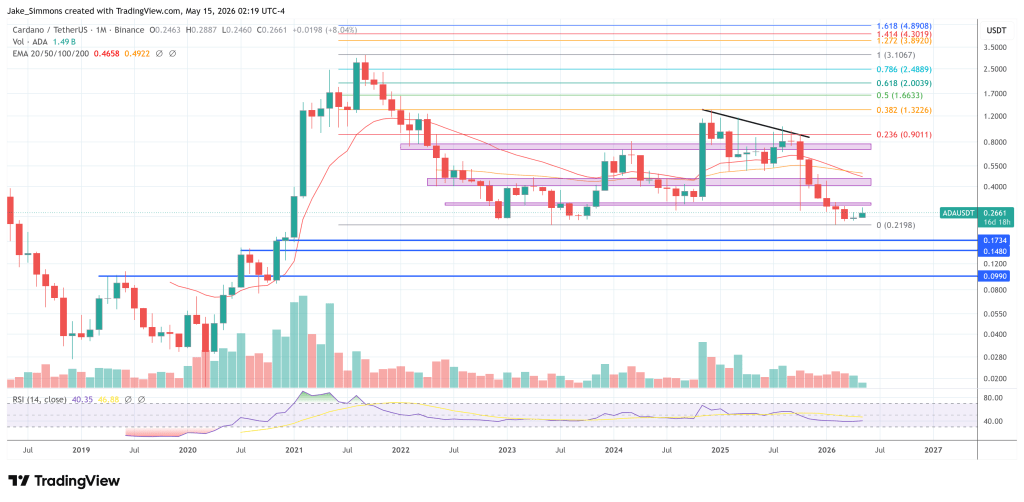
At the time of writing, ADA was trading at $0.2661.