The ongoing debate surrounding the relevance of Bitcoin’s (BTC) four-year cycle theory has stirred considerable interest among crypto analysts and enthusiasts. This theory postulates a predictable pattern in Bitcoin’s price movements and investor behavior, traditionally characterized by distinct phases: accumulation, growth, distribution, and decline. Recent discussions indicate that while some believe this cycle may be losing its significance, others assert it remains intact.
Current Perspectives on Bitcoin’s 4-Year Cycle
On May 23, a prominent crypto analyst named Mags took to social media to address the discourse questioning the validity of the four-year cycle. In his post, he highlighted the ongoing arguments from various experts, including well-known figures like michael Saylor, who contend that the cycle’s relevance might be diminishing.
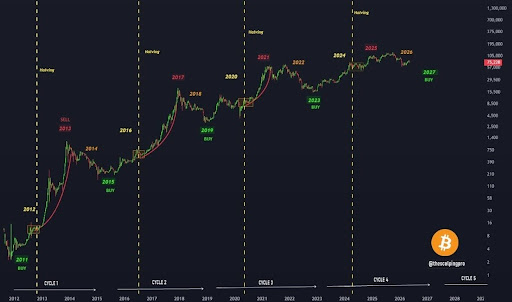
In response to Mags’ insights, members of the crypto community have engaged in comparisons between the present market conditions and those of earlier cycles. Key factors influencing this dialogue include:
- The introduction of Spot Exchange-Traded Funds (ETFs)
- An increase in institutional investment
- The broader acceptance of cryptocurrencies
Despite opinions suggesting a shift in market dynamics, Mags maintains that the four-year cycle is still evidenced by the consistent patterns observed in past cycles. His analysis, supported by historical charts, illustrates how Bitcoin’s market has historically followed a series of stages related to price and investor sentiment.
During the 2011 to 2014 cycle, for instance, Bitcoin’s pricing experienced several crucial phases:
- 2011: A notable decline, providing an optimal buying window for investors.
- 2012: A gradual increase in price, leading investors to hold onto their assets.
- 2013: Prices surged, prompting many investors to sell for profit.
- 2014: A sharp market correction, representing the bear market phase before the next cycle began.
This four-stage pattern was similarly observed in the 2015-2018 and 2019-2022 cycles. According to Mags, the same structure is unfolding in the ongoing cycle, with Bitcoin transitioning through phases such as Buy, Hold, and Sell, suggesting that a bear market phase currently characterizes 2023.
Looking Ahead: The Next Cycle from 2027 to 2030
Mags has further speculated about what the future might hold, predicting that the cycle from 2027 to 2030 could mirror previous cycles. He postulated that Bitcoin would likely repeat the familiar stages of Buy, Hold, Sell, and Bear market.
If this prediction holds true, Mags indicates that 2027 could present a significant opportunity for accumulation ahead of the next bull market. He firmly opposes the notion that the four-year cycle is no longer relevant, asserting that the historical structure continues to resonate within the current market.