The recent progress in the cryptocurrency sector signals a growing interest from financial institutions. Notably, the BNB Chain ecosystem has marked significant advances, highlighted by the introduction of the inaugural US Spot Exchange-Traded Fund (ETF) and its potential to benefit from forthcoming regulatory developments.
The Launch of BNB ETF in the US Market
On Thursday, asset management firm vaneck launched the VanEck BNB ETF on Nasdaq, identified by the ticker VBNB. This new product represents the first US exchange-traded fund providing direct exposure to BNB, the third-largest cryptocurrency by market capitalization, excluding stablecoins.
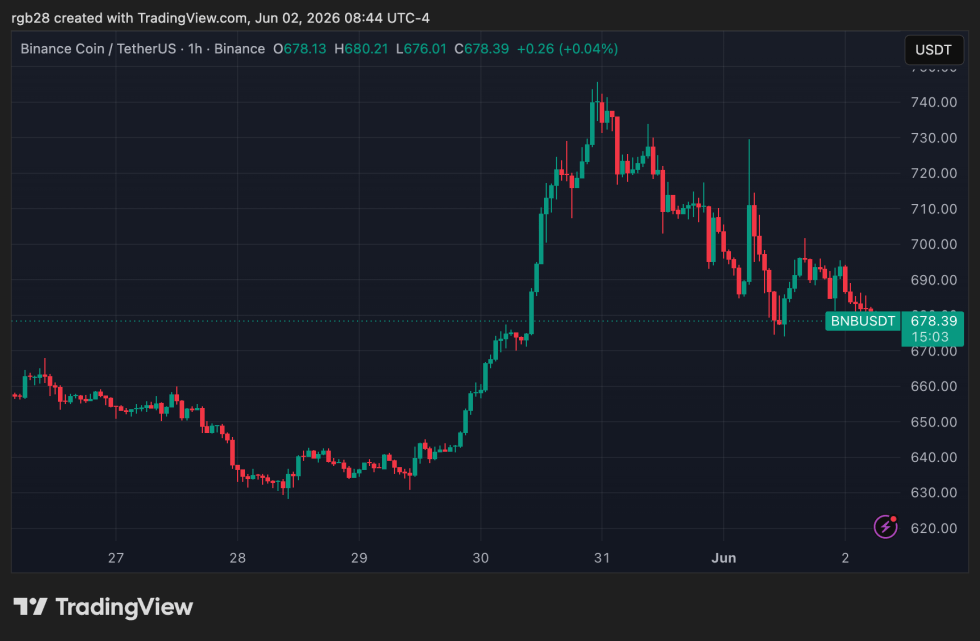
The amended Form S-1 from May outlines a management fee of 0.39%. Anchorage Digital Bank acts as the custodian, ensuring that the assets are securely stored offline.
“Up until now, BNB was one of the few prominent cryptocurrencies lacking a US spot ETP option,” remarked Kyle DaCruz, Director of Digital Assets Product at VanEck. “The introduction of VBNB now provides U.S. investors essential access to one of the most influential networks in the digital asset landscape.”
VanEck emphasizes BNB’s robust performance and sound fundamentals as the basis for this new listing, citing over 14 million daily transactions and more than 2.5 million active users on its network.
“BNB has demonstrated resilience throughout recent market fluctuations,” stated Patrick Bush, Senior Investment Analyst at VanEck. “Its active user engagement contributes significantly to this stability.”
The introduction of this ETF expands VanEck’s portfolio of exchange-traded products that grant spot crypto access, joining existing offerings such as their bitcoin etf, HODL. This launch represents a crucial milestone for the BNB Chain ecosystem, providing institutional investors a regulated entry point into the BNB network.
VanEck was the pioneer in filing for this ETF in May 2025, followed by Grayscale’s similar initiative announced in January 2026, which further indicates a competitive landscape for these investment vehicles.
BNB Chain and Future Regulatory Impacts
In another significant update, Grayscale’s Head of Research, Zach Pandl, indicated that the BNB Chain is well-positioned to attract institutional investments following the anticipated passage of the CLARITY Act.
Pandl’s report suggests that upcoming regulatory enhancements in the US may “unlock” various blockchain applications, such as tokenized assets and decentralized finance (DeFi), leading to broader industry benefits.
It is expected that institutional funds will concentrate on established and compliant chains like Ethereum, Solana, and BNB Chain as these networks emerge as leaders in crucial areas of digital finance.
With a total of $3.67 billion in distributed asset value, BNB Chain has positioned itself as a strong competitor in the tokenized assets market, following Ethereum’s lead. Notably, although there was a slight 4.24% decrease in distributed asset value recently, the network has experienced a 121.62% increase in real-world asset (RWA) transfer volumes during the same timeframe.
Furthermore, the number of RWA holders surged by 68.47%, reaching 77,155 by June 1. Recent reports have highlighted BNB Chain’s rapid growth in RWA holders, marking a 567% increase since January 2026.
In addition, BNB Chain is a notable player in the stablecoin sphere, evidenced by its substantial transaction volumes. Data reveals that in March, the chain accounted for approximately 40% of global small-value stablecoin transactions, despite holding only 5% of the total supply. Currently, the network’s stablecoin transfer volume stands at $231.9 billion, with a total of 68.53 million stablecoin holders—over 9% and 8% growth in the past month, respectively.
Grayscale has also identified BNB Chain as a leading ecosystem within the DeFi space, based on criteria such as total value locked (TVL) and user engagement with applications.
In summary, the BNB Chain has solidified its reputation as a significant player at the intersection of traditional finance and decentralized networks. Financial institutions are utilizing this ecosystem for permissioned financial products, while investors benefit from easy access to high-value offerings, such as Circle’s US Yield Coin (USYC) and Franklin Templeton’s technology initiatives.