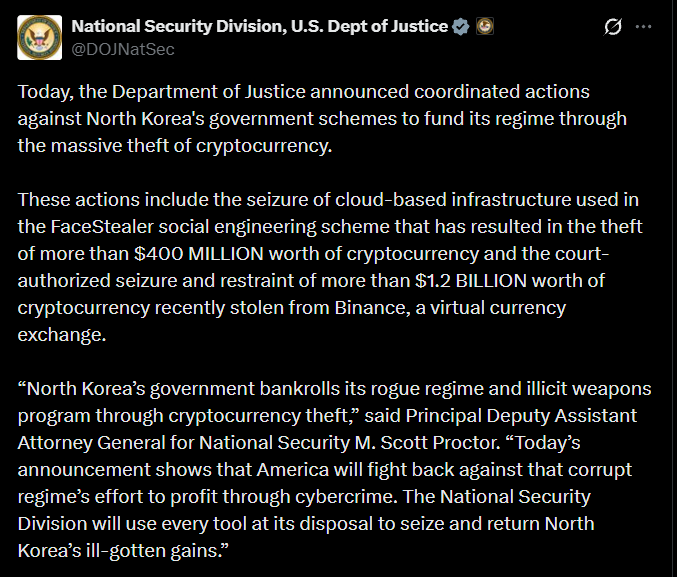
The U.S. Department of Justice (DOJ) has recently received court approval to seize over $1.2 billion in cryptocurrency linked to the major hack of Binance, which occurred in late October. This move represents a significant milestone in efforts to recover funds stolen during the hack, which resulted in losses exceeding $6 billion.
On October 29, a group associated with North Korea, known as TraderTraitor, executed the attack on Binance, making off with substantial amounts of digital assets. According to the DOJ, more than $2.7 billion of the stolen cryptocurrency has been immobilized through cooperative efforts between federal agencies and private sector partners. The recent court ruling pertains to a portion of this already frozen amount rather than an additional recovery.
DOJ’s Court Approval for Seizure Explained
The DOJ’s authorization allows for the seizure or restriction of funds from the Binance attack, targeting assets that the FBI has linked directly to North Korean hackers. These hackers are known for their complex strategies involving the movement of stolen cryptocurrency through various platforms to mask the funds’ origins.
Binance, in response to the hack, previously announced its estimated losses at around $6.3 billion and committed significant resources to remedy the situation. Following the incident, the company released a proof-of-reserves snapshot as part of their transparency efforts.
U.S. officials indicate that investigations continue to trace the remaining assets, with proactive measures being taken to prevent further movement of the stolen funds.
The FaceStealer Operation and Deepfake Technology
In addition to the Binance seizure, the DOJ disclosed the disruption of another cybercrime campaign known as FaceStealer, which has allegedly netted over $400 million through innovative hacking methods. This operation distinguishes itself by utilizing AI-generated deepfakes and social engineering techniques to extract funds from unsuspecting victims.
Attackers typically initiate contact through compromised accounts, utilizing pre-recorded videos or deepfakes to impersonate familiar individuals to their targets. By inducing a false technical issue during online meetings, they trick victims into installing malicious software that grants access to their systems and cryptocurrency holdings.
The DOJ investigation also reveals that some attacks were carefully timed to occur many months after the initial compromise, highlighting the calculated approach of these cybercriminals. Authorities have seized over 900 recorded webcam videos linked to this operation, underlining the campaign’s invasive nature.
Targeting Developers and Supply Chain Risks
Authorities noted that the FaceStealer initiative expanded its focus to include developers of open-source software, raising alarms about potential supply chain vulnerabilities. By compromising developers’ devices or accounts, attackers could inject malicious codes into widely used software, posing risks to a broader audience.
The DOJ emphasized that the operation aimed to exploit the trust inherent in professional relationships. Efforts are underway to limit the hackers’ operational capacity, with the FBI providing resources to educate potential targets about recognizing such scams.
Implications for Crypto Security
The enforcement actions taken by the DOJ outline the emerging sophistication of cyberattacks linked to North Korea, particularly regarding the cryptocurrency sector. While the binance breach illustrates the extensive financial repercussions of such attacks, the FaceStealer operation highlights the dangers posed by advanced social engineering tactics.
While freezing stolen assets is a critical step, it does not guarantee that they will be returned to their rightful owners without further legal and investigative processes. With court-approved measures now detailing actions against more than $1.2 billion in assets, U.S. authorities are making strides toward addressing one of the largest cryptocurrency thefts recorded.
The ongoing focus on disruptive tactics employed by cybercriminals underscores the need for heightened awareness and security within the cryptocurrency industry as it navigates evolving threats.