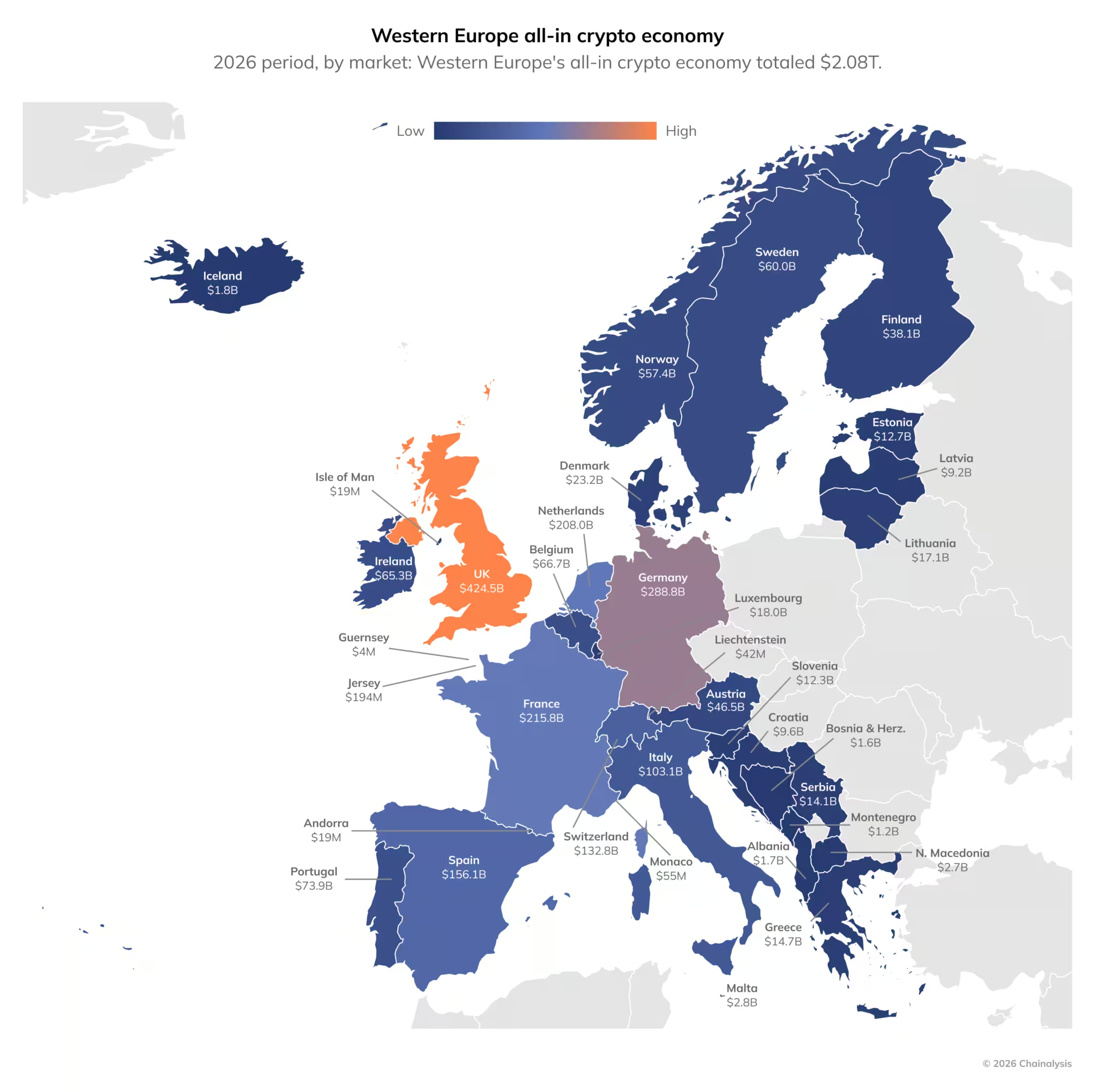
Western Europe’s cryptocurrency market has shown resilience, achieving a remarkable $2.08 trillion in transaction activity, propelled by an upsurge in stablecoin adoption.
A recent report from blockchain analytics firm Chainalysis, released on November 9, indicates that crypto activity in the region grew by 1.2% between July 2025 and June 2026, making Western Europe the second-largest regional crypto economy globally. This growth positions the region among a select few that have managed to expand during a broader global downturn.
Among the notable trends, stablecoins have emerged as a critical driver of this growth. Personal wallet holdings of stablecoins surged by 131%, significantly outpacing the global growth rate of 52%. However, the data also highlights diverging trends within major markets, notably the UK, which remains the largest cryptocurrency market in Europe despite a decline in overall activity.
UK Remains Dominant Yet Contraction Persists
The UK accounted for a substantial share of Western Europe’s crypto activity, generating approximately $424.5 billion in transaction value during the reporting period. However, this represents an 8% year-over-year decline, attributed in part to a decrease in decentralized exchange trading.
In terms of transactional volume, Germany follows the UK with $288.8 billion, while France and the Netherlands recorded $215.8 billion and $207.8 billion, respectively. Spain and Switzerland rounded out the top six, contributing $156.1 billion and $132.8 billion. Collectively, these countries comprise about two-thirds of the crypto economic activity in the region, underscoring how concentrated the sector is in major financial hubs.
Stablecoin Growth Exceeds Global Averages
Stablecoins continue to be a major factor in driving crypto expansion across Western Europe. The region’s stablecoin holdings grew significantly, increasing its share of global stablecoin balances from 3.4% to 5.1%. Strong performances were noted particularly in Austria and France, suggesting a trend towards stablecoins becoming integral for how Europeans manage digital assets.
Regulatory developments are also playing a crucial role in this landscape. The European Union’s Markets in Crypto-Assets Regulation (MiCA) aims to create a standardized framework for crypto asset issuers and service providers, thereby clarifying operational requirements for businesses across the bloc.
UK Domestic Stablecoin Transfers Surge
Despite an overall downturn in the UK’s cryptocurrency sector, the domestic stablecoin market thrived. Transfers between wallets in the UK ballooned to $2.09 billion during the reporting period, a significant increase from just $109 million a year prior. This surge accounts for about 60% of Western Europe’s domestic stablecoin transfer activity, eclipsing the combined total of $1.41 billion from other countries in the region.
The trend indicates an increasing preference for using stablecoins in domestic transactions. In the UK, domestic transfers surpassed cross-border transfers by a factor of 1.32. Conversely, other parts of Western Europe are seeing higher volumes in cross-border stablecoin transfers relative to domestic activity.
Behavioral data from retail wallets also reflects this growing interest in stablecoins, with approximately 1.03% of eligible wallets in the UK converting a majority of their cryptocurrency holdings into stablecoins, a rise from 0.66% the previous year.
French Investors Opt for Self-Custody
France experienced a noteworthy increase in stablecoin holdings, with personal wallets witnessing a staggering 192% growth over the reporting period. The number of French wallets holding stablecoins jumped from 3,577 in June 2025 to 12,255 a year later. Notably, stablecoins represented 54.2% of withdrawals from centralized exchanges in France by the end of this period, the highest among major Western European markets analyzed.
This rise in self-custody coincides with periods of fiscal pressure and political uncertainty, though the report does not draw direct causal links. The trend suggests a growing preference among French crypto users for moving stablecoins into personal wallets, allowing for greater control over their digital assets and indicating a shift in stablecoin usage patterns across the region.
The Future of Crypto in Western Europe: Regulation and Adoption
Western Europe’s cryptocurrency economy, valued at $2.08 trillion, illustrates a region adapting to a changing market landscape while remaining resilient. While the UK leads by transaction value, the decline in its market contrasts with growth in other parts of the region. The rising importance of stablecoins, both in terms of holdings and domestic transfers, signals a critical evolution in how users engage with digital assets.
The upcoming implementation of MiCA could further shape the market by establishing a clearer regulatory environment, potentially fostering engagement from traditional financial institutions with blockchain technologies. As euro-denominated stablecoins gain traction, the connection between conventional finance and the digital asset ecosystem might strengthen.
The sustainability of these trends will depend on effective regulatory frameworks, active participation from institutional players, and continued demand for stablecoin-based financial solutions.