Bitcoin is poised for a potential transformation as developers of artificial intelligence explore avenues for autonomous software to handle payments independently.
Recently, Lightning Labs announced a significant advancement with a new technology called pi402, which enables AI coding agents to transact directly in Bitcoin (BTC) for necessary computing services.
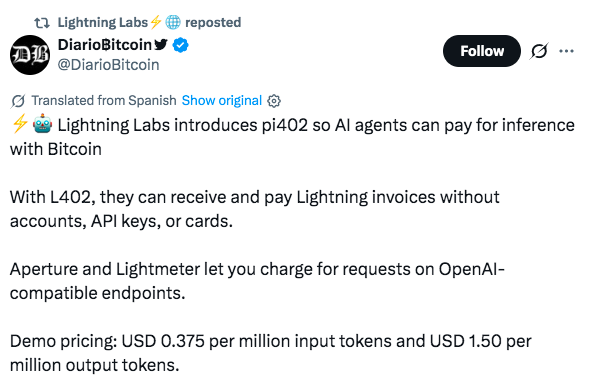
Launched on November 12, this open-source technology positions Bitcoin’s Lightning Network as a viable solution for automating payments required for various AI operations.
Revolutionizing Payments for AI Agents
According to the official announcement from Lightning Labs, pi402 makes it possible for AI agents to cover costs for computational tasks directly through Bitcoin. This facilitates a transaction model where traditional billing channels, such as credit card accounts and subscriptions, can be bypassed.
Inference—when AI models generate output or complete tasks—relies on substantial computing power typically accessed through complex payment methods. By contrast, pi402 simplifies the process, allowing AI agents to swiftly settle invoices and complete necessary operations autonomously.
Open-Source Innovation and Micropayment Capabilities
The new system utilizes Lightning Network’s L402 payment authentication protocol to ensure secure and quick transactions. Once an AI agent pays for a service, it receives immediate credentials, enabling seamless access to required resources.
This innovation could result in a surge of Bitcoin transactions as AI applications increasingly integrate payment functionalities directly into their operations. Given the nature of AI tasks demanding numerous small transactions, the Lightning Network becomes particularly appealing.
Lightning Labs highlighted its technology’s capacity to facilitate payments down to “millisatoshis,” enabling exceedingly granular billing that makes even minimal computing tasks economically viable.
The Potential Impact on Bitcoin Demand
The introduction of pi402 raises intriguing questions about the future demand for Bitcoin as AI software demands services more dynamically. Instead of requiring a conventional banking setup, AI agents could utilize Bitcoin wallets to facilitate these transactions effortlessly.
This shift may enhance Bitcoin’s position in micropayments, contrasting with traditional systems that often impose fixed processing fees, making small transactions unfeasible.
Beyond user convenience, the unexpected rise in Bitcoin transactions could reinforce bitcoin’s role as an internet-centric financial network, albeit with the important caveat that elevated transaction volume does not guarantee higher Bitcoin valuations. The broader ramifications will hinge on how the market engages with Bitcoin and service providers.
Integrating AI and Cryptocurrency
Historically, artificial intelligence and cryptocurrency have operated in separate domains. However, the emergence of autonomous payment systems could effectively bridge these fields. Despite AI’s capacity for complex problem-solving, finance remains a barrier due to the human-centered requirements of traditional systems.
By adopting Bitcoin’s Lightning Network, developers can design applications that facilitate real-time payments for services, reducing reliance on human intervention to authorize transactions. The pi402 technology also provides spending controls, allowing developers to limit expenditures as needed.
Challenges Ahead
Despite the promising nature of this announcement, challenges persist. For Bitcoin to gain widespread adoption among AI services, a substantial number of service providers must support Lightning payments. Additionally, issues related to wallet security, liquidity, and Bitcoin’s inherent volatility will have to be addressed by developers.
Currently, pi402 serves as a tool for developers rather than an indication of mass commercialization. However, if autonomous AI agents do emerge as significant consumers of computing resources, Bitcoin could play a vital role in their transactional frameworks, boosting its utility beyond the speculative trading environment.