In the ever-evolving landscape of cryptocurrency, Bitcoin has been facing significant challenges as it remains under the $70,000 mark. Continuous efforts to regain momentum have been thwarted by sellers, fostering a sentiment of caution among investors. Analysts are beginning to voice concerns about a potential decline below the $60,000 threshold if this trend continues. Increasing volatility and tighter liquidity conditions are fueling a defensive approach among both retail and institutional traders.
Nevertheless, a recent report from CryptoQuant highlights an intriguing angle on the cryptocurrency’s present condition. It notes that Bitcoin has been on a downward trend for approximately four months since reaching its all-time high in late 2025. While the price fluctuations indicate weakness, the analysis suggests we might be entering an area characterized by undervaluation when assessed through on-chain metrics.

Historically, these situations arise towards the end of corrective cycles, prompting participants to reconsider their strategies and reduce excessive speculation. Although this does not imply an immediate turnaround, it opens up the possibility of diminished downside risks, particularly if liquidity conditions in the wider market stabilize.
MVRV Indicates Bitcoin May Be Approaching an Undervalued State
The findings also reveal that valuation ratios are nearing historical accumulation levels. The Market Value to Realized Value (MVRV) ratio, a crucial on-chain metric, sits around 1.1 at present. Readings below 1 typically indicate that Bitcoin trades below its overall cost basis, a hallmark of potential undervaluation. While we have not yet crossed this pivotal threshold, current levels suggest we are nearing a point where downside risks could diminish.
Moreover, experts point out a key distinction from previous cycles. Unlike prior bull markets, Bitcoin did not experience a surge into an overheated valuation territory before this correction began. This observation implies that the current downturn may avoid the capitulation patterns seen in earlier bear market cycles, complicating any historical comparisons.
Strategically, market downturns often present prime opportunities for long-term investment. For assets like Bitcoin, which maintain a generally upward trajectory, positioning during these slumps often enhances risk-adjusted returns. However, this approach does not negate the short-term volatility risks, especially as liquidity conditions remain fluid and market sentiment experiences fluctuations.
Sustained Bearish Pressure Below Critical Averages for Bitcoin
The price dynamics of Bitcoin showcase a persistent downward trend, delineated by a series of lower highs and lower lows since its late-2025 apex around the $120K mark. Recent price slides below the $70K level emphasize a bearish trend, especially as it lingers well under both the 50-week and 100-week moving averages, which are currently on a downward trajectory. This trend typically signals ongoing distribution rather than a mere temporary correction.
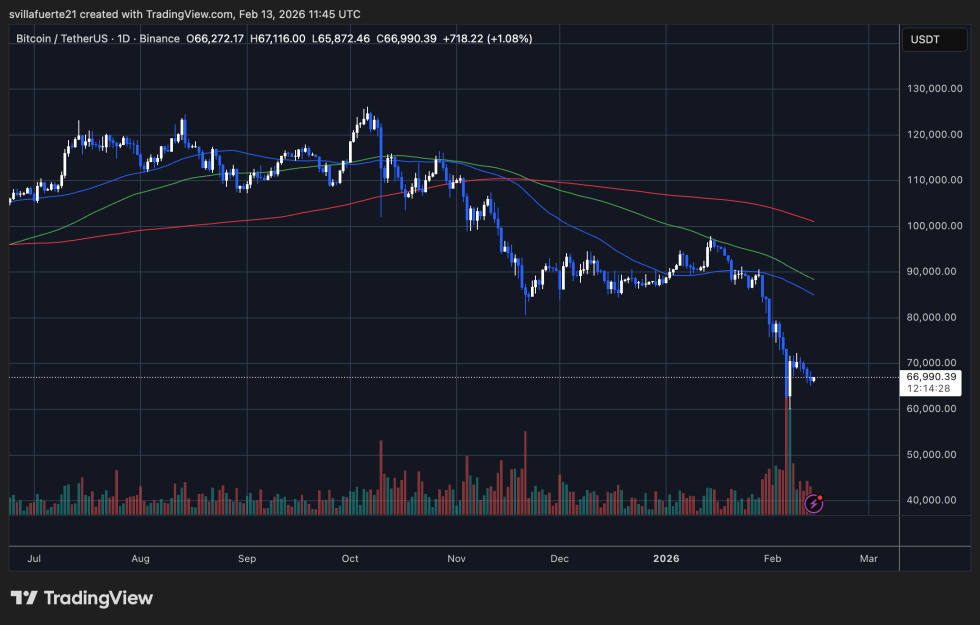
The swift drop into the mid-$60K range was marked by a significant increase in trading volume, likely indicating forced liquidations or aggressive selling, rather than just profit-taking. Although there have been attempts to stabilize around the $65K-$68K area, the lack of robust buying momentum indicates that buyers remain cautious. Historically, such weak recoveries following high-volume sell-offs often signify continued market uncertainty instead of an imminent reversal.
From a technical viewpoint, the next important focus lies at the $60K psychological level, which may serve as temporary support amid persistent selling pressure. Conversely, a genuine recovery would necessitate reclaiming the $70K mark and maintaining stability above key moving averages. Until that occurs, the broader market trend appears defensive, suggesting that volatility will likely continue as traders search for a more stable equilibrium.
Image courtesy of ChatGPT, chart sourced from TradingView.com