BitMine Faces Significant Market Volatility with Ethereum Holdings
BitMine’s recent struggles underscore the volatility inherent in the cryptocurrency market, particularly concerning Ethereum. Over the week ending November 22, the company’s market valuation plummeted by approximately $655 million, despite it increasing its Ethereum (ETH) holdings. This decline represents nearly 2.67 years of projected annual staking revenue, illustrating the financial risks associated with heavy investments in cryptocurrencies.
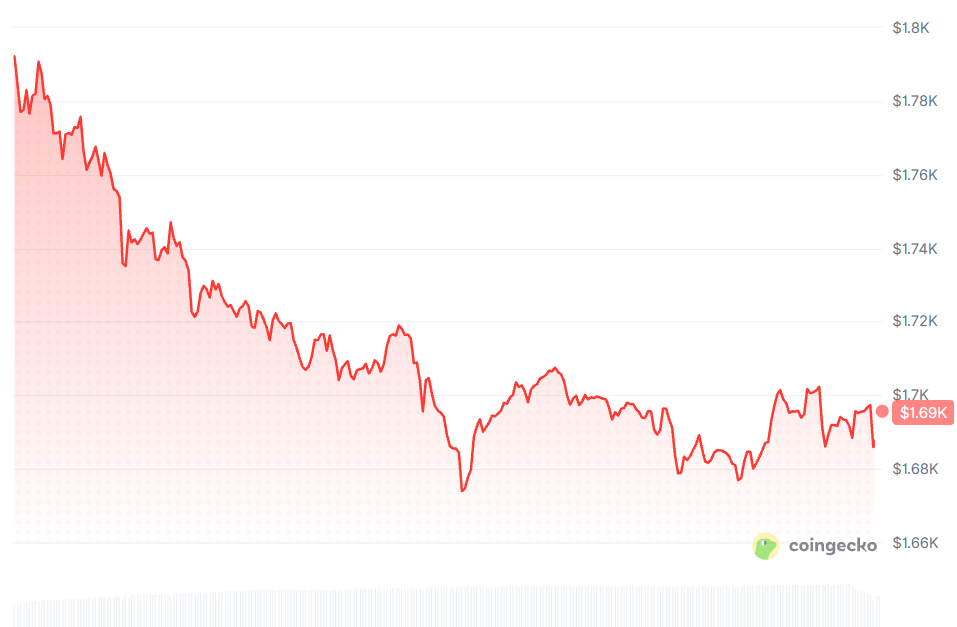
On November 15, BitMine’s Ethereum balance was recorded at 6,077,745 ETH. By November 22, this had risen to 6,085,564 ETH. However, the value of these holdings dropped significantly as Ethereum’s market price declined, resulting in a total valuation decrease from about $11.08 billion to $10.42 billion.
Declining Ethereum Prices Amplify Financial Risks
During that week, BitMine acquired an additional 7,819 ETH, which had an approximate value of $13.4 million at the time. Despite this, the overall decrease in Ethereum’s price caused the valuation of BitMine’s existing holdings to fall by roughly $668.5 million. When accounting for the newly added ETH, the total net loss on treasury value reached around $655.2 million. Although the company engages in staking to generate revenue, these earnings have not been sufficient to offset the effects of market fluctuations.
Currently, BitMine has staked 5,227,037 ETH, accounting for about 86% of its total Ethereum holdings. Management anticipates that this could yield approximately $245 million annually. However, even minor fluctuations in Ethereum’s price can heavily impact this projected income. For instance, a drop of about $40.26, or approximately 2.35%, could equate to a loss of a whole year’s staking revenue. Notably, every $100 change in Ethereum’s price can influence the market value of BitMine’s treasury by roughly $608.6 million.
Concentration in Ethereum Presents Financial Vulnerabilities
BitMine’s strategy to expand its Ethereum position exposes it to significant risks regarding the cryptocurrency’s long-term performance. The company now holds nearly 6.09 million ETH, corresponding to around 4.98% of the total circulating supply. This degree of concentration poses both opportunities and threats; any significant recovery in Ethereum’s price would enhance the value of BitMine’s assets, while further declines could exacerbate existing paper losses.
In its fiscal 2026 annual filing, submitted on November 10, the company reported $121.4 million in staking and validation revenue, but also noted $6.23 billion in unrealized losses from digital assets, alongside a net loss of $6.3 billion. Additionally, BitMine has cautioned that ongoing equity offerings could lead to shareholder dilution, complicating the potential transformation of its sizable asset pool into tangible value per share.
Future Ethereum Price Movements Could Alter BitMine’s Outlook
The current value of BitMine’s treasury makes it acutely sensitive to subsequent price movements in Ethereum. A potential rise to approximately $1,821 could restore the treasury’s value to about $11 billion, in line with its November 15 valuation. On the contrary, if Ethereum’s price dipped to $1,500, the treasury could shrink to around $9.1 billion, reducing estimated annual staking revenue to $215 million.
These scenarios serve as illustrative examples rather than definitive price forecasts, as they exclude further purchases and potential expenses. The interplay of staking revenue and bitcoin’s market price puts BitMine in a precarious position, raising questions about whether its staking strategy can mitigate the volatility tied to its substantial Ethereum holdings.
Will BitMine’s staking revenue ultimately provide a buffer against the volatility of its significant Ethereum assets, or will the company’s concentrated exposure lead to excessive risk during market downturns?