Ethereum’s New DeFi Security Tool Raises Concerns Over Censorship
Ethereum’s decentralized finance (DeFi) ecosystem is witnessing significant changes with the introduction of a new security tool designed to preemptively block harmful transactions. Developed by Phylax and integrated into Titan Builder, this system aims to protect protocols from exploits that could lead to substantial financial losses. However, its capabilities also spark a debate regarding transaction filtering and potential censorship on the Ethereum network.
Innovative Circuit Breakers Aim to Mitigate Exploits
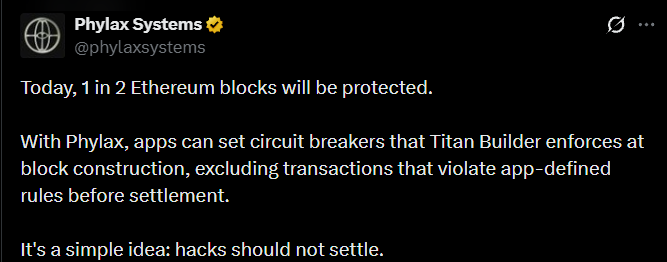
In a recent announcement made on November 10, Phylax revealed its collaboration with Titan Builder, allowing Ethereum applications to establish predefined rules to filter high-risk transactions during the block creation process. Titan Builder, responsible for producing roughly half of all Ethereum blocks, performs these checks to help prevent the finalization of malicious transactions.
This proactive approach is a shift from traditional methods that typically react after an exploit has already occurred. Phylax illustrated the effectiveness of their system by highlighting a scenario in which a vulnerable DeFi vault could mistakenly release $1 million to a user with shares only valued at $1,000. The integrated circuit breaker would limit the transaction amount, potentially preventing the vault from being drained.
Balancing Security Measures with Operational Integrity
Phylax CEO Odysseas Lamtzidis emphasized that their system allows for configurations that mitigate the risk of freezing smart contracts. One recommendation includes implementing a fail-open approach, where transactions can proceed even if security mechanisms fail, rather than being automatically blocked.
Some industry voices, such as blockchain researcher Shapiro, advocate for establishing mandatory fail-open protections, suggesting a protocol should not have the ability to block transactions without explicit safeguards in place. This ongoing discussion reflects a complex challenge for DeFi developers: balancing the need to block suspicious transactions while ensuring the seamless operation of legitimate activities.
Concentration of Power in Ethereum’s Builder Market
The introduction of the transaction-filtering system has also raised critical questions about the existing concentration within Ethereum’s block-building market. Ethereum researcher Fan Zhang pointed out that the technology’s reliability is partly due to this concentration, suggesting that while it offers security benefits, it may also reinforce systemic risks.
Another researcher, Sen Yang, warned that if major protocols depend on a limited number of builders for security enforcement, these builders might gain unfair advantages, further entrenching their dominance within the ecosystem. Though proposals like the enshrined proposer-builder separation (ePBS) could alleviate reliance on third-party relays, they do not directly address the issue of builder centralization.
Navigating the Fine Line Between Security and Censorship
Phylax contends that their system does not empower external entities to control Ethereum transactions. According to Lamtzidis, all filtering rules are determined by the applications that opt to integrate the technology, positioning these measures within the existing framework of smart contracts. His assertion is that legitimate security checks differ fundamentally from censorship, which he defines as arbitrary or coercive actions.
Researcher Stefanie Boss expressed a nuanced perspective, suggesting that security measures based on transaction outcomes may entail less risk compared to those targeting specific users. Ultimately, the influence of Phylax’s system will depend on how it is implemented by protocols, how builders adapt, and how the larger Ethereum community addresses the balance between enhancing security and avoiding increased centralization.
As the DeFi landscape evolves, will Phylax’s transaction-filtering system enhance security, or could it lead to new forms of censorship for Ethereum users? Should protocols be mandated to adopt fail-open protections?