Zcash founder Zooko Wilcox has outlined the objectives of the proposed Ironwood upgrade, which aims to provide users with immediate, trustless verification of ZEC’s circulating supply from the very first block of its activation. This upgrade addresses a significant concern within the Zcash community regarding the ability to confirm the integrity of the supply without reliance on developers, auditors, or retrospective assumptions.
In a recent post on social media and subsequent discussions on the Zcash Community Forum, Wilcox emphasized that the primary function of Ironwood is not to ascertain past counterfeiting incidents within the Orchard pool, but rather to enable users to validate the current circulating supply independently by running a full node.
Wilcox stated, “Upon the activation of Zcash Ironwood, you will gain an immediate trustless verification of the correct supply of Zcash, which stands at 16 million ZEC now and will eventually reach 21 million ZEC.”
Understanding the Trustless Supply Verification through Ironwood
This clarification is crucial given the inherent privacy features of the Orchard pool. While confidentiality is a core aspect of Zcash’s offerings, it complicates discussions surrounding the potential exploitation of past vulnerabilities without leaving discernible trails in a public ledger. Wilcox seeks to draw a clear line between two critical issues in this debate: the existence of counterfeit coins and the verifiability of the current supply after Ironwood’s implementation.
“This distinction seems to confuse many. No counterfeit coins were created, and the current supply is valid,” Wilcox explained. “These are fundamentally different points, and my priority is on the latter.”
Under the Ironwood upgrade, the existing Orchard pool will not be able to serve as an active forum for transactions. New output transactions within the old Orchard pool will be rejected, necessitating funds to be channeled through Zcash’s turnstile accounting method before entering into the new Ironwood pool.
This turnstile mechanism is central to the proposal’s integrity. It monitors how much ZEC legitimately transitions in and out of each pool, preventing the movement of quantities exceeding the legitimate inflows. Wilcox asserts that users will not need to rely on the full migration of previous Orchard users or speculative assumptions regarding potential attackers.
“The promise of immediate trustless verification regarding the soundness of the Zcash supply holds true regardless of whether any counterfeit coins exist within the Orchard pool,” he clarified. “This is made possible because Ironwood will eliminate any excess ZEC from the Orchard pool from the very first block of its activation.”
Wilcox highlighted a critical threshold: the amount deemed legitimately part of the ZEC supply within the Orchard pool, which he estimated at 4.5 million ZEC. Any amount exceeding this limit will not be able to circulate under the new regulations, making it ineligible for continued use within the old Orchard pool or for transference to other pools beyond the turnstile restrictions.
“It will eradicate any excess ZEC promptly, trustlessly, and universally,” he explained. “This will happen even if there is no excess ZEC present. If there isn’t, Ironwood simply provides the mechanism to prove its absence.”
While Wilcox personally believes there are no counterfeit ZEC coins, he underscored that the design of Ironwood diminishes the need for reliance on his perspective or anyone else’s opinion. Within his forum commentary, he illustrated two hypothetical scenarios: one where numerous counterfeit ZEC were generated within Orchard before the vulnerability was addressed and one where they were not. In either case, he contended, Ironwood will allow users to establish on Day 1 that no more than 16 million ZEC are currently in circulation.
Moreover, the proposal could serve as a diagnostic tool over time regarding the potential exploitation of the Orchard pool. If users migrating to Ironwood do not attempt to withdraw excess ZEC from the old pool, this would imply that no counterfeiting took place. Conversely, if excess ZEC are detected and rejected by the turnstile, this would indicate a prior occurrence of counterfeit activities, while maintaining the integrity of the circulating supply.
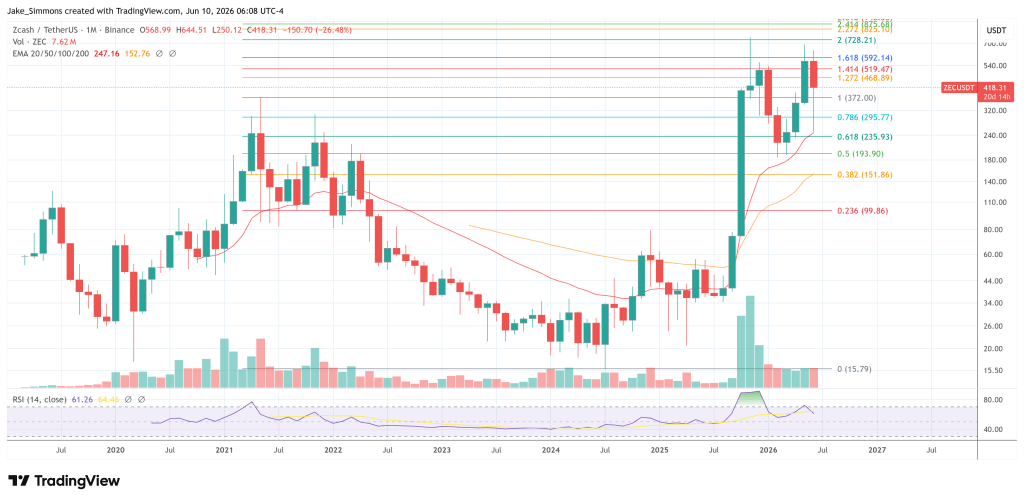
As of now, ZEC is trading at $