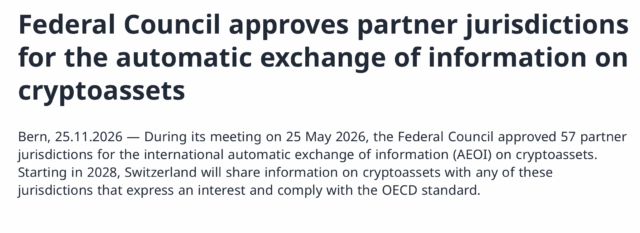
Switzerland is making significant strides in the realm of cryptocurrency taxation, as the Federal Council approved a framework for the automatic exchange of digital asset information with 57 potential partner jurisdictions set to begin in 2028. This move enhances Switzerland’s efforts to align with international tax transparency standards, which are already applied to traditional financial institutions.
The initiative aims to improve compliance among cryptocurrency service providers by following the Organisation for Economic Co-operation and Development’s (OECD) Crypto-Asset Reporting Framework (CARF). Under this framework, exchanges will be required to identify their customers’ tax residency and report various aspects of their cryptocurrency activities. However, it’s important to note that this new reporting system does not introduce any additional taxes on cryptocurrencies; it is designed to change how authorities gather data to enforce existing tax obligations.
Delayed Implementation Finally Takes Shape
This decision comes after a series of postponements concerning the establishment of the international reporting framework for crypto. The Swiss government had previously delayed its implementation while lawmakers debated the selection of jurisdictions for information sharing. The State Secretariat for International Finance indicated that the rollout could not begin earlier than January 1, 2027, and the current approval does not guarantee that all listed jurisdictions will start exchanging information by 2028. Participation from each jurisdiction remains contingent upon mutual interest and adherence to international reporting standards.
For Bitcoin holders who trade through international exchanges, this development may have greater ramifications than previous changes to local tax legislations. Tax authorities will now have easier access to information regarding individuals’ cryptocurrency activities, potentially reducing the need for extensive individual investigations.
Implications for Cryptocurrency Investors
The framework established by Switzerland does not merely aim to collect taxes on cryptocurrency but rather focuses on ensuring compliance with existing regulations. This is particularly significant for investors who may believe that utilizing foreign exchanges could exempt them from domestic tax liabilities.
Under the CARF, cryptocurrency exchanges are obligated to collect and report a range of information about their clients, including names, addresses, and tax identification numbers. This shift could create a notable difference for investors, clarifying the relationship between the country in which they hold assets and where their tax obligations lie.
As this framework is enacted, it marks a notable evolution in how Switzerland—and potentially other jurisdictions—manage cryptocurrency-related tax issues, underscoring the ongoing global trend toward increased transparency and accountability in the digital asset domain.
Switzerland is advancing its cryptocurrency regulation framework, aiming to align digital asset transactions with traditional financial systems. A newly established agreement allows foreign tax authorities to access information on Swiss-held cryptocurrency accounts, contingent on the investor’s residency and the activation of relevant information exchange agreements.
This initiative means that activities beyond mere Bitcoin sales could trigger reporting obligations. For instance, transactions involving the conversion of Bitcoin into stablecoins, moving assets between different platforms, or receiving specific cryptocurrency distributions can all generate records due for reporting.
Understanding Self-Custody and Reporting Obligations
The implications of cryptocurrency transfer practices, especially concerning self-custody, are notably intricate. For example, when Bitcoin is transferred into a private wallet, it does not automatically exempt previous transactions from the reporting duties of an exchange. The OECD highlights that such transfers from reporting providers to private wallets still come under scrutiny for potential tax record submissions.
Important to note, however, is that this framework does not grant governments the ability to control private keys or require all self-custody transactions to be reported under the OECD’s Common Reporting Standard for cryptocurrency assets (CARF). Nonetheless, the nature of interactions with regulated financial entities is crucial, as these moments can trigger reporting responsibilities.
The debate surrounding Bitcoin adoption often intertwines the concepts of financial independence and anonymity. While self-custody empowers users to manage their assets more autonomously, it does not completely shield them from governmental oversight concerning transactions made through regulated services.
Balancing Transparency with Data Protection
The Swiss State Secretariat for International Finance describes its regulatory approach as essential for ensuring that cryptocurrencies receive equitable treatment akin to traditional financial investments. Advocates argue for equal tax enforcement standards, noting that digital asset investors should not enjoy a lower level of scrutiny compared to those using conventional financial institutions.
However, the push for increased financial transparency creates new responsibilities for governmental and financial institutions that handle such data. Mistakes in classifying residency, inconsistent transaction records, or errors in assessing historical costs can expose investors to significant tax liabilities.
Moreover, the security of personal data associated with cryptocurrency activities becomes a pressing concern. Sensitive identity information can lead to severe financial repercussions if disclosed improperly. Consequently, governments must ensure robust protections are in place for the data they manage and that investors have reliable methods for rectifying inaccurate information.
While pushing for greater tax transparency is a legitimate aim, it should not permit lapses in data protection or unauthorized assumptions about investors’ financial actions.
The Road Ahead: Key Developments by 2028
Looking forward, critical milestones include the implementation of Swiss reporting obligations, the activation of information exchange arrangements with various jurisdictions, and clear guidance for cryptocurrency service providers regarding compliance. Investors are urged to keep an eye on the start date for data collection, as it may not align with when authorities begin sharing these records.
Switzerland’s strategic move reflects a broader trend in which access to global cryptocurrency markets increasingly comes with the expectation of similar reporting obligations as traditional financial sectors. Although Bitcoin investors still maintain the ability to hold and transfer their assets independently, the assumption that utilizing foreign exchanges can obscure activities from tax authorities is becoming considerably less tenable.