Recent analyses highlight the persistent centralization of Bitcoin mining power, with a notable concentration in just a few countries, indicating a significant reliance on a limited geographical base.
United States Dominates Bitcoin Hashrate with 37.4% Control
According to a recent study by Hashrate Index, there has been a marked shift in the geographical distribution of Bitcoin Hashrate over recent months. The term “Hashrate” pertains to the overall computational power that miners contribute to the Bitcoin network, expressed typically in hashes per second (H/s) or more commonly, in exahashes per second (EH/s).

The data from Blockchain.com reveals that the worldwide Bitcoin Hashrate has seen a downturn this year, raising questions about the underlying causes.
Several factors might lead to a decline in Hashrate, with fluctuations in Bitcoin prices often being the most influential. Since miners earn rewards in Bitcoin, their profitability is closely tied to the crypto’s value in USD. A downturn in Bitcoin prices may force less efficient miners to disconnect due to declining returns.
Notably, the Bitcoin market has experienced considerable losses since late 2025, contributing to a decrease in the average Hashrate from 1,083 EH/s in October to around 953 EH/s currently.
Additionally, a shift in focus among major mining companies towards artificial intelligence data centers has impacted overall Hashrate. Many firms are opting to prioritize AI operations over Bitcoin mining, reflecting a strategic pivot within the industry.
Interestingly, while the global Hashrate is in decline, individual nation trends differ. The United States, for instance, experienced a slight decrease of 0.13% in its Hashrate share since the start of 2026, while countries like Kyrgyzstan and Paraguay increased their shares by 0.4% and 0.3%, respectively.
Below is a visual representation highlighting the current mining share of the top 10 countries:
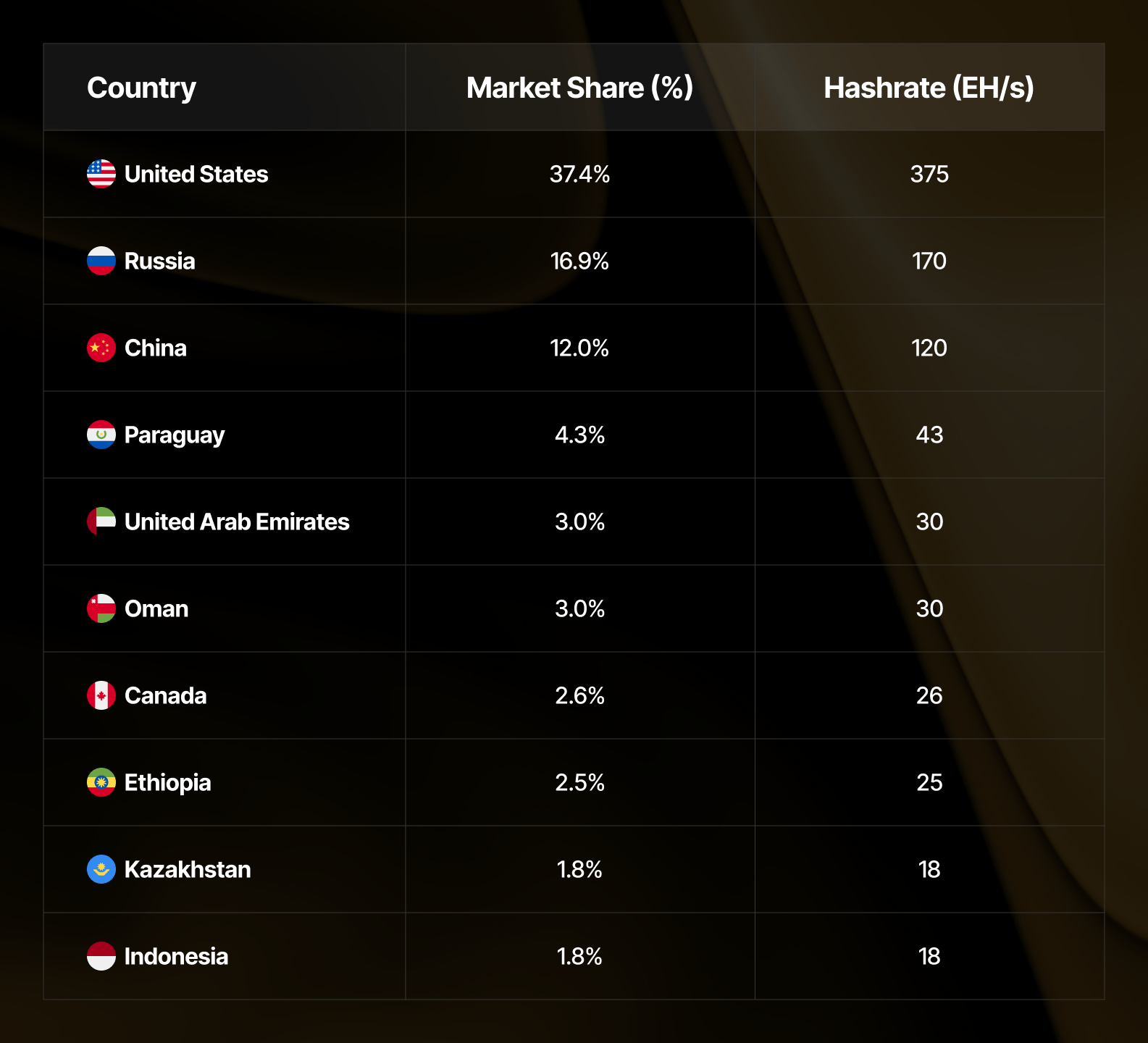
As evident, the United States, Russia, and China account for the majority of the global Hashrate with respective shares of 37.4%, 16.9%, and 12%. Combined, these three nations hold a considerable 65% of the total Hashrate, raising concerns about the impacts of centralization. Such concentration can create vulnerabilities, where political or social changes in these regions could disrupt the entire Bitcoin network.
Prior to mid-2021, China’s mining sector was unparalleled. However, following a regulatory crackdown, miners migrated, leading to a significant drop in global Hashrate. This year saw operational disruptions caused by weather conditions in the U.S., once again affecting overall mining metrics.
Bitcoin Price Movement
In recent trading sessions, Bitcoin has experienced a price correction, currently resting at approximately $67,900.