The cryptocurrency landscape is currently navigating through a challenging period of unpredictability, especially amid the ongoing tensions in Eastern politics. As traditional markets react, crypto investors approach with increased caution. A fresh report from XWIN Research Japan underscores a significant aspect of this environment—how distractions can divert attention from the essential concerns of crypto users.
According to the FBI’s 2025 fraud statistics, the amount lost to crypto-related scams reached a staggering $11.3 billion, marking it as the most substantial category of fraud reported at the federal level. Scams linked to investment schemes alone accounted for $8.6 billion. Additional fraud types, including romance and impersonation scams, increasingly utilized cryptocurrencies for transactions thanks to their secure properties like irreversibility, anonymity, and swift transactions.

It’s crucial to highlight the demographics affected by these scams, rather than assuming they target only inexperienced investors. Individuals aged 60 and above incurred around $4.4 billion in losses, reflecting that no age group is exempt. The fundamental issue is not a lack of knowledge; instead, it revolves around the structural challenge posed by irreversible transactions.
In a tumultuous market swayed by geopolitical uncertainties, the eye-popping $11.3 billion figure serves as a stark reminder that risks to crypto users often lie beyond market metrics.
Emerging Trends: Freedom in the Crypto Space
The analysis by XWIN Research Japan points to a notable transformation accompanying the surge in fraud—an uptrend in self-custody as users increasingly shift their assets away from exchanges. This migration indicates a critical shift towards independence, but it also brings accompanying responsibilities.
Factors contributing to this trend include growing institutional strategies for custody, stronger beliefs in long-term holding, and heightened awareness surrounding counterparty risks. All these elements signal a collective movement towards direct asset control.
Ethereum is a clear representation of this shift. The rise in smart contract deployments signifies real-world utilization across decentralized finance (DeFi), NFTs, and payment infrastructures. Its framework encourages individual wallet interaction, necessitating that users engage directly with their assets. Ethereum’s design not only supports self-custody; it is fundamentally built upon it.
The report illustrates a troubling paradox: record-high scams coexist with increased network activity and an outward trend in asset withdrawal. These elements might appear contradictory, yet they form a cohesive narrative. More individuals are seizing control over their funds just as the ramifications of a security breach or scam become irrevocable.
Opting for self-custody means taking on responsibility rather than simply upgrading one’s security. In a domain shadowed by $11.3 billion in losses to fraud in a single year, this is not a decision to be taken lightly. Market prices may recover, but a hacked wallet presents irreversible consequences.
Current Market Developments: A Stabilizing Crypto Landscape
As of now, the total cryptocurrency market cap hovers around $2.4 trillion following a substantial pullback from the $3.8 to $4.1 trillion range. This shift reflects a significant shift from growth to a more cautious and corrective phase. Currently, the price dynamics are positioned below the 50-week moving average (blue) and are testing the 100-week (green) average.
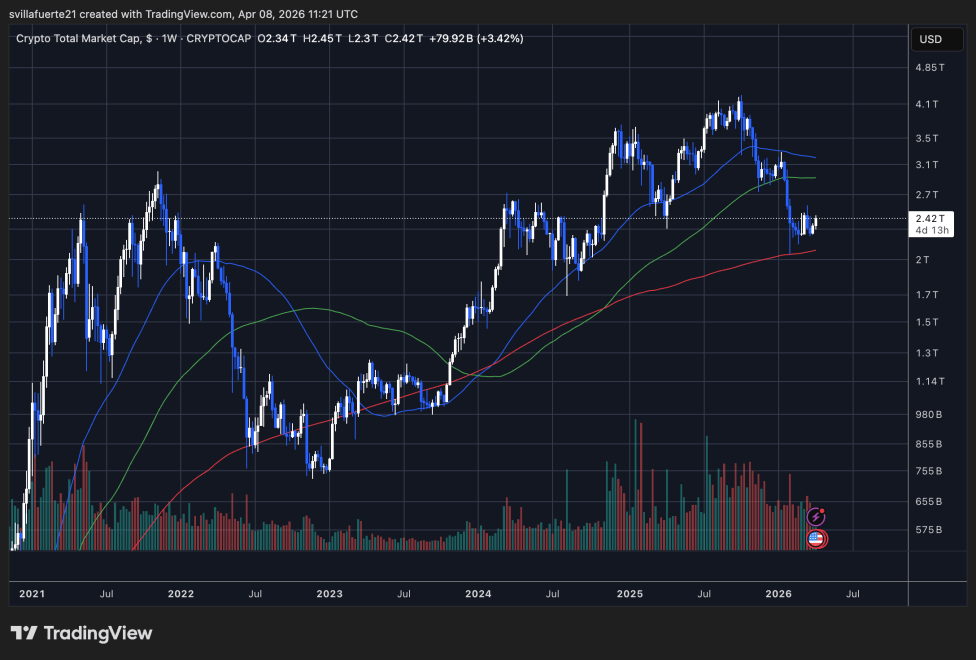
This rejection from higher levels saw an uptick in trading volume, an indicator of distribution rather than simply a low-liquidity pullback. Following this adjustment, the price action has contracted, aiming to establish a foundational support point above the 200-week moving average (red), which continues its upward trend. This threshold now plays a pivotal role in determining whether the broader market structure can maintain its stability.
Short-term efforts to regain the 50-week moving average have repeatedly failed, suggesting that upward momentum is faltering. However, the lack of continued aggressive selling indicates the market remains in a state of equilibrium rather than capitulation.
Given the structural significance of this region, maintaining support above present levels could signal a resumption of the upward trend in higher timeframes. Conversely, a decline below the 200-week moving average would indicate a more profound market contraction, transitioning from correction to a downward trend phase.
Image credit: ChatGPT, chart from TradingView.com