The world of cryptocurrencies is constantly evolving, and with the rise of quantum computing, the need for robust security measures is becoming increasingly critical. A recent initiative aims to bolster Bitcoin against potential quantum threats while staying within its existing framework.
StarkWare’s chief product officer, Avihu Levy, has proposed an innovative concept known as Quantum Safe Bitcoin (QSB). This approach aims to enhance the security of Bitcoin transactions, making them more resistant to quantum computing attacks without requiring any changes to the underlying Bitcoin protocol.

The methodology focuses on countering the capabilities of quantum computers utilizing Shor’s algorithm, which poses a significant risk to conventional cryptographic methods.
Innovative Solutions Within Established Parameters
Levy’s strategy effectively adheres to Bitcoin’s pre-existing scripting limitations and avoids the need for a soft fork. Instead of depending on traditional elliptic curve mathematics, QSB employs a unique hash-to-signature challenge. This mechanism requires users to discover an input whose hash resembles a valid ECDSA signature, thus relying on brute-force calculations rather than methods that quantum computers could exploit.
This innovative tactic is noteworthy; it does not seek to overhaul Bitcoin entirely. Instead, it introduces a targeted safeguard utilizing regulations already in place, demonstrating a commitment to adapting without compromising the integrity of the original system.
Researchers emphasize this approach as a temporary but essential response to the pressing issue of quantum security, highlighting that the long-term requirements for Bitcoin’s defense are yet to be fully resolved.
Mixed Reception: Support and Criticism
The response to Levy’s proposal has been a mix of enthusiasm and skepticism. StarkWare CEO Eli Ben-Sasson heralded the development as groundbreaking, proclaiming it effectively renders Bitcoin quantum-safe at present. However, not all experts share this perspective.
Bitcoin Environmental, Social, and Governance (ESG) advocate, Daniel Batten, expressed concerns, arguing that the proposal overlooks vulnerabilities associated with exposed public keys and inactive wallets. He pointed out that significant amounts of Bitcoin, roughly 1.7 million BTC in early P2PK addresses, could be exposed to risks from advanced quantum capabilities.
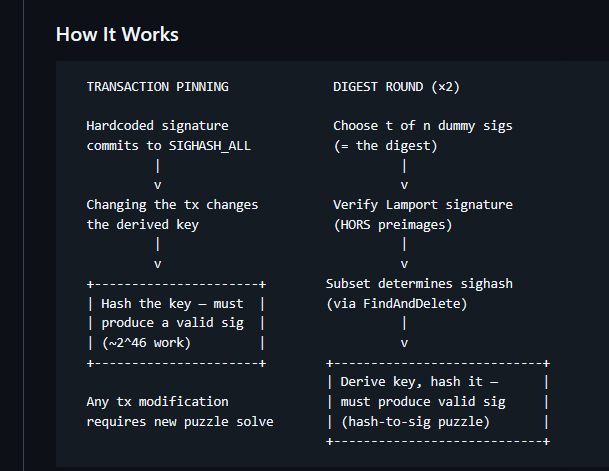
Additionally, while the new scheme presents an alternative, it is specifically tailored for larger transactions and incurs a higher computational cost—making it impractical for everyday use.
THIS IS HUGE. Bitcoin is Quantum-Safe TODAY.
Even if a quantum computer appeared, one that breaks the conventional Bitcoin signatures, it shows a practical way to create safe Bitcoin transactions. WITH NO CHANGE TO BITCOIN PROTOCOL!!!
— Eli Ben-Sasson | Starknet.io (@EliBenSasson) April 9, 2026
Temporary Measures Amid Ongoing Debate
The discourse surrounding quantum risks has stirred division within the Bitcoin community. Some advocate for maintaining Bitcoin’s original design without alterations, while others propose freezing or burning at-risk assets. A separate faction suggests upgrading the protocol to accommodate quantum-resistant signatures.

Levy’s proposal seeks to position itself as a viable option in this heated discussion, offering users a stop-gap strategy that doesn’t hinge on universal consensus across the network.
Despite its merits, the researchers recognize that protocol-level revisions could provide a more sustainable long-term solution. They also note that the QSB approach is not universally applicable, especially for advanced applications like the Lightning Network.
The implications of this research are timely, as Google has recently released findings that add urgency to the discussion, with Lightning Labs’ chief technology officer, Olaoluwa Osuntokun, also unveiling a quantum fallback prototype recently.
Featured image from Pixabay, chart from TradingView