The path to enacting the CLARITY Act remains fraught with challenges, primarily due to the need for bipartisan support. This was highlighted by asset management firm Grayscale, which expressed cautious optimism regarding the bill’s potential for passage.
In the current Senate composition, Republicans hold 53 seats, indicating that a minimum of seven Democratic senators would need to support the bill for it to move through the chamber successfully.
Recent Developments on the CLARITY Act
The CLARITY Act advanced out of the Senate Banking Committee last Thursday after a vote predominantly reflecting party lines. All 13 Republican members favored it, accompanied by the support of two Democrats.
However, nine Democrats opposed the bill. The legislation, designed to provide the crypto industry with clear regulatory guidelines, has been a focal point of contention since its introduction in July 2025.
Grayscale referenced the GENIUS Act as a necessary precedent for future actions. This particular bill passed the Senate with significant support, including votes from 18 Democrats.
Implications for the Economy
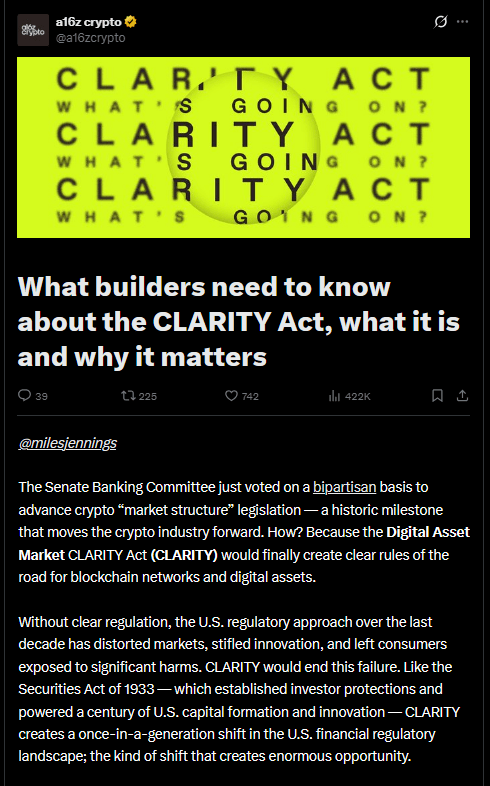
A notable perspective from venture capital firm a16z cryptocurrency indicates that the ramifications of the CLARITY Act extend beyond the crypto sector. The firm argues that establishing a comprehensive legal framework would cultivate greater innovation within the United States.
They pointed to the positive outcomes derived from the passage of the GENIUS Act, asserting that such legislation has the potential to enhance growth and adoption, benefiting both the U.S. economy and the global standing of the U.S. dollar.
As of the publication date, the US dollar index, which evaluates the dollar’s performance against a selection of major currencies, was recorded at 99.26, reflecting a 1.25% increase over the previous month, according to data from TradingView.
International Repercussions
Joseph Chalom, CEO of Sharplink Gaming, highlighted another critical aspect of the discussion, noting that the implications of the CLARITY Act could resonate globally. While many in the U.S. perceive this legislation as primarily domestic, Chalom suggested that other nations are closely observing it as they consider their own crypto regulations.
The perspective provided by a16z is clear: when the U.S. establishes legal frameworks that harmonize consumer protection with innovation, it not only enhances its capability in the technology sector but also sets a precedent for the rest of the world.
As the Senate prepares to make decisions regarding this important legislation, the focus now shifts to key vote counts.
Featured image from MadebyBaurley, chart from TradingView