Bitcoin has recently surpassed the $80,000 mark, reaching a notable high that has drawn significant attention from both investors and analysts alike. This upward movement occurred alongside a wave of profit-taking, showcasing the dynamic nature of the cryptocurrency market.
Understanding Bitcoin’s Recent Performance
According to on-chain analytics firm Santiment, Bitcoin exhibited a record of net realized profits of approximately $207.56 million in a single day. This figure is the highest recorded in the past month and reflects a significant shift in trading behavior. Investors who had acquired Bitcoin at lower prices are now capitalizing on their gains by selling their holdings into a readily engaged market.
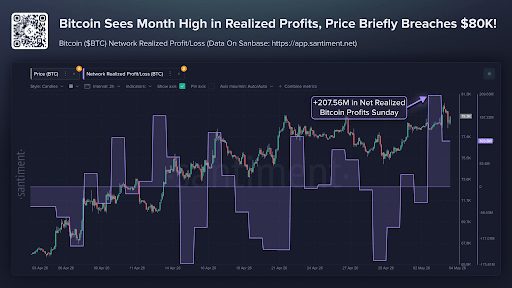
By assessing the Network Realized Profit/Loss metric, which compares the original purchase value of coins with their current market price, we can better understand the implications of these sales. For instance, if an investor purchased Bitcoin at $50,000 and sold it when the price reached $80,000, the realized profits contribute positively to this metric.
Market Reaction to Profit-Taking
Analyzing the price movements while this profit-taking occurred reveals important trends. Bitcoin not only broke through the $80,000 threshold, but its value also reached a peak of $82,751 shortly afterward. The significance of this movement lies in its timing — it did not arise from a panic-driven market but rather reflects solid price action as it broke through a level it had struggled to surpass for several weeks.
Demand Sustains Prices Amid Selling Pressure
The $207 million cashout marks a notable moment in Bitcoin trading, but it is crucial to contextualize this figure. While it represents a one-month high, it falls short of being an all-time peak. Historical trends show that Bitcoin often endures and flourishes even amidst larger profit-taking events.
Such sales, while seemingly bearish at first glance, can indicate a healthier market structure when met with substantial demand. As older holders distribute their cryptocurrency, new buyers stepping in at higher prices significantly alter market dynamics. This transfer means that the market is prepared for new cost bases, as buyers entering around $80,000 are likely to sustain their positions even if the price experiences minor retracements.
Implications of Shifting Holder Dynamics
Market health can depend heavily on the transitioning ownership of Bitcoin. When long-term holders sell into a strengthening market, new investors are likely to show resilience against minor price declines, forming a more robust support level near $80,000. However, should realized profits continue to escalate, new investors might start to exhibit signs of distribution, influencing future price movements.
In conclusion, while Bitcoin’s current rise and the consequent profit-taking might suggest volatility, they also reflect a potentially strong market foundation. Understanding the interplay of supply and demand is crucial for future predictions regarding Bitcoin’s price trajectory and overall market behavior.