Vitalik Buterin, the co-founder of Ethereum, has recently shared insights about the future direction of the Ethereum Foundation (EF). His reflections indicate a shift towards a more focused and intentional role for the EF, which includes reducing the frequency of ETH sales while prioritizing Ethereum’s long-term sustainability, privacy, security, and resistance to external control.
In a detailed post on X, Buterin articulated this evolving perspective as a strategy to redefine the EF’s role within a broader ecosystem rather than serving as the primary governing body of Ethereum. He emphasized that his reflections represent his personal viewpoint and do not reflect an official mandate from the board.
“First of all, this is only my own view. The board is not just me, and I do not possess any special authority over the other board members,” said Buterin. He mentioned that the board’s composition is expanding and indicated a desire for his influence within the foundation to diminish, which he considers beneficial.
A Focused Ethereum Foundation for the Future
Buterin noted that recent changes made by the EF have led to enhanced execution and a greater concentration on realistic goals. However, with these improvements in place, he pointed out a new concern: the foundation’s actions have not consistently aligned with Ethereum’s core values of decentralization, privacy, and security.
According to Buterin, the EF is transforming to be a smaller organization with a more significant purpose, stating that it should act as just one of many entities in the Ethereum ecosystem rather than as its key coordinating body.
- Currently, the EF holds approximately 0.16% of all ETH, a fraction that is less than many individual ETH holders possess.
- This limited holding contrasts with other blockchain foundations that often maintain larger reserves.
- The EF’s initial mission was to fund Ethereum’s development as detailed before its launch, which, according to Buterin, was successfully achieved in 2022.
“Now, the EF is prioritizing usage of its available resources to ensure longevity rather than broad expansion,” Buterin explained, adding that reduced ETH sales are a part of this strategy.
The EF will concentrate on initiatives that are essential for Ethereum’s success as a decentralized, open, and secure platform, which might exclude certain respected projects and individuals aligned with Ethereum’s mission.
Prioritizing Values Over Speed
In his technical discussion, Buterin introduced the concept of CROPS: censorship resistance, openness, privacy, and security. He argued that these aspects should define Ethereum’s ambitions instead of merely focusing on speed and throughput.
“For some, impressive metrics may mean ultra-low latency and high transactions per second (TPS). I believe pursuing this path could lead to mediocrity,” he cautioned. He acknowledged the importance of scaling but emphasized that Ethereum’s advantage lies deeper than just performance metrics.
- Buterin highlighted the potential of AI-assisted formal verification for improving security and creating a more robust Ethereum ecosystem.
- He also pointed out the need for minimizing reliance on intermediaries in smart contracts and privacy protocols.
“It’s quite disappointing that many smart contract wallets still depend on intermediaries for transaction inclusion,” he said, advocating for better inclusion processes and public access to the mempool.
ETH’s Economic Significance
Buterin underscored ETH’s economic role, asserting that it is the most valuable asset stemming from the Ethereum network. He stated that Ethereum safeguards around $250 billion worth of ETH, and the properties he highlighted are advantageous for the cryptocurrency itself.
He revealed that nearly 90% of his wealth is tied up in ETH, while a small portion is allocated to various open-source initiatives. Nevertheless, he noted that some critical tasks for supporting the asset lie outside the EF’s current scope, requiring involvement from other organizations and major ETH holders.
Looking forward, Buterin anticipates that the foundation’s restructured approach will stabilize within the coming months. He concluded with a straightforward summary: EF will indeed be “a smaller organization than in previous years,” with a clearer focus on delivering meaningful outcomes for the Ethereum network.
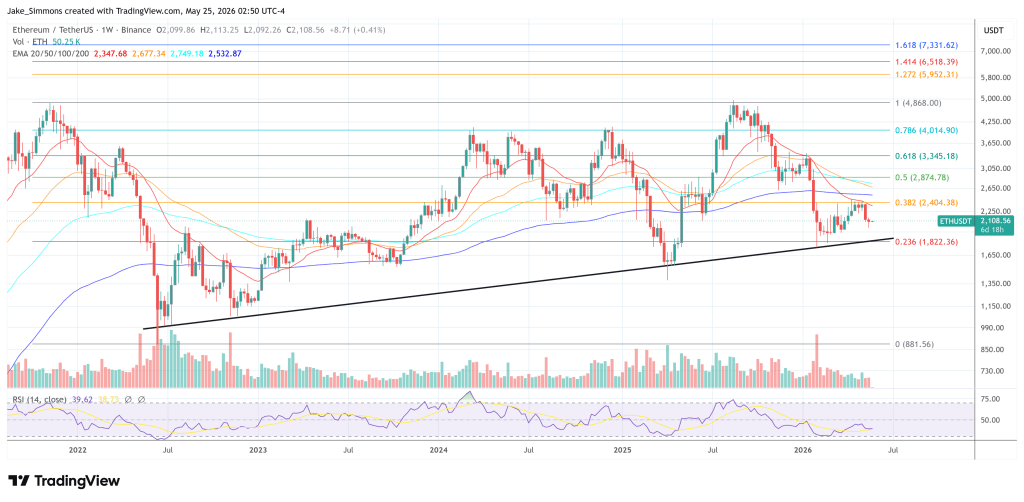
As of the latest update, ETH is trading at $2,108.