Recently, former President Donald Trump has re-engaged in the discussion surrounding the regulatory framework for digital assets in the United States. His remarks indicate his intent to establish a “future-proof” structure for the cryptocurrency market as the Senate prepares to address the CLARITY Act. This legislation aims to clarify the regulatory status of digital assets, including exchanges, custodians, stablecoins, and derivatives markets.
In a post on Truth Social, Trump criticized the previous regulatory approach under SEC Chair Gary Gensler and described his administration’s efforts as essential in making the U.S. a leader in the cryptocurrency sector. This post gained attention after the Senate Banking Committee’s recent advancements on the CLARITY Act, signaling that the dialogue on crypto regulation is intensifying.

Trump expressed concerns that prior regulations had stifled innovation in the American crypto industry, claiming, “Gary Gensler and the ‘Anti-Crypto Army’ nearly destroyed the American Crypto Industry,” and emphasized his commitment to solidifying a favorable regulatory environment for the sector.
NEW: President Trump says his administration is building a “future-proof” digital asset market structure that can’t be undone by “crypto haters.”
This marks the first time the president has publicly weighed in on crypto market structure since March. pic.twitter.com/7FNN06Vasy
— Eleanor Terrett (@EleanorTerrett) May 27, 2026
CFTC Chairman Mike Selig reiterated Trump’s stance, affirming that America is currently the “Crypto Capital of the World.” The conversation about market structure is crucial as it impacts how various cryptocurrencies and digital assets are categorized—either as securities or commodities—and determines the regulatory oversight from different agencies.
The Significance of Market Structure in Crypto Regulation
The legal framework surrounding cryptocurrency can have far-reaching implications for:
- Registration pathways for digital assets.
- Disclosure requirements for transactions.
- Consumer protection measures.
- Anti-Money Laundering (AML) protocols.
- Market integrity standards.
Highlighted during Trump’s administration was an executive order issued on January 23, 2025, which focused on fostering the growth of digital assets. This order emphasized key aspects such as maintaining self-custody options, advancing public blockchain access, promoting dollar-backed stablecoins, and delineating clearer jurisdictional boundaries among regulators.
In July 2025, Trump signed the GENIUS Act, establishing regulations for stablecoins, which mandates that they be fully backed by reserves in liquid assets, with monthly public disclosures to ensure transparency. This act is viewed as a significant step towards formalizing a regulatory framework for digital currencies.
The Path Ahead: The CLARITY Act
The CLARITY Act aims to provide clarity in the treatment of various digital assets and has already garnered bipartisan support. The House passed it by a 294–134 margin, and the Senate’s Banking Committee has similarly moved forward with its version, although not without contention.
The Senate’s proposal includes several key features:
- A new category for ancillary assets.
- Initial and semiannual disclosures for transactions.
- A “Regulation Crypto” exemption to streamline certain offerings.
Despite positive momentum, the bill faces opposition from critics concerned about its AML provisions and potential conflicts of interest for political officials involved in crypto ventures. Additionally, concerns about the division of authority between the SEC and CFTC remain unresolved.
The proposed legislation is time-sensitive, given the impending summer recess and approaching midterm elections, which could complicate the final approval of the bill. Stakeholders in the crypto space are closely monitoring these developments as they could profoundly affect the industry’s regulatory environment moving forward.
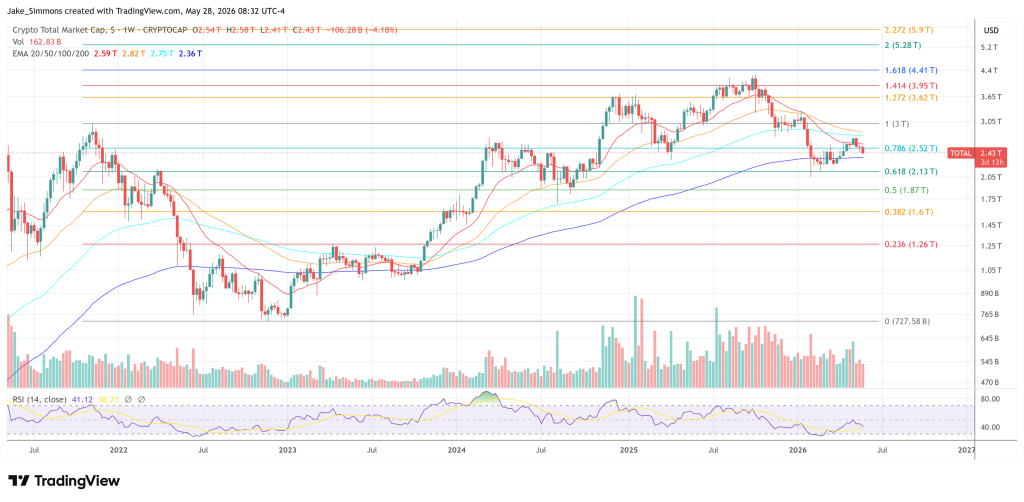
As of now, the total market capitalization of cryptocurrencies stands at approximately $2.43 trillion, indicating the substantial interest and investment in the digital asset space.