The Bitcoin market is currently facing significant challenges, with the recent price decline dropping to approximately $61,000. This downturn is impacting both large and small investors, as the amount of BTC in profitable positions is decreasing, leading to a more bearish market sentiment.
Profitability Fluctuations in the Bitcoin Supply
The ongoing decrease in the percentage of circulating Bitcoin held at a profit suggests that a crucial change may be on the horizon. Following this sharp decline, analysts are suggesting that the market may be approaching a point described as a profitability reset.
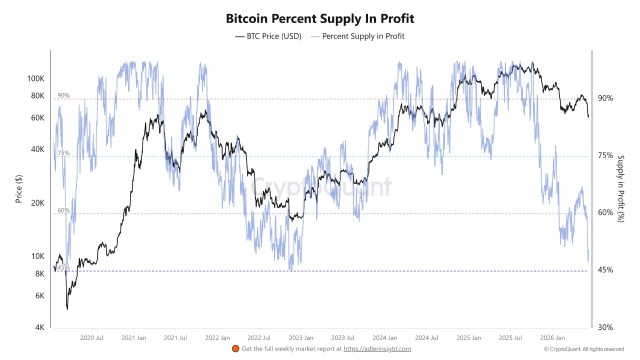
According to a report from CryptoZone, the on-chain metrics for Bitcoin indicate a reduction in the number of holders benefiting from their investments. Currently, the percentage of the supply showing profit is approaching the 45% threshold. Historically, this level has been linked with times of increased market strain, where many investors shift from unrealized gains to unrealized losses.
Experts indicate that this decline signifies a broader impact on the Bitcoin network, rather than being confined to a small subset of holders. The rapid change in profitability metrics provides significant insights into the market psyche, reflecting a mix of fear, capitulation, and potential opportunity.
Historically, periods in which over 90% of Bitcoin holdings are profitable have correlated with strong upward momentum and confidence among investors. However, when the profitability metrics fall toward the 45% mark, it often denotes late-stage corrections characterized by pessimism.
The current correction has seen a significant portion of Bitcoin’s supply lose its profit margin, suggesting a reset in market expectations. From an on-chain perspective, this compression in profitability often serves as a mechanism to purge excess speculation from the market.
Market Redistribution Dynamics
As less resilient investors exit their positions under market pressure, Bitcoin is gradually transitioning to holders with long-term investment strategies. While this redistribution may introduce short-term volatility, past cycles suggest it can lead to a more sustainable market structure in the long run.
The approaching 45% profitability mark should be closely monitored. Although no singular metric can define an exact market bottom, past cycles indicate that profitability readings near this threshold often come with increased capitulation risk and present long-term accumulation opportunities.
Current data reflects a market in a profound reset, rather than one marked by euphoria, and emphasizes the need to observe investor behavior in the following weeks. Analyst Ted Pillows has pointed out that Bitcoin is currently showcasing liquidity clusters on both the upside and downside.
On the upside, significant liquidity is noted in the range of $64,000 to $66,500. Conversely, there is long-side liquidity present between $58,000 and $60,000. Despite recent downturns, new long positions continue to emerge.