Solana has recently witnessed a renewed discussion surrounding the potential disinflation of its native token, SOL. Following a proposal on GitHub centered on improving Solana’s tokenomics, co-founder Anatoly Yakovenko has indicated the need for a further exploration of these economic adjustments. This dialogue comes in light of prior debates concerning SOL issuance, fee mechanisms, and validator economics, especially after the unsuccessful SIMD-0228 vote last year.
The conversation ignited with a tweet from the pseudonymous Solana researcher Dr Cavey phd, inviting followers to discuss making SOL valuable again. Responses from notable figures such as Helius CEO Mert Mumtaz and Yakovenko indicated a positive engagement with the idea, while Vibhu Norby of the Solana Foundation reacted with enthusiasm.
SIMD-0547: Revisiting Solana’s Burn Mechanics
On May 30, Dr Cavey phd introduced a GitHub discussion titled “Improving SOL tokenomics via a resource-based base fee.” This proposal highlighted that the existing burn rate of SOL does not significantly reflect network activity. According to the post, at a processing rate of 3,000 transactions per second (TPS), the current SOL burn amounts to only 648 SOL daily, which lacks meaningful impact.
The author of the proposal critiqued the idea of uniformly increasing the base fee, explaining that such a move could adversely affect different network users. Retail participants and market makers experience various cost implications, and a blanket fee increase could threaten the decentralization of Solana. The proposal instead advocates for a resource-based base fee designed to be entirely burned.
- This mechanism would charge and burn 0.1 lamport per cost unit requested.
- The approach was chosen to ensure it doesn’t significantly raise costs for market makers.
Example scenarios illustrate varying impacts based on transaction types. For instance:
- A swap from Shekel to SOL via OKX could see an increased cost of about 60% due to a new burned base fee.
- Conversely, a USDC to 99% transaction via DFlow with a large priority fee would experience a nominal rise of only 2%.
The proposal suggests that if transaction blocks average between 50 million and 300 million cost units, this new method could increase daily SOL burns to approximately 1,080 to 6,480 SOL while still falling short of the estimated 60,000 SOL inflation per day.
Commenters took to the discussion, questioning whether the proposed burn rate would make a substantial difference. Concerns were raised about the need for a tighter empirical basis for estimates, with some suggesting that a significantly higher demand would be necessary for the changes to positively impact inflation rates.
Revisiting Disinflation through SIMD-0411
As the conversation progressed on X, Yakovenko addressed the necessity for a new proposal to enhance the disinflation rate of SOL. The existing SIMD-0411 proposal aims to escalate the disinflation rate from 15% to 30%. This modification would allow for a quicker decline in SOL issuance while maintaining a terminal inflation rate at 1.5%.
Key points of the SIMD-0411 proposal include:
- Aiming for terminal inflation to be reached in approximately 3.1 years instead of the previously estimated 6.2 years.
- Projecting a reduction of around 22.3 million SOL in total emissions over six years, translating to a 3.2% lower supply than under the existing plan.
The new proposal seeks to be less complex than SIMD-0228, which was unsuccessful in March 2025 due to not meeting Solana’s two-thirds approval threshold despite a favorable turnout. The previous proposal’s failure stemmed from a divide on who should bear the burden of reduced emissions.
Going forward, the future of Solana’s tokenomics may hinge on finding a balance between encouraging lower issuance or increased fees while addressing validator sustainability. This ongoing discourse remains pivotal as SOL continues to navigate its path within the blockchain landscape.
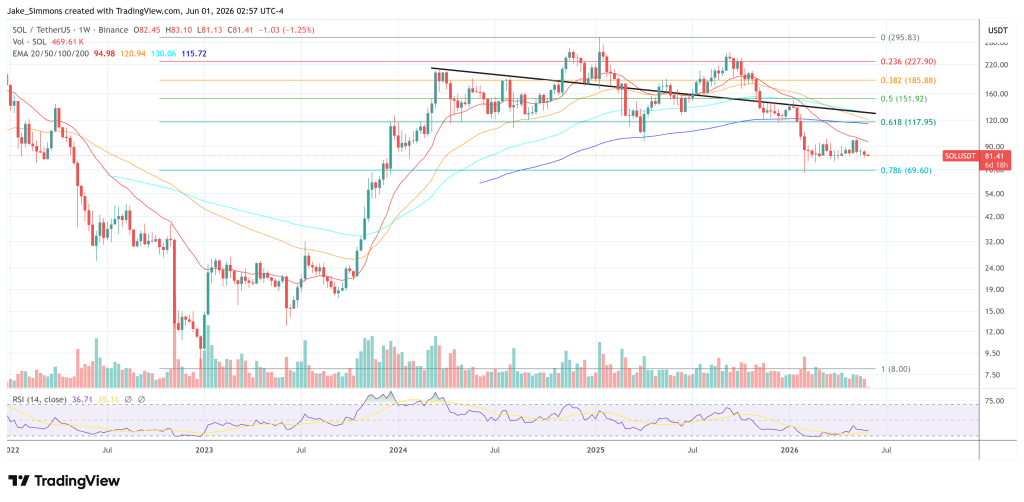
As of the latest update, SOL is trading at approximately $81.41.