The XRP Ledger is on the cusp of introducing native lending features that could reshape its role in institutional finance. Recent validator support for a proposed lending protocol has been on the rise, signifying progress toward an upgrade that would enable financial entities to utilize fixed-term lending directly within the network.
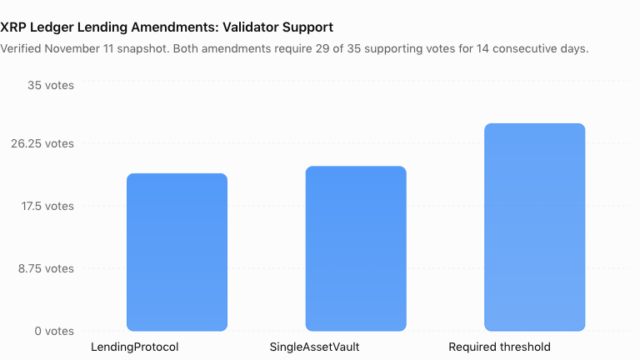
According to a voting snapshot dated November 11, the LendingProtocol amendment garnered backing from 22 of the 35 trusted validators, while the closely related SingleAssetVault amendment secured 23 votes. Both proposals will need at least 29 validators to support them for two consecutive weeks before they can be activated.
Although they have yet to meet this threshold, the increasing support reflects significant advancement towards expanding the XRPL’s financial infrastructure.
Validator Momentum for XRP Ledger Lending Proposal
The proposed lending system has gained traction, showcasing additional validator support since October. On October 19, only 19 validators endorsed the LendingProtocol amendment, but this number rose to 22 by November 11, representing approximately 63% of trusted validators. Similarly, the SingleAssetVault proposal climbed from 21 to 23 supporting validators, equating to roughly 66%.
According to the XRP Ledger amendment tracker, the LendingProtocol required just seven additional votes, whereas the SingleAssetVault needed six at the time of the snapshot. Importantly, both amendments are interconnected, meaning that both must secure sufficient approval for the lending infrastructure to function on the XRP Ledger mainnet.
It is also crucial to note that surpassing the 29-vote threshold does not result in immediate activation; proposals must maintain the requisite majority for a continuous two-week period. This process provides validators ample opportunity to evaluate proposed changes prior to integration into the network.
Potential Transformation of the XRP Ledger
The anticipated lending framework would inject new financial capabilities directly into the XRP Ledger. Users could deposit supported assets into shared vaults, establishing liquidity pools accessible to loan brokers who could then issue fixed-term loans.
Distinctly different from many decentralized finance lending protocols, this system would not necessitate borrowers to provide collateral directly. Instead, loan brokers would assume the responsibility for credit assessments, risk management, and the provision of first-loss capital.
Ripple has previously elucidated how this lending system could be implemented within traditional financial markets. In a statement made on June 29, Ripple’s Jasmine Cooper detailed the envisioned lending architecture and its potential applications for institutional finance.
She highlighted that the protocol differentiates credit decisions from loan execution, enabling financial institutions to maintain control over underwriting while utilizing the blockchain for managing repayment schedules, interest calculations, and settlements.
An example provided by Ripple illustrated a payment provider seeking short-term liquidity during the wait for a cross-border transaction settlement. Instead of relying solely on a traditional bank credit line, this provider could potentially tap into liquidity via an institutional lending facility based on the XRP Ledger.
Implications for XRP Demand
A significant question surrounding this proposal is whether enhanced lending capabilities will affect demand for XRP. The answer largely hinges on how institutions and other players engage with the network following activation.
The XRP Ledger currently accommodates payments, tokenized assets, and decentralized trading. By adding native lending, additional opportunities may arise for liquidity providers and financial entities. Ripple’s broader roadmap in decentralized finance emphasizes its intent to enhance XRP Ledger functionality across payments, collateral management, and on-chain credit.
If lending activity increases, it could lead to higher transaction volumes and broader participation in the network. However, rising lending levels do not guarantee a proportional increase in XRP demand, as the lending system can support various assets. Institutional users may prefer utilizing stablecoins or other tokenized financial instruments over XRP.
Nevertheless, XRP remains the native asset of the network, used to cover transaction fees. An uptick in network activity could enhance XRP’s overall utility, although the direct impact on its market price remains uncertain.
Current Market Analysis for XRP
This lending proposal comes at a challenging time for XRP’s market performance. Recent trading has seen XRP approaching the crucial $1 level amidst a broader correction in the cryptocurrency market, making this price point vital for traders.
A sustained recovery above this threshold could motivate buyers to aim for the resistance zone between $1.17 and $1.18. Should XRP gain momentum beyond these values, traders may look at even higher resistance levels. Crypto analyst Ali Martinez recently suggested a potential recovery toward $1.30; however, the foundational $1.14 support for this prediction has since weakened.
This situation underscores the importance of current price movements over earlier technical forecasts. While the proposed lending amendments represent a possible long-term development catalyst, their impact on price will depend on actual adoption and not just validator endorsement.
Looking Ahead for XRP
The immediate focus will be whether the LendingProtocol and SingleAssetVault can gather the needed additional validator votes. Once both amendments secure sufficient support for two consecutive weeks, the XRP Ledger could unveil its native lending framework.
Developers are already working on further enhancements to the proposed system, indicating that technical progress continues even as the voting process is in motion. For institutional users, the introduction of lending could extend the XRP Ledger’s capacities beyond mere payment processing and asset transfers.
For XRP investors, the pressing concern is whether these new functionalities will attract substantial financial activity to the network.